Event registration can be found here including tickets for Workshops and the Networking Event. The full Programme can be found here. Paper Speaker bios and full abstracts can be found here. Keynotes and this year’s Reading List can be found here. Workshops and Roundtable information can be found here. Our post on How to Join the Discord can be found here.
Written by GIFCon 2025 Social Media Officer Lea Warren.
If you’ve been keeping up with our social media, you might have seen our TBR recommendations over the last few weeks to brush up on some of the works that will feature at this year’s GIFCon.
But the books we’ve highlighted are just the tip of the iceberg when it comes to all the incredible texts we’ll be covering over GIFCon’s three days of panels, workshops, roundtables, keynotes, and more. And even with three packed days of queer fantasy conversations, we’ll only manage to cover a fraction of what is out there for fantasy readers.
That’s why, in addition to creating a TBR list for GIFCon 2025, we’ve also explored the general landscape of queer fantastika today. We couldn’t help but wonder – how popular are queer fantasy stories in the general market? Which titles are selling the best? Are there any new voices that we should be snagging on our next trip to the bookstore?
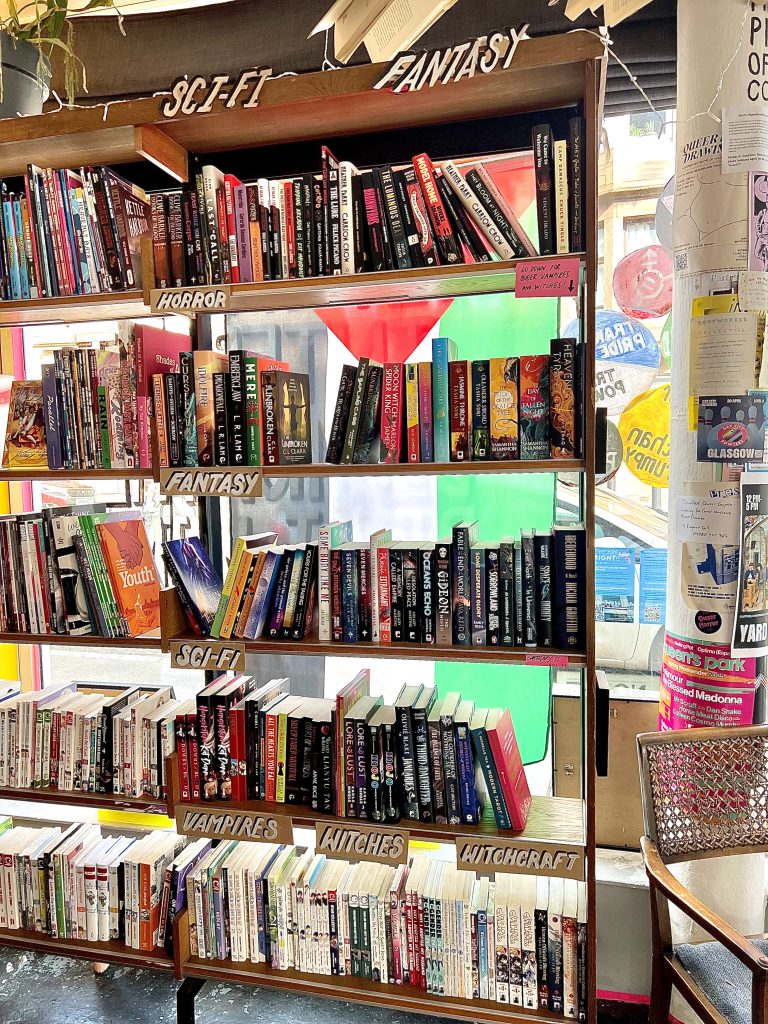
To help answer a few of these questions, we took a trip to Category Is Books, a beloved queer indie bookshop here in Glasgow. Category Is Books ‘is a space to learn about, be inspired by and share in our love of queer books, history, art, activism, writing and storytelling’, which made it the perfect place to do a bit of sleuthing on queer fantastika favourites.
All following images are courtesy of Grace Worm in a visit to Category Is Books in late April. This image shows the Sci-Fi and Fantasy section of the bookstore.
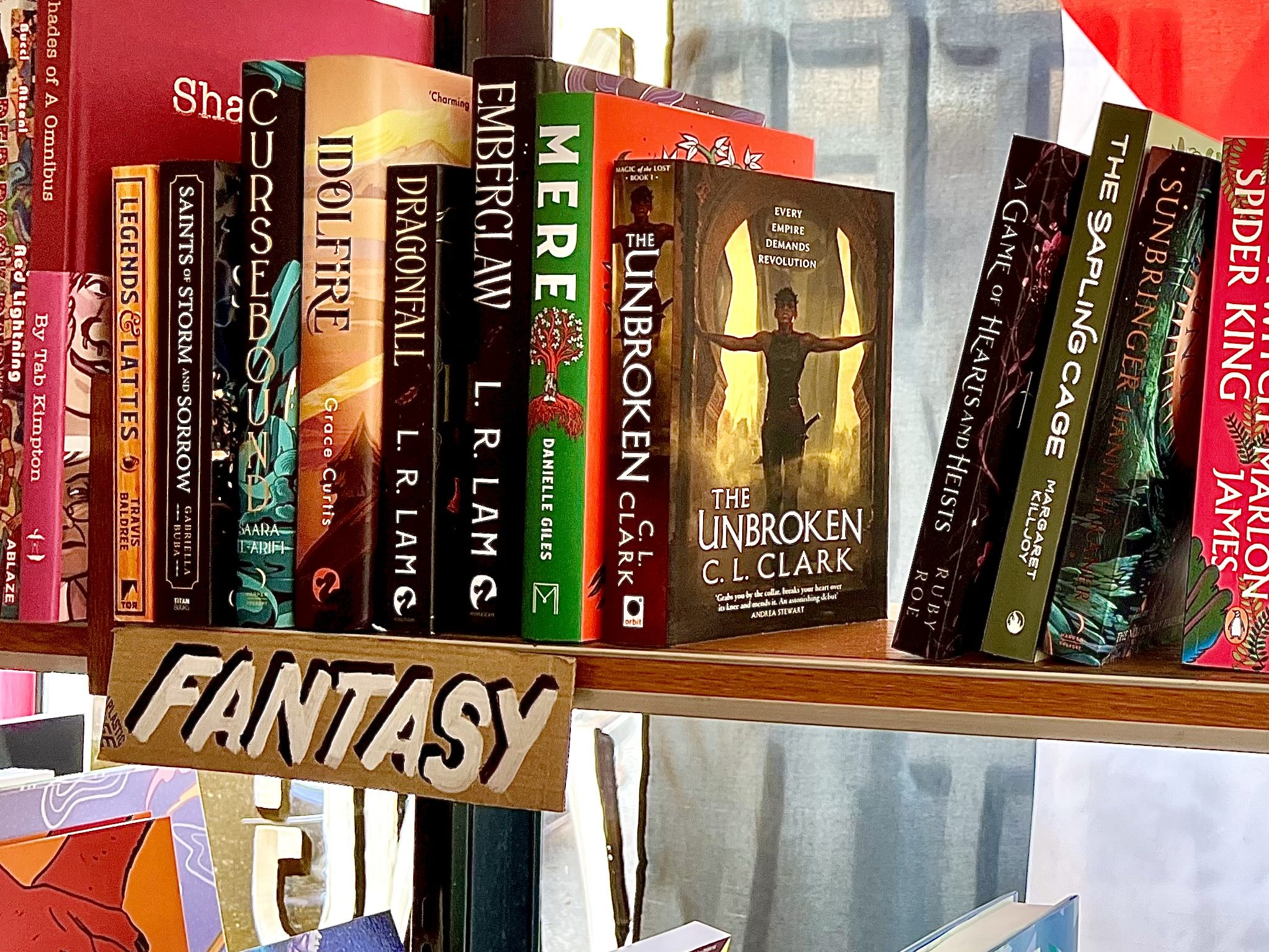
Amongst their curated fantasy stock are some titles made familiar by their places on various bestseller lists, including Sunbringer by Hannah Kaner, Legends and Lattes by Travis Baldree and The Priory of the Orange Tree by Samantha Shannon. Some of the other titles Category Is has in stock include Saints of Storm and Sorrow by Gabriella Buba, a ‘fiercely imaginative Filipino-inspired fantasy’ and The Unbroken by C. L. Clark, which draws on the colonial history of France and North Africa to create an epic political fantasy.
Picture of a portion of the Fantasy bookshelf
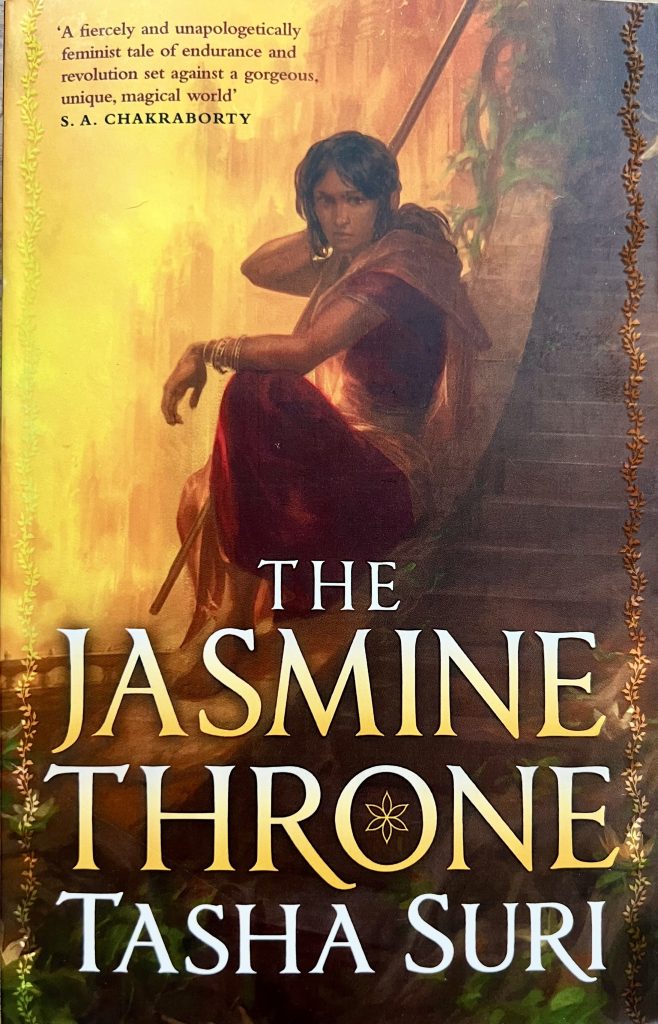
The Category Is shelves also feature the works of well-loved fantasy authors like Marlon James, N.K. Jemisin, Tasha Suri, and A. K. Mulford, among others, making for a booklist that is wonderfully diverse in its authors and its stories. During the visit, a staff member recommended The Jasmine Throne by Tasha Suri and Spells: 21st Century Occult Poetry by Sarah Shin, which our very own Deputy Chair Grace snapped up (we’ll have to ask her what she thinks once she’s had the chance to give them a read!).
Picture of the cover of the book The Jasmine Throne
Picture of the cover of the collection Spells
Overall, exploring the shelves of Category Is not only reinforced just how broad the landscape of queer fantastika is, but also got us even more excited to dive into this year’s theme at GIFCon 2025.
If you’re in the Glasgow area and are looking for your new favourite fantasy read, we highly recommend a stop through Category Is Books! https://www.categoryisbooks.com/
If you’re looking to brush up on queer fantasy for GIFCon, or just for fun, we’ve got you covered. Check out our TBR list of some of the texts our incredible panelists, Keynote speakers, and workshop leaders will be covering at GIFCon 2025.
Books, Novellas, Short Stories & Poetry:
Mantis by Julia Armfield (short story)
Modern Tales of Faerie by Holly Black (collection of short stories)
Gemma Doyle series by Libba Bray
The Bloody Chamber and Other Stories by Angela Carter (collection of short stories)
Peter Darling by Austin Chant
Decolonising the Conrad Canon by Alice M. Chapman-Kelly*
Fanfiction as Queer Healing: Femslash Authorship and the Swan Queen Ship by Alice M. Chapman-Kelly*
The Unbroken by C. L. Clark
Monstrilio by Samano Cordova
Masquerade series by Seth Dickinson
Kissing the Witch by Emma Donoghue (short story)
The End Crowns All by Bea Fitzgerald
The Fallen-Fey Chronicles series by S.L. Gavyn
Spear by Nicola Griffith (novella)
Annals of the Western Shore series by Ursula K. Le Guinn
The Left Hand of Darkness by Ursula K. Le Guinn
Grab the Bull by the Horns by Sam Hall
Howl’s Moving Castle by Diana Wynne Jones
The Meat Tree by Gwyneth Lewis
Ash by Malinda Lo (short story)
No & Other Love Stories by Kirsty Logan* (collection of short stories)
Now She is Witch by Kirsty Logan*
Things We Say in the Dark by Kirsty Logan*
The Gracekeepers by Kirsty Logan*
The Gloaming by Kirsty Logan*
Elemental Logic by J. Marks
Dragonriders of Pern series by Anne McCaffrey
Cyberpunk Culture and Psychology: Seeing through the Mirrorshades: Seeing Through the Mirrorshade by Anna McFarlane*
The Edinburgh Companion to Science Fiction and the Medical Humanities edited by Anna McFarlane* and Donna McCormack
Song of Achilles by Madeline Miller
Lud-in-the-Mist by Hope Mirrlees
Dark Fey trilogy by Cynthia A. Morgan
The Wood Beyond the World by William Morris
The Locked Tomb series by Tamsyn Muir
A Fairytale for Everyone edited by Boldizar M. Nagy (collection of short stories)
Princess Princess Ever After by Kay O’Neill
The Tea Dragon Society by Kay O’Neill
Little Thieves trilogy by Margaret Owen
Equal Rites by Terry Pratchett
Wain by Rachel Pummer (short story)
Duskwalker Brides series by Opal Reyne
Interview with the Vampire by Anne Rice
Goblin Market by Christina Rossetti (poetry)
Bluebeard’s First Wife by Seong-Nan (short story)
Priory of the Orange Tree by Samantha Shannon
Mail Order Minotaur by Lilith Stone
Tangleweed and Brine by Deirdre Sullivan (collection of short stories)
The Jasmine Throne by Tasha Suri
Cemetery Boys by Aiden Thomas
The Southern Reach trilogy by Jeff Vandermeer
Dragon’s Bait by Vivian Vande Velde
Tales From Beyond the Rainbow by Pete Jori Wood (short story)
Orlando by Virginia Woolf
*Keynote speaker at GIFCon 2025
Film/TV:
Gawain and the Green Knight (1991)
Hercules (1997)
Supernatural (2005 – 2020)
Sherlock (2010 – 2017)
Teen Wolf (2011 – 2017)
Troy: Fall of a City (2018)
She-Ra and the Princesses of Power (2018 – 2020)
The Untamed (2019)
The Owl House (2020 – 2023)
Gawain and the Green Knight (2021)
Arcane (2021 – 2024)
First Kill (2022)
The Sandman (2022 – 2025)
House of the Dragon (2022 – )
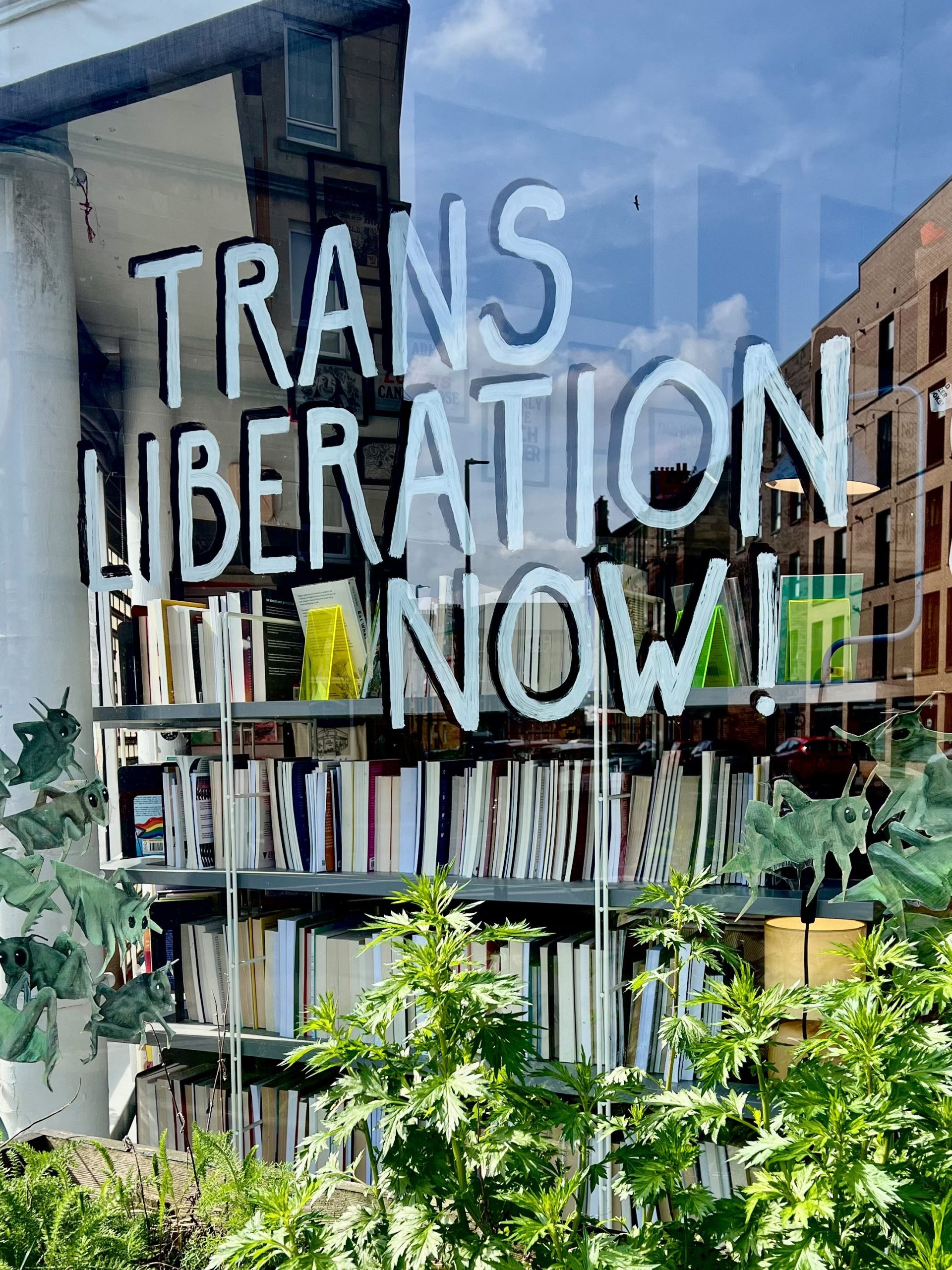
April window image from Category Is Books with the text “Trans Liberation Now!”
Event registration can be found here including tickets for Workshops, this year’s Seminar, and the Networking Event. Paper Speaker abstract and bios can be found here. Keynotes and this year’s Reading List can be found here. Workshops and Roundtable information can be found here. The Crafting Your Queer Fantasy TBR post can be found here.
After the pandemic, GIFCon moved our conversations online with Discord and we’ve stayed there. In our Discord, we continue to connect people across the world for social conversations in the current digital age. The GIFCon Discord is supplementary to the conference, it’s completely optional to join, but many of our excellent events and continued conversations during GIFCon take place in this online space. This discord is a way for attendees and panelists to continue the conversation after panels, socialise, find links to GIFCon social media, technical support, games, and social events such as our Research and Artist Spotlights in the weeks leading up to and during GIFCon. The GIFCon Committee has tried hard to make the Discord as welcoming as possible to those both familiar and unfamiliar with Discord and we really look forward to bringing together attendees, speakers, volunteers, and committee alike on there.
Our Discord is a moderated and personalised online platform that abides by our Code of Conduct, with different chat “Channels” organized by panels and/or interests. Users of our Discord must explicitly agree to our Code of Conduct in order to join (or see) the conversation. Any users in the Discord who violate this Code will be muted or potentially removed from GIFCon’s Discord (read our Discord rules for full Discord policies). We also have several help channels within the Discord to help get you started or reach our team of Volunteers with questions.
We know that some of our attendees may be unfamiliar with this platform and therefore, we have put together this short guide with instructions for accessing the GIFCon Discord below.
If this is your first time using Discord, you will need to create a username and enter your email (you will then need to confirm your email with Discord). If you already have a Discord account you will need to log into your account.
(Image 1 is a screenshot showing a Discord login for first-time users of Discord when using the join link.)
Step 2:
Read the Rules of our Discord Server and Agree to our Code of Conduct
When you first join our server, you will only be able to view our Rules Channel. Each Discord server is unique as each server owner can personalise a server with specific permissions and different chat and voice channels. The GIFCon server is organized so that users must agree to our Rules or they cannot actually enter our Discord and see the rest of our channels where conversations are taking place.
(Image 2 is a screenshot of the Discord showing the point of view of a user who has joined but as not agreed to the code of conduct. A white arrow overlaid on the screenshot of Discord draws points to the left where the only server Channels visible are “rules” and “Voice Channel”.)
The white arrow in the image above points to this server’s Channels. Until a Discord user agrees to our Code of Conduct in the Rules Channel (the top channel visible when first clicking the link), then they will only be able to see this limited view of the Discord where all other channels are hidden.
If you read through the post in the Rules Channel, you will see that it asks you to react with a thumbs up emoji to a specific message. If you use this thumbs up, you are explicitly agreeing to our Code of Conduct (CoC) and Netiquette, which is required to enter any digital space hosted by GIFCon. Reacting with the Thumbs Up emoji and entering the server is as simple as clicking the Thumbs Up button at the very bottom of the Rules message.
(Image 3 is a screenshot of the Discord showing the cursor hovering over the Thumbs Up emoji. Clicking this emoji means that users agree to the Code of Conduct and is necessary to enter the GIFCon Discord Server. User names of specific users has been blurred with rainbow images for privacy.)
You can see that a large number of other users have similarly reacted with a Thumbs Up to the correct message in Image 3 and you just need to click this emoji in order to agree to our CoC.
Step 3:
Enter the GIFCon Discord and Start with the “Getting Started” Channel
Once you have agreed to our Code of Conduct by reacting in the Rules Channel, on the left-hand side bar, you will now be able to see the entire server not just the Rules Channel. It is imperative that you agree to our Code of Conduct in Step 2, or you will not be able to see the other conversations.
(Image 4 is a screenshot of the GIFCon Discord server with all channels now visible including a voice and video channel “Voice Channel (radio GIFCon), a chat channel “getting-started”, a chat channel “ask-for-help”, a chat channel “networking”, a chat channel “chat”, a chat channel “playing games”, a thread channel “queering-the-fantastic”, and chat channels for each panel, “panels-a”, “panels-b”, and “panels-c”. There is a large white arrow overlaying the screenshot pointing the left to draw attention to the newly visible channel menu.)
Contrasted with image 2 in “Step 2” above, the white arrow in this image (Image 4) points to all of the server’s Channels that are now visible because the user has agreed to the Code of Conduct.
Until a Discord user agrees to our Code of Conduct in the Rules Channel (the top channel visible when first clicking the link), then they will only be able to see this limited view of the Discord where all other channels are hidden.
Congrats! You can now interact in the GIFCon Discord server! If you’re unfamiliar with Discord, you should read the “getting-starting” channel which explains the GIFCon Discord in more detail!
Happy Chatting!
Important Tip:
Discord assigns users Roles within a specific server. In the GIFCon Discord server, you can visually see if you or someone else has clicked the link to join but NOT clicked to agree to our terms and conditions. Their username in the Discord server will appear as bright red, as with the account “Tester” in the image below.
(Image 5 is a screenshot of an automatic message in the main Chat Channel showing the user “Tester”, whose name appears in bright red and text indicating they joined the subreddit at 1:36PM.)
If you right click on their name and view their profile, you will see that they only have the Role “Joined” assigned, which means they clicked the link to join the Discord, but have not agreed to the Code of Conduct in Rules and cannot see the rest of the Discord server. This is why their name appears as red.
You can right-click on a person’s name in Discord and click “profile” for a pop-up to appear showing the user’s active roles in the server. As you can see in Image 6 below, if you view the profile of a user who has not agreed to the Code of Conduct by reacting with a Thumbs Up emoji, in this case a profile for “Tester”, they will only have the role “Joined” indicated they followed the join link to our Discord, but have not agreed to the Code of Conduct and therefore cannot view the other Channels.
(Image 6 is a screenshot in Discord of the user profile of “Tester” with information on their history in the server and under “About Me” it shows “Roles” with only a red circle and the text “Joined” listed under Roles.)
In contrast, a user who has agreed, will not appear red and will be automatically assigned the Role “GIFCon 2025” as shown with the user Tester in Images 7 & 8 below.
(Image 7 mirrors Image 5 except that the text “Tester” now appears in purple rather than bright red.)
(Image 7 mirrors Image 6 except that in the profile for “Tester” under Roles is now listed “GIFCon 2025” with a purple circle to the left of the text in addition to a red circle and “Joined” to the right of this also underneath Roles.)
Thank you for viewing this guide and if you have any further questions about our Discord you can reach us via email at GIFCon@glasgow.ac.uk.
Event registration can be found here including tickets for Workshops and the Networking Event. The full Programme can be found here. Paper Speaker bios and full abstracts can be found here. Workshops and Roundtable information can be found here. The Crafting Your Queer Fantasy TBR post can be found here. Our post on How to Join the Discord can be found here.
Please find below our keynote speakers for this year’s GIFCon, the reading list in collaboration with Glasgow’s own Category is Books will be coming soon!
Kirsty Logan
Keynote Wednesday May 7, 2025 from 15:30 – 16:30 BST
The ABCs of Queer Horror: Appetite, Bodies and Coveting (or Craving?)
Kirsty Logan’s latest books are the story collection No & Other Love Stories and the memoir The Unfamiliar: A Queer Motherhood Memoir. She is also the author of three novels, three story collections, two chapbooks, a 10-hour audio play for Audible, several collaborative projects with musicians and visual artists, and around 300 short stories. Her books have won the Lambda, Polari, Saboteur, Scott and Gavin Wallace awards. Her work has been optioned for TV, developed for film, adapted for stage, recorded for radio and podcasts, exhibited in galleries and distributed from a vintage Wurlitzer cigarette machine. She is currently collaborating on several projects across film, TV, collaborative chapbooks, and performance.
Kirsty Logan’s Keynote will cover her work more generally but primarily focus on two of her texts: Things We Say in the Dark and No and Other Love Stories. Both of these compelling volumes of stories focus on women’s experiences, rendered through Kirsty Logan’s distinctive style—one that shifts between the dark, the emotional, the humorous, the tender, and, at times, the unsettling in familiar and yet “queered” worlds. Other favorites of her work include The Gracekeepers, Now She is Witch, and The Gloaming where she combines fantasy, female desire, myths, history, horror, loss, and mystery in her detailed characters and narratives.
Anna McFarlane
Keynote Thursday May 8, 2025 from 13:30—14:30 BST
‘Fantasy and Trauma: Imagining a Queer Pregnancy’
Anna McFarlane is a Lecturer in Fantasy Literature at the University of Glasgow. Her research on traumatic pregnancy in fantastika was awarded a British Academy Postdoctoral Fellowship, and she is a Visiting Collaborator on the Wellcome-Trust funded Future of Human Reproduction project. She is co-editor of The Edinburgh Companion to Science Fiction and the Medical Humanities.
For more information on Dr Anna McFarlane or the topic of her Keynote, we recommend reading her article “Sharing experiences of pregnancy and trauma through science fiction” from 2018 in The British Academy website or The Edinburgh Companion to Science Fiction and the Medical Humanities, the introduction of this collection is available here on Google books. Anna McFarlane is also the author of the excellent Cyberpunk Culture and Psychology: Seeing through the Mirrorshades: Seeing Through the Mirrorshades for cyberpunk enthusiasts and scholars.
Dr. Alice M. Chapman-Kelly
Keynote Friday May 9, 2025 from 12:45-13:45BST
Queer Friendships, Soft Workplaces and the Other Comforts of the Swan Queen Archive – Some Thoughts on Why We Read Fic.
Dr Alice M. Chapman-Kelly is a Teaching Associate at the University of Strathclyde. She has published widely on the relationship between lesbian literary history and femslash fanfiction and is the author of two academic monographs, Decolonising the Conrad (Liverpool UP, 2022) and Fanfiction as Queer Healing: Femslash Authorship and the Swan Queen Ship (Bloomsbury Academic, 2024).
Dr Alice M. Chapman-Kelly has two books available online and in print. Decolonising the Conrad Canon is a fascinating exploration Joseph Conrad’s work and the relationship between author, anti-colonialism, race, women, “lesbianism”, and cannon available online at JSTOR here. Of particular relevance to her Keynote is her second book, Fanfiction as Queer Healing: Femslash Authorship and the Swan Queen Ship, which can be found with Bloomsbury here. It is a thorough and bewitching examination of Femslash Fiction and the complex relationship between fan and text, with particular attention to themes of sapphic desire, anti-racism, maternity and parenting, and childhood through her analysis of the “Swan Queen” fandom.
Event registration can be found here including tickets for Workshops and the Networking Event. The full Programme can be found here. Keynotes and this year’s Reading List can be found here. Workshops and Roundtable information can be found here. The Crafting Your Queer Fantasy TBR post can be found here. Our post on How to Join the Discord can be found here.
This document is updated as needed. All times listed are BST, British Summer Time.
Abstract: The Queer Trickster in Margaret Owen’s Little Thieves
As scholars such as Helena Bassil-Morozow (2012, 2015, 2017) have explored, the trickster character type—with its roots in mythology, folklore, and oral storytelling traditions—has been constantly reinvented and remixed in the context of contemporary literature and pop culture. Alongside the potential to perform queer readings and retellings of mythological tricksters such as Loki, there is a greater sense of queer resonance in the characteristics and social role of the trickster. Likewise, the themes of liminality, marginality, shape-changing, and questioning authority with a playful and rebellious sense of humour, mean that the trickster may be especially at home in work aimed at adolescent readers, particularly those of marginalised identities. As my thesis (2023) argued, the emerging space of queer young adult (YA) literature is a vibrant storytelling landscape for trickster characters and trickster tales.
In this presentation I will discuss one example and explore the queer trickster characteristics of Vanja “The Penny Phantom” Schmidt, the anti-heroine of Margaret Owen’s Little Thieves fantasy trilogy (2021-2025). Vanja is a young, queer, marginal figure caught between Gods and humans, and her character arc is deeply concerned with agency and autonomy in a way quintessential to trickster tales. She uses shapeshifting magic and clever subterfuge to impersonate nobility and steal from the rich, transgressing the supposedly immutable borders of wealth and class, all while offering the reader scathing and witty critique of the power structures and entitled individuals that support this social divide. Vanja’s liminality, humour, and emergence as an (accidental) folk hero mark her as a queer teenage trickster protagonist and a fascinating example of the potential in this storytelling space.
Bio: Alex Henderson holds a PhD in Creative Writing from the University of Canberra, where they completed a creative thesis on LGBTQIA+ representation in young adult genre fiction. Their scholarly work has been published in the International Journal of Young Adult Literature, Papers: Explorations Into Children’s Literature, and the Journal of Popular Romance Studies; and their short stories have appeared in literary magazines and anthologies, including the Aurealis Award finalist An Unexpected Party (Fremantle Press, 2023).
Alexandra Davies
Abstract: Are we too heteronormative?”: Mpreg and transgression in Teen Wolf fanfiction
This paper explores the transgressive potential of mpreg (“male pregnancy”) in Teen Wolf fanfiction to challenge heteronormative gender norms. Specifically, it responds to Sophie Lewis’ call to “[decouple] gestation from the gender binary” and generate “utopian thought” about reproduction. I argue that some mpreg fanfiction already engages with these goals and is well placed to do so, as an ‘unauthorised” literature that reimagines pre-existing texts and worlds. However, mpreg stories have also been accused of reinforcing heteronormative values and family structures. This research tests the transgressiveness or heteronormativity of the mpreg trope through a mixed methods approach. By reviewing the metadata of highly rated stories on AO3 (a popular fanfiction archive) about Teen Wolf’s most popular couple (Stiles/Derek), I have identified several seemingly heteronormative trends. These included the fandom’s preference for depicting Stiles (the more easily feminised character) as a pregnant man. However, by identifying less commonly employed tropes, I will explore gender and species taboos that complicate surface level ‘heteronromative’ readings of the characters. These include depicting Derek as a pregnant alpha werewolf, werewolf cubs and male lactation. With reference to feminist theory by Elizabeth Grosz, Barbara Creed and Iris Marion Young, I trace strategies some authors use to queer and even break down the gender binary.
Bio: Alexandra Davies (she/her) is a first year PhD student at the University of Strathclyde where she is researching fandom bullying and censorship. She also completed her Masters in Gender Studies at the University of Strathclyde where she explored feminist science fiction and werewolves. She wrote her thesis on heteronormativity and mpreg (male pregnancy) in Teen Wolf fanfiction, which included a deep dive into lycanthropy and feminist and psychoanalytic theory on monstrosity and reproduction. She also has a Master’s and Bachelor’s degree in Classics from the University of Bristol and retains extensive knowledge of Graeco-Roman mythology.
Alexis Lothian
Abstract: White Men, Otherwise? Slash Fanfiction, Race, and the Persistence of Slavefic
Slash fanfiction emerged in the 1970s and 1980s as a genre of informally published romantic and erotic fiction that fantasized sexual relationships between male, largely white fictional characters, and has been an immensely influential thread within the vast and diverse universe of contemporary fanfiction. Feminist scholars have argued that slash represents an egalitarian erotics by using the unmarked bodies of men to explore women’s sexual fantasies without the constraints imposed on female bodies. Yet some slash places its erotics within contexts of intense hierarchy and domination, worldbuilding slaveholding fantasy societies in order to imagine a sexual relationship between an enslaved individual and his owner. For such fiction to be written and shared between white fans without recognition of its implicit racial content reproduces antiblackness by presuming that chattel slavery’s histories of violence and dehumanization are available to be the backdrop of white sexual imagining. But this critique does not help us understand why “slavefic” has been so persistently popular––including among fan writers and audiences of color.
I use queer of color critique to explore a popular and complex example of slavefic by a Black writer. “A Kept Boy,” begun by poisontaster in 2008, developed into a shared universe set in an alternate United States of America in which a debt-based version of slavery is legal and compulsory. The primary romance is between a white man enslaved since early childhood and a white male slave owner with abolitionist aspirations, A BDSM romance fantasy of power, complicity and consent, “A Kept Boy” offers pleasures that would play out very differently were they not manifesting on white male fictionalized bodies. It raises the question: could imaginatively enslaving the bodies of white men become a mode of reckoning with what Sharon Holland has called the erotic life of racism?
Bio: Alexis Lothian is Associate Professor in the Harriet Tubman Department of Women, Gender, and Sexuality Studies at University of Maryland College Park. Her research centers on speculative fiction, digital media, and fan culture and their relationships to gender, race, and disability justice. She is the author of Old Futures: Speculative Fiction and Queer Possibility (NYU Press, 2018) and has published in Utopian Studies, American Quarterly, Feminist Studies, Transformative Works and Cultures, International Journal of Cultural Studies, Cinema Journal, and Camera Obscura, among other venues. She co-edits the Queer/Trans/Digital/Diaspora series for NYU Press.
Amy Richmond
Abstract: “The blood of the tree spreading over her tongue”: Drinking the Juices of Queer Power
Eve and the apple; deflowering; nectar; juices: to engage with botanical symbolism is to engage with imagery of sex, of desire, of the eroticised woman. These images are seen as symbols of innocents succumbing to temptation or of wicked femininity and place the erotic woman as the desired and not in the active role of the desiring. This paper seeks to queer this status quo. Through engagement with narratives from across fantastic modes, the analysis dissects how botanical symbolism has been employed by female creators of fantasy to allow their female characters agency over their own desires. It engages in detailed close reading of the uses of repeated imagery and atypical metre, in conjunction with relevant critics, to queer readings of feminine fruit consumption as transgressive and deviant behaviour, and grant agency and power to the characters. Analysis primarily takes the form of direct textual engagement, closely reading the use of botanical symbolism in relation to the relationships of the characters connected with it. It bolsters its argument by engaging with the concept of queer radicalism and through the employment of – and, sometimes, disagreement with – relevant theorists and critics. It interrogates symbols of fruit consumption, body exchange, and erotic desire in Christina Rossetti’s ‘Goblin Market’ (1859) and Samantha Shannon’s The Priory of the Orange Tree (2019), with reference to Hope Mirrlees’ Lud-in-the-Mist (1926).
Bio: Amy Richmond (she/they) is an independent researcher who holds an MA(hons) in English from the University of Aberdeen and an MLitt in Fantasy Literature from the University of Glasgow. Specialising in contemporary fantastic fiction, their research interests include spatial theory, queer theory, Young Adult fiction, and body politics. She has presented at GIFCon and Exclamat!on Conference and is on the Mapping the Impossible journal board as Social Media Officer and Copyeditor. They currently work as an Assistant Commissioning Editor for Emerald Publishing.
Anna Bark Persson
Abstract: Sword Lesbians: Fantastic Fantasies in Fantasy Fiction and Fandom
“The root cause to all of the world’s problems,” according to men’s right activist Andrew Tate, is “that there’s not enough men who walk around […] with swords.” Around the same time as Tate became a household name in late 2022 when arrested for sex trafficking, a tweet with an attached TikTok video went viral. Posted by user @elianadivakarr, it read “SHE HAS A SWORD NOW” and showed a buff lesbian using a broadsword to split a tree trunk into wood.
Nicole Coenen, a.k.a @lumberjacklesbian, is part of a wider preoccupation with swords and the queer women who wield them in online sapphic spaces. Where in the mainstream, swords are associated with traditional, reactionary, and problematic forms of male masculinities – such as Tate’s and his fans’ – queer women have appropriated the imagery of swords and knights and associated symbolism for lesbian purposes. This trend can be seen across social media platforms (like tumblr, Reddit, X, and TikTok), in fandom spaces, and in recent fantasy fiction – such as Tamsyn Muir’s The Locked Tomb (2019–), Seth Dickinson’s The Traitor Baru Cormorant (2018), and C.L. Clark’s The Unbroken (2022).
In this paper, I read the sword lesbian across fantasy texts and online fandom spaces, understanding it both as a lesbian and masculine motif, drawing on Elizabeth Grosz’s (1995) concept of the lesbian-machinic and on female masculinity (Halberstam 1998; Noble 2003; Mackay 2021). I approach the sword lesbian both as a way to forge connections around queer female sexual identity and an instantiation of the wider societal preoccupation with supposedly traditional and/or toxic forms of masculinities, highlighting the need to understand how masculinity is represented and constructed online beyond male masculinities.
References Grosz, Elizabeth. 1995. Space, Time, and Perversion: Essays on the Politics of Bodies. Routledge. Halberstam, Jack. 1998. Female Masculinity. Duke Univ. Press. Mackay, Finn. 2021. Female Masculinities and the Gender Wars: The Politics of Sex. I.B. Tauris
Bio: Anna Bark Persson (she/her) is a postdoctoral researcher in English literature at Umeå University, Sweden. In the postdoc project “Reimagining the Red Planet: Feminist and Queer Interventions”, she explores feminist and queer Mars fiction and alternate conceptualization of the red planet and space exploration beyond the mainstream or traditional Mars SF. She holds a PhD in gender studies and wrote her thesis, Steel as the Answer? Viking Bodies, Power, and Masculinity in Anglophone Fantasy Literature 2006–2016 (2023), on Viking motifs in gritty fantasy. Her main research interests include speculative fiction, outer space, queer theory, and (queer) masculinities.
C.T. Power
Abstract: House of the Dragon: Making Things Perfectly Queer
This paper proposes to analyse HBO’s House of the Dragon (2022-), the prequel to Game of Thrones (2011-2019), to highlight an emergent narrative positing of queerness and queer characters within a broader corpus of contemporary telefantasy adaptations. From the explicit relationship between The Wheel of Time’s (Amazon Prime Video; 2021-) Moiraine and Siuan, to the onscreen exploration of Jaskier’s sexuality in The Witcher (Netflix; 2019-), to Rhaenyra’s onscreen queerness, these telefantasy adaptations are not shying away from bringing queer characters to the fore. While none of these series is about queerness, it is inscribed into the narratives as commonplace. These series enable a diverse range of queer readings. Taking one example from the third chapter of my PhD which analyses the proliferation of queer characters in 2020s telefantasy, this paper examines the queer implications of Rhaenyra and Alicent’s narrative tension in House of the Dragon.
From the outset, the series establishes the strong connection and friendship which ties these two characters together. The crux of the series lies in the destruction of their friendship which sets them apart. Reading this and their resulting feud and obsession through a queer lens however allows for a deeper understanding of the tensions between the two and sexuality within this fantasy world. Queer characters and queer readings are nothing new in telefantasy, with series such as Buffy the Vampire Slayer (The WB; 1997-2003) having long engagements with fans and queer studies alike. However, as this paper argues, telefantasy has entered a new queer phase, differing significantly from earlier queer antecedents within the genre. Examining this through House of the Dragon’s implicit and explicit engagements with queerness allows us to understand developments in the genre at large.
Bio: C. T. Power is a final year PhD candidate in University College Dublin and resident scholar of the UCD Humanities Institute. Her research focuses on fantasy in television and literature, offering an inter-sectional analysis of the representation of gender, race and sexuality in the contemporary genre. Her project, Possibilities and Potentialities: Race, Gender, Sexuality and the Evolution of Transmedia Fantasy 2011-2024, combines interdisciplinary analysis of fantasy novels with their television adaptations, exploring the emergence of fantasy TV and the inter-medial impact of the genre’s new prominence in the market. They are also a keen hiker, swimmer and cinema-goer.
Caighlan Smith
Abstract: Challenging Chronos: Re-Queering Classical Mythology in Stray Gods: The Roleplaying Musical
In their review of the buried queer histories of video games, Bo Ruberg (2019) observes that, “video games have always been queer.” While much older than the video game medium, classical Greek mythology has likewise always been queer. Although contemporary media has predominantly straightwashed classical mythology, some adaptations have begun a “re-queering” process. For example, Madeline Miller’s The Song of Achilles (2011) reinvigorates Achilles’ queer relationship with his male companion, Patroclus, a plotline explored elsewhere in Troy: Fall of a City (2018) on Netflix. Summerfall Studios’ Stray Gods: The Roleplaying Musical (2023) is an interactive digital narrative game which embraces the queerness of Greek mythology, not only in content but in form. Through its primary game mechanics of player narrative choice and alternate endings, Stray Gods queers both the time and space in which players experience this retelling of Greek myth. Rather than forcing players into a set narrative, Stray Gods uses the video game form to challenge the typical chrononormativity of contemporary media. Elizabeth Freeman (2010) developed the concept of “chrononormativity” to discuss how the timelines our lives are expected to take are generally heteronormative, from marriage to children to the gendered and straight roles of stereotypical family life. Ruberg highlights how video games have their own form of chrononormativity, designed to feed into heteronormative and neoliberal linear expectations of the “good life.” In this presentation, I review how Stray Gods designs queer time and queer spatiality into its gameplay, which works alongside its narrative embracing of queer sexual, romantic, and gender identities, to not only reinstate the queerness of Greek mythology, but to remind us that myth itself – as a narrative form which only exists through regular change and reinterpretation – is a fluid, queer medium.
Bio: Caighlan Smith is a Ph.D. candidate and Vanier Scholar with the English Department of Memorial University of Newfoundland. Smith is an award-winning fiction novelist and holds a B.A. (Hons.) in English from Memorial University and an MLitt (with Distinction) in Fantasy from the University of Glasgow. Her research interests include ideology critique, intersectional feminism, popular culture, and video game hero narratives. Among other work, she has published on the hero archetype’s patriarchal messages in dystopian literature (Gramarye) and the neoliberal management mechanics of zombie apocalypse video games (Game Studies).
Catherine Olver
Abstract: Family (of) Trees? More-Than-Human Families in Queer Fairytales
Family trees are linked to real trees by more than metaphor. Throughout history, family trees have determined who inherits and rules land and its plant, animal, and human inhabitants. Patrilineal inheritance rules have also oppressed queer individuals by enforcing gender binaries and heterosexual marriage. This paper examines how queer fairytales reimagine families and inheritance based on connections other than blood, and therefore as more-than-human.
In Emma Donoghue’s “Kissing the Witch” (1997), fairy-tale heroines refuse patriarchal pressure to marry and instead live with female lovers, mostly on the margins of society in wild places. Rather than bearing heirs, they redirect their fertility into relationships with nonhumans around them, healing work as wise women (a role historically overlapping with the midwife, as Kevin Goldstein explains), and supporting younger queer individuals. The structure of Donoghue’s book reinforces this anti-patriarchal model of fertility and inheritance, as we would expect from a 1997 collection.
Angel Daniel Matos cautions that many contemporary books for queer young people offer an assimilative vision of happiness. In most European cultures, being queer no longer forces individuals to the edge of society. To what extent do collections of fairytales and folktales like Pete Jordi Wood’s “Tales From Beyond the Rainbow” (2023), Rachel Plummer’s “Wain” (2019), and the Hungarian collection “A Fairytale For Everyone” (2020, edited by Boldizsár M. Nagy) continue to reject the patriarchal family tree and offer a green, as well as queer, vision of family?
Goldstein, Kevin. ‘Nurtured in a Lonely Place: The Wise Woman as Type in “The Goose Girl at the Spring,” in “Trangressive Tales: Queering the Grimms,” edited by Kay Turner and Pauline Greenhill, Wayne State UP, 2012. Matos, Angel Daniel. “The Reparative Impulse of Queer Young Adult Literature.” Routledge, 2025.
Bio: Catherine Olver writes for a greener future and a proud queer present: through her poetry and fantasy writing for different age groups and through academic articles as an ecocritic with a PhD from the University of Cambridge. Find her wandering @the_wordwoods on X and Instagram, and discover more of her creative and academic work at https://catherineolver.co.uk.
Cheryl Myfanwy Morgan
Abstract: The Fourth Branch – Past and Future
The Fourth Branch of The Mabinogion begins with a story in which two brothers rape a sacred virgin. As punishment they are made to spend three years living as animals: deer, wild boar and wolves. Each time they are a mated pair, and the brothers take it in turns as the female, experiencing pregnancy and childbirth.
Later in the narrative, the hero Llew is cursed never to have a human bride. To get around the curse he is given a wife who is made from flowers.
In 2009 Seren Books began publishing a series of novellas that are modern re-interpretations of stories from The Mabinogion. One of these, The Meat Tree, is based on the Fourth Branch. Written by Gwyneth Lewis, a former National Poet of Wales, it is a science fiction story set on a space ship in which the fantastical elements take place in an immersive virtual reality game. Lewis notes that some of the inspiration for the story came from meeting the transgender biology professor, Joan Roughgarden, who is an expert in sex and gender in the animal world.
This paper will look at what we can know about attitudes towards gender in mediaeval Wales, at the time when The Mabinogion was written down, and at the way that Lewis has re-interpreted the themes for the modern world.
Bio: Cheryl Morgan (she/her) is a writer, editor, and publisher. She is the winner of four Hugo Awards and is the owner of Wizard’s Tower Press. Her critical work has appeared in a variety of venues including the Academia Lunare series, Fafnir, Vector, Speculative Insight and Imagining the Celtic Past in Modern Fantasy. Cheryl was a Guest of Honour at the 2012 Eurocon in Zagreb and the 2019 Finncon in Jyväskylä. She was a keynote speaker at Worlding SF at the University of Graz in 2018, and at When It Changed, at the University of Glasgow in December 2022.
Eleanor Patterson
Abstract: Outside the Box: Form and Gender in Neil Gaiman’s The Sandman
Recent allegations against Neil Gaiman have perhaps shifted many people’s perceptions of his work, particularly the long-standing fan favourite series of The Sandman. Whilst I acknowledge the allegations against Gaiman and stand with the victims, I still aim to use The Sandman as an example of the way trans and non-binary characters have been portrayed in various forms of media since the series’ original release in comic book form between 1989 and 1996. Throughout this paper, I will compare and analyse the changes made to the character of Desire through the cultural and social shifts that occurred alongside the release of new adaptations and interpretations of The Sandman. Having first been released as a comic book, The Sandman was subsequently adapted into audio by Audible in 2019, and then into a television series released by Netflix in 2022, after many failed attempts to adapt the work for film. As their name suggestions, Desire is a character who has power over many forms of sexuality and is able to use their shifting appearance to literally embody what other people desire. Due, in part, to the amount of time that passed between adaptations there were many changes made to wording and characterisation across the series, with many of these reflecting instances where the comic was no longer considered politically correct. By considering these changes, it is possible to examine the role media type plays in representing gender, particularly as it exists outside the mainstream conception of the gender binary. This paper will conclude by asking how much the character of Desire is shaped by the medium used to tell the story, and whether or not The Sandman’s place as a seminal piece of the fantasy canon influences the stories it tells.
Bio: Eleanor Patterson (she/they) is a recent graduate of the University of Glasgow’s MLitt programme. As part of their dissertation for this course she curated a digital exhibition featuring artwork from the Hunterian Art Gallery, alongside an analysis of the illustrations of eighteenth-century educational texts. Following this, Eleanor hopes to begin a PhD at the University of Glasgow examining the role of adaptation in shaping representations of gender in Neil Gaiman’s The Sandman.
Elisa Pesce
Abstract: Transcending Life, Death, and Magic: The Falt Lines of Identity in Aiden Thomas’s Cemetery Boys
This paper presents Aiden Thomas’s Cemetery Boys (2020) as a YA urban fantasy/gothic novel centered on liminality: its protagonists, Yadriel Vélez Flores and Julian Diaz, embody the subversive blurring of several interrelated boundaries — those between the Latin American and the dominant (white) community in contemporary East Los Angeles, immigrants and born U.S. citizens, genders and sexual orientations, and the world of the living and that of the dead. Using Cemetery Boy’s magicification of the latter boundary as an entry point for my analysis of other instances of borderlines and margin(alisation) in the novel, I argue that, by falling in love with each other, Yadriel and Julian transform said borderlines into fault lines, or faults. In fact, the novel challenges a metaphorical understanding of faults as weak areas likely to cause problems or failure and portrays instead Yadriel and Julian as faults in the geological/geographical sense of the term, that is, as producers and releasers of transformative energy. Yadriel particularly (and thanks to Julian) harnesses this energy to discontinue the customs and traditions that prevent him, a transgender boy, from being understood and accepted by his family and community. My analysis combines Sharon P. Holland’s theories of social death and “raising the dead” with studies of trans geography, especially Jack Halberstam’s reading of “trans” as a politics of transitivity and Eva Hayward and Jami Weinstein’s signification of the prefix as “agitation, operation, locomotion, localization, and action” that troubles “ontologized states.” (1)
(1) Sharon P. Holland, 2000, Raising the Dead: Readings of Death and (Black) Subjectivity; Jack Halberstam, 2018, Trans* A Quick and Quirky Account of Gender Variability; Eva Hayward and Jami Weinstein, 2015, “Tranimalities in the Age of Trans* Life”.
Bio: Elisa Pesce (she/her) is PhD candidate in English Literature at the University of Glasgow. Her new project reorients her doctoral research on the anti-hegemonic potential of women’s maximalist novels by focusing on how YA fantasy and superhero narratives explore power dynamics and discrimination in contemporary U.S. culture and society. Elisa was Early Career Fellow of the International American Studies Association in 2023/24. She has presented her research outputs at various international conferences and in international journals such as EJAS, REDEN and RIAS. She is the co-editor of the special section on book bans of issue #35 of RSAJournal.
Elizabeth Elliott
Abstract: Early modern Scottish fantasy: Queer embodiment and practices of social exclusion in The Gyre Carling
Focusing in on a moment in the history of fantastic narrative, this paper examines how a poem from sixteenth-century Scotland illustrates a process of geographical storytelling that contributes to the production of gendered and raced conceptions of sexuality and public space. Imagining a mythic origin story for North Berwick Law that turns on the expulsion of an unruly ogress from the borders of Scotland, ‘The Gyre Carling’ mobilises the traditional function of monster stories, in ‘defining what Europeans viewed as civilized cultural practices and establishing antipathy towards bodies and desires at odds with a European Christian ideal’ (DeVun 2021: 40). Antisemitism and Islamophobia intersect in the poem’s depiction of monstrous femininity, its misogynistic humour at once serving to set limits on the social acceptability of women’s exercise of sexual agency, and to map out which bodies are deemed as having the right to belong, which are constructed as interlopers. Drawing on work in Black feminist geography and premodern queer studies, this paper exposes a small part of the sedimented history through which heterosexuality and heteronormativity have been produced and reified as natural, in the relatively recent past. As Katherine McKittrick argues, recognition of how cartographic stories such as ‘The Gyre Carling’ work to ‘unjustly organize human hierarchies in place and reify uneven geographies in familiar, seemingly natural ways’ opens up the possibility that ‘these rules are alterable and there exists a terrain through which different geographic stories can be and are told’ (McKittrick 2006: x).
Leah DeVun, The Shape of Sex: Nonbinary Gender from Genesis to the Renaissance (Columbia University Press, 2021)
Katherine McKittrick, Demonic Grounds: Black Women and the Cartographies of Struggle (University of Minnesota Press, 2006)
Bio: Elizabeth Elliott is a senior lecturer in English Literature at the University of Aberdeen. With research interests in the history of emotion, queer theory, and medievalism, her recent publications include publications include work on responses to Arthurian myth in Young Adult fiction.
Dr. Emma French
Abstract: “They hate to see a girlboss winning”: the reinvisioning of race and sexuality within D&D’s drow elves
As a site where anxieties surrounding race and feminine sexual agency overlap, the once-monstrous coding of dark elves (drow) within Dungeons & Dragons (D&D) 5th Edition illustrates prejudices of the predominantly white male authorities behind the D&D game text. However, recent D&D-inspired texts in videogames and actual play media have popularised alternative drow narratives, which counteract the racism and misogyny present within game rubrics. Many authors attempt to either revise the game-text’s demonisation of femininity, or generate sympathy and recognised personhood for drow individuals through queer romantic relationships.
This paper will examine attempts to create sympathetic drow in recent D&D media, touching on Critical Role, Escape from the Bloodkeep, and Baldur’s Gate 3. It discusses the attempts made to revise and dismantle drow monstrosity, focusing around two themes: the innate and intrinsic ‘evil’ of drow, and the predatory cast placed upon the agency and sexuality of female drow, which mimics the techniques Edward Said noted of Anglocentric approaches to the Orient. This paper highlights how authors revise the themes of gender and sexuality within the drow text, often without fully dismantling the Orientalist coding underlying drow soceity.
This paper therefore concludes with a brief examination of how drow and their revision within these various texts is indicative of a wider trend noted by Fan Studies scholars such as Mel Stanfill (2021), Alexis Lothian (2021), and Rukmini Pande (2018): that the supposedly utopian, progressive properties ascribed to fandom in scholarship apply to the confidence with which transformative works typically queer their original text, rather than necessarily decolonise it. As a textual artefact that spans the intersections of queerness, gender discourse, and race, drow thus serve as a useful case study for showing the strengths, weaknesses, and underlying biases of current fandom discourse – which seems to still be struggling to articulate its refiguring of race, particularly when compared to its celebration of queer identities.
Bio: Dr. Emma French completed her PhD at the University of Glasgow very recently (in December 2024). Her thesis focused on D&D as transformative fantasy, looking at the ways that professional D&D players revise or challenge literary fantasy convention within their play. Her work is published in the Fantastika journal, as well as Real Life in Real Time (2023) and Utopia at the Tabletop (2024). Until she tentatively leaves academic hibernation, she can typically be found at home snuggled up with her two cats, Jester and Vex.
Faarih
Abstract: Gothic Sanguinities: Reimagining Vampiric Metaphors in the Post-AIDS Era
Blood, sex, queerness—the defining trifecta of vampirism. Vampiric media holds particular significance for queer people, who tend to identify with the creature of darkness that lives at the fringes of society. Identification with the abject and the other is a means of reclaiming power in a society that stigmatises queerness and characterises it as a source of moral and social corruption. In the wake of the AIDS epidemic, the queer body was further pathologiesed as a site of physical corruption and contagion. As Sontag puts it in AIDS and its Metaphors, “AIDS is understood as a disease not only of sexual excess, but perversity” (114). Like the vampire, AIDS is seen to be invited into the body, causing an unnatural and irreversible transformation that poses a danger to other members of society. At the same time, the vampiric body is the antithesis of disease—though its uncanny nature evoke dis-ease.The vampire thus exists in a paradoxical state of eternal preservation and perpetual infection. Its body, frozen at the moment of death, represents both decay and immortality—a contradiction that mirrors the complex reality of living with chronic illness in the modern era. This duality is manifested in Anne Rice’s Interview with the Vampire (1976) and its 2022 AMC adaptation, where the vampire’s body becomes a site of both horror and transcendence. Through comparative analysis of these texts, this paper examines how vampire metaphors evolved to process the cultural trauma of the AIDS crisis, transforming Gothic tropes of contagion and corruption into metaphors for survival and resistance. By tracking the shift from coded to explicit representation of queer desire both these versions, we can understand how vampire Gothic continues to articulate intersection of queerness, disability, and immortality in contemporary culture.
Bio: Sandhra Sur (chosen name, Faarih) is a queer writer and academic who holds an MLitt in Fantasy from the University of Glasgow (2024). Their research focuses on intermedial interpretations of the fantastic, which influences their creative practice of combining immersive soundscapes with storytelling. They have performed their work at local queer art exhibitions and are currently working on a novel exploring the generational and national trauma of the 1970s Naxalbari Movement in India through the lens of fantasy and horror.
Frankie Bradley
Abstract: Monstrous Love & Queer Identity
Monster Romance, while considered taboo in mainstream circles, has become a popular concept in the fantasy romance genre, with thousands of titles available that cater to every niche interest. Monsters flood the market with minotaurs (Mail Order Minotaur by Lilith Stone, Grab the Bull by the Horns by Sam Hall), ogres (Get In My Swamp by G.M. Fairy), and faeries of every court (Dark Fey by Cynthia A. Morgan, The Fallen-Fey Chronicles by S.L. Gavyn) just to name a few. While many of these romances are presented as heteronormative—a cisgender woman involved with a masculine presenting creature—there is an element of queerness in the pursuit of that which has been othered by society. Monsters have had a long history of queer coding, an act that utilizes queer stereotypes to signal a monster or villain as being inherently evil. However, the monster romance seeks to subvert the idea of the monstrous as unattractive or repulsive by embracing it as a potential romantic and sexual partner. By comparing paranormal, or monstrous, romances such as the Modern Tales of Faerie by Holly Black, Duskwalker Brides by Opal Reyne, and Dragonbait by Vivian Vande Velde, we can see what queer stereotypes are in use when characterizing the female heroines and their monstrous counterparts, how these narratives compare to openly queer narratives, and how effective these romances are as stand ins for queer identity.
Bio: Frankie Bradley is a PhD researcher in the School of Arts & Humanities at Ulster University. They are currently working on projects involving decolonization in speculative fiction and exploring how identities are impacted by imperialist culture norms. With over a decade’s experience in the book industry, they have a variety of skills and are always willing to pick up new ones.
Gabriella Fryer
Abstract: “Marvellous wound”: a medieval-queer reading of Angela Carter’s The Bloody Chamber
This essay explores the potential for a medieval-queer reading of Angela Carter’s The Bloody Chamber. It begins by examining specific moments of fluidity between human and nonhuman/more-than-human forms in Old Norse Literature and aims to contextualize these moments as part of a pre-historical understanding of ontological existence, which we might recontextualize in the 21st c. as a form of “queerness.”
The essay also establishes that even as these stories were being written down, this way of being was being pushed to the margins. The re-emergence of the “queer” figures we find in Old Norse Literature in 19th-20th c. fairytales and fantastical stories often retain and reaffirm the kinds of negative characterizations that were attached to, once upon a time, more socially and culturally acceptable ways of existing with and in the world.
While Carter’s The Blood Chamber responds to the second-wave feminism of its historical moment, this essay argues that Carter’s exploration of the nonhuman/more-than-human more closely aligns with queer theory. By analyzing stories like “The Tiger’s Bride,” “The Lady of the House of Love,” and “The Company of Wolves,” the essay demonstrates how Carter’s heroines transgress societal and gender expectations and find empowerment through their monstrous transformations. These transformations are not merely symbolic; they represent a rejection of patriarchal norms and an embrace of a more fluid ontology. Furthermore, it suggests that Carter’s “queer” retellings subvert the moralizing and gendered norms of later fairytale and fantasy stories by tapping into the pre-historical roots of these figures.
Ultimately, the essay proposes that a medieval-queer reading of The Bloody Chamber offers a way to transcend the limitations of human-centric perspectives, opening up possibilities for a more radical and inclusive understanding of being.
Bio: Gabriella Fryer earned her MA in English at the University of Maine. She studies medieval and gothic literature and writes about the intersections of ontology, ecology, and storytelling. She also enjoys writing poetry, flash fiction, and short stories inspired by fairytales and folktales. Her chapbook, Muted Red, was published by Bottlecap Press in 2023 and her creative writing can also be found in Crow & Cross Keys, 11 Willows Press, Shemom, Broadside Journal, among others. When she is not reading or writing, Gabriella enjoys cooking and spending time outside with her husband and kids.
Harry Rollison
Abstract: “She’d be both, or none at all […] a witch and a wizard too”: Queering the Gendered Magical Binary in Terry Pratchett’s Equal Rites
This paper examines the ways in which Terry Pratchett satirises, disrupts, and queers the gendered magical binary in his 1987 novel Equal Rites.
In Fantasy, magic is frequently defined and delineated by gender: wizards are men and witches are women. The distinction is so ubiquitous that, in his speech ‘Why Gandalf Never Married’, Pratchett proposes ‘In the fantasy world there is no such thing as a male witch […] There certainly isn’t such a thing as a female wizard’. This gendered magical binary is often hegemonic. As Pratchett summarises, there is a ‘very clear division between magic done by women and magic done by men’: witchcraft is ‘poor quality, third-rate, negative stuff’, while wizards are ‘cerebral, clever, powerful, and wise’. Subsequently, witches are ancillary to wizards, narratively peripheral, and denied depth of characterisation. The magical binary thus promotes patriarchal thinking and reductive gender stereotypes.
In Equal Rites, Pratchett distances witches from magic, reinscribing witchcraft as domestic work to explores ideas of womanhood. Conversely, wizards are depicted as the antithesis of their stereotype which, alongside presenting Granny Weatherwax as a male-coded witch, inverts both parties’ traditional allocations within the magical binary. This critique is most explicit through Eskarina Smith: a girl who is assigned a wizard at birth but then trains as a witch. Esk’s movement between magical professions, and subsequent insistence upon assuming both identities, destabilises and queers the magical binary. Throughout Equal Rites, Pratchett provides metafictional commentary on the hegemonic depictions of gender in the Fantasy genre, proposing author and reader agency is required to incite purposeful change.
References: Terry Pratchett, ‘Why Gandalf Never Married’ (Novacon 15, 1985), https://ansible.uk/misc/tpspeech.html [accessed 3 April 2024].
Bio: Harry Rollison (he/him) is a practice-based English PhD candidate at Royal Holloway, University of London, where he also received his BA in English and MA in Creative Writing. An Epic Fantasy author—meaning he writes books that are too long—his research examines the subgenre’s systemic conservatism through the figure of the witch.
Inês Guedes Vaz
Abstract: Paper Title: Us Princesses Have to Stick Together: Uses and Representations of Queerness in Contemporary YA Fantasy Animation
Young Adult fantasy narratives oftentimes take the shape of coming-of-age stories, depicting and exploring the experiences and struggles characteristic of adolescence. On the other hand, while animation pieces can be more commonly associated with childhood, there are countless examples of those that explore this passage from childhood onto adulthood. As such, in this paper I seek to explore how YA fantasy animation works feature and address specific coming-of-age struggles of today’s world, specifically by considering how queerness is used and represented in these stories, focusing on how it influences worldbuilding and characterization, and how different experiences of the LGBTQUIA+ spectrum are incorporated. To this end, I will be focusing on two main texts – She-Ra and the Princesses of Power (SPOP) and The Owl House (TOH) – as they can be seen as two recent examples of innovative projects that deal with queer themes and stand as stepping stones within the context of their respective studios, industry titans DreamWorks and Disney Television Animation. I want to look at these two works specifically for the ways in which they intertwine notions of magic, queerness and morality, and how these affect the construction of personal identity, focusing on the deconstructions and subversions they make of said matters whilst also looking at the history of queer representations within the mentioned studios, discussing issues of queer-coding in this context, as well as addressing matters of censorship. Hence, by looking at the different ways in which queerness informs the construction of these characters and worlds, I hope to point out how shows like SPOP and TOH help to enrich fantasy narratives for young viewers while also contributing to the normalization of queerness in mainstream media.
Bio: Inês Vaz is a Portuguese PhD student and aspiring researcher who reconciles her personal interests with academic work, so she has an excuse to buy more books. In her PhD thesis, which is being funded by the Portuguese Foundation for Science and Technology, she will deal with representations of hags and crones in works of fantasy animation of the last century, focusing primarily on notions of monstrosity and Otherness in the show The Owl House (2020-2023). In previous research she has explored themes such as the monomyth, literature and other media, adaptation, animation, and children’s and YA fiction.
Isabelle Hanshue
Abstract: Monsters Who Inspire Love: Monstrosity and the Queer Family Dynamic in Gerardo Sámano Córdova’s Novel Monstrilio
In Mary Shelley’s 1818 novel Frankenstein, the creature states: “If I cannot inspire love, I will cause fear, and chiefly towards you … my creator.” For the monster rejected by his creator, the only option left is to inspire fear rather than love. But what if someone chose to love their monstrous creation? Gerardo Sámano Córdova’s novel Monstrilio examines what would happen if a family chose to embrace and love their monstrous child, rather than reject and fear them like Victor Frankenstein. The love for the monstrous child transforms and hybridizes the family and its individual members, changing it from a traditional “nuclear” family structure into a nontraditional queer family dynamic. This paper will also examine the way in which the novel conceptualizes monstrosity, particularly in relation to questions of identity, queerness, transformation, and the depiction of queer desire and cannibalistic hunger. The primary theoretical approach of this paper will be centered in Posthumanism, Queer Theory, and Monster Theory; with a particular focus upon concepts of hybridity, Otherness, and anthropophagy.
Bio: Isabelle Hanshue (she/her) got her MLitt in Fantasy Literature from the University of Glasgow in 2023. Her main areas of academic interest are horror, the Gothic, and the Weird with a focus upon Monster Studies. She is particularly interested in depictions of vampirism, anthropophagy, and consumption and how that interconnects with concepts of monstrosity in media. She is currently working on several writing projects, both academic and creative, and juggling learning both Romanian and Japanese.
Abstract: ‘From where I stand, you’re all legs’. Expectation, Desire and Queerness in Dragon Age: Veilguard
As modern queerness advances, so do the expectations of the queer media audience. Queer media has traversed various tropes, such as the demonisation of queerness and the traditional “coming-out” narrative, but increasingly more queer narratives are steering away from queer-centric narratives to queer-additive narratives. The focus of these stories is less about who queer people are, and more about what they do as themselves. Games are a prime example of this, largely driven by the tastes of a queer audience that changes the onus of queer narratives. Games that focus on player choice and provide fantasy, especially roleplay games, benefit massively from an understanding of their audiences and their wants, needs, and, ultimately, expectations of queerness in modern games. Using a case study of games in the Dragon Age series and a longitudinal study of reflections collected from the Diversity Lounge at PAX East after the release of Dragon Age Inquisition, we look at expectation fulfilment of expressions of desire for queerness in games. We find that the latest in the Dragon Age series, Dragon Age: The Veilguard has largely fulfilled these expectations, though is not without its criticism.
Bios: Jamie Alexander Nicholas (He/They) is a lecturer in Games Development at the University of Staffordshire, focused on the development of Games Visual Effects and Production Methodologies. Their work focuses on the representation and development of queer characters and narratives within game worlds, and examines the translation of queer culture into the video game medium. He is currently working on a PhD in Queer Representations in Game Mechanics. This focus came from a chance encounter in Fallout: New Vegas in which a bug caused his game character’s gender to accidently switch after being shot in the leg with a 38. Magnum.
Esther MacCallum-Stewart (she/her) is a Professor of Games Studies at the University of Staffordshire, and was the Chair of Glasgow 2024, A Worldcon for Our Futures in 2024. Her work examines the ways that players tell stories in and about games, as well as representations of gender and sexuality within this.
Catherine Flick (she/her) is a Professor of Ethics and Games Technology at the University of Staffordshire. Her research explores the ethical and social impacts of games, particularly where emerging technologies are involved.
Kashish Gera
Abstract: ‘From Ships to Shifts: Exploring Queer Transformations and Reader Biases Across Fanfiction Platforms’
Fanfiction, a playground for subversive creativity, has been an important channel to challenge and reinforce cultural narratives. Countless transformative works are hosted on platforms like AO3, Wattpad, and Fanfiction.net; however, practices of “gayifying” canonically straight characters and “straightifying” canonically queer ones reveal underlying biases that shape these spaces. This paper examines the intersection of platform dynamics, fan practices, and cultural attitudes toward queerness through a dual-method approach: platform analysis and survey data collected from fanfiction readers and writers. This paper uses case studies from fandoms, including Arcane (Caitlyn/Vi), Harry Potter (Draco/Harry), Supernatural (Dean/Castiel), and The Untamed (Wei Wuxian/Lan Wangji), to explore how fan practices may vary between different platforms. AO3 often fosters a celebratory approach to queer storytelling, where in contrast Wattpad’s design, as well as demographic trends, may have the weight of tendency towards heteronormativity. Surveys can reveal so much about the motivations of fans, therefore showing how these practices become acts of reclamation or if in contrast they reveal discomfort with overt queerness. This analysis reveals the ambivalence of fanfiction as both a site of queer resistance and a reflection of societal bias. In one sense, the “gayification” of straight characters offers a means of combating queer erasure, but in another, the “straightification” of queer characters highlights the persistence of tensions within fan communities. This paper interrogates these dynamics and situates fanfiction as a critical locus for negotiating queer identity and representation, revealing both its transformative potential and its limitations.
Bio: Kashish Gera is an undergraduate student specializing in literature, media, and cultural studies. Her research interests span fandom studies, queer representation, and digital spaces, with a focus on how fan communities engage with and reshape canonical texts. She also explores themes of freedom, resistance, and agency in 19th-century literature, particularly in poetry. Kashish is passionate about examining the intersection of identity, representation, and bias, blending literary analysis with media studies to understand how marginalized voices are represented and negotiated. Her work seeks to contribute to more inclusive, diverse, and critical discourse in both academic and creative spaces.
Katarina Dulude
Abstract: What if I Choose the Dream?: Exploring Fantastic Otherworlds in Queer Neo-Victorian Texts
In her work, Fantasy: The Literature of Subversion, Rosemary Jackson posits that fantasy’s function as a genre is to tell of desire and, if that desire is a threat to the prevailing social order, to subsequently expel it. This paper aims to both demonstrate and subvert Jackson’s theory while exploring the role of fantastic otherworlds in queer neo-Victorian and Victorian texts. It contrasts one of the earliest modern fantasy novels, William Morris’s The Wood Beyond the World (1893), with two neo-Victorian fantasies: The Gemma Doyle Trilogy (Libba Bray, 2003-2007) and Peter Darling (Austin Chant, 2021). Using researcher Frog’s definition of otherworlds as “a fantastic location where the possibilities of imagination are reality” (Frog, 2021), this paper investigates the existence of literary otherworlds as heterotopic spaces where characters who enter them can explore their queerness freely, without the constraints of repressive societal norms from the ‘real worlds’ whence they came. Utilizing psychoanalytic and queer theory, as well as the work of Jackson and neo-Victorian scholars Ann Heilmann and Mark Llewellyn, this paper thoroughly examines the roles of fantastic otherworlds in Victorian and neo-Victorian literature. Though Jackson’s theory generally holds true for Victorian fantasy, I argue that it does not for neo-Victorian fantasy. Instead, I assert that neo-Victorian otherworlds instead function as a heterotopia where “play” as described by D.W. Winnicott occurs, allowing for the exploration of repressed parts of the self. Rather than expel these repressed parts, fantastic otherworlds enable characters to reintegrate them into their self-conception, as Winnicott describes. Fantasy worlds providing an alternative world for queer people to explore our true selves without the constraints of a potentially less than welcoming ‘real world’ occurs outside of neo-Victorian fantasy (table-top-roleplaying games are another obvious example that have received much academic attention in recent years) and merits further study.
Bio: Katarina Dulude recently graduated with an MLitt in Fantasy Literature from the University of Glasgow. Her research interests include queer and feminist studies, fantastic otherworlds, and psychoanalytic theory. She previously completed a B.A. in Literature and Political Science at Rhode Island College. She has three publications, including her undergraduate thesis “Mad Men, Troubled Mothers, and Scarred Children: Representations of Parent-Child Trauma in Mad Men” and two others in Johns Hopkins University’s Macksey Journal. She enjoys creative writing, acting and photography, adores cats, speaks three languages, and has an undying obsession with She-Ra and the Princesses of Power.
Laura Ciriza Martín
Abstract: Just because something has always been done…”: Gender, Sexuality, and Binaries in Samantha Shannon’s The Priory of the Orange Tree
The present paper aims to analyze the representation of gender and sexuality in Samantha Shannon’s “The Priory of the Orange Tree”. More specifically, I intend to examine how Shannon’s worldbuilding—through its diverse societies, power structures, and interpersonal relationships—challenges traditional gender norms and heteronormativity. The novel offers a complex exploration of gender that disrupts the binaries often prevalent in the fantasy genre. Indeed, I shall argue that Shannon critiques rigid gender roles by centering matriarchal governance in the Queendom of Inys, where power is held by women, and by integrating queer relationships as central to the narrative. In this way, the novel emphasizes inclusivity, promoting a broader understanding of identity and desire. By focusing on these elements, Shannon subverts conventional fantasy tropes that typically reinforce patriarchal and heteronormative structures where male dominance and heterosexuality are normalized. In contrast, “The Priory of the Orange Tree” presents a world in which women occupy significant leadership roles, both in politics and warfare, and where queer relationships are not only normalized but vital to the progression of the narrative. Through this innovative worldbuilding, Shannon offers a powerful critique of traditional gender norms. Furthermore, drawing on contemporary feminist and queer theory, I will demonstrate that Shannon’s world is not merely a setting for storytelling but an intentional framework for exploring the fluidity of identity and sexuality. These themes are not just incidental but are positioned as essential for the reimagining of social and political power structures within the fantasy genre. By challenging the dominant heteronormative paradigms, “The Priory of the Orange Tree” offers a radical rethinking of how identity, sexuality, and power can be represented in both fantasy novels and fiction in general, highlighting the potential for change and the celebration of diversity in both fictional and real-world contexts.
Bio: Laura Ciriza Martín is currently pursuing a PhD in Comparative Literature and Literary Studies at the University of the Basque Country (UPV/EHU), which explores the Gothic conventions present in George R. R. Martin’s “A Song of Ice and Fire”. Prior to her doctoral studies, she earned a Bachelor’s Degree in English Studies, with a minor in English Literature (2020) and a Master’s Degree in Comparative Literature and Literary Studies (2023) from the same institution. In 2017, Laura was named as the winner of the VIII Concurso Internacional Universitario de Microrrelatos “Félix Menchacatorre” in the English category.
Laura García Soria
Abstract: ‘Boy Island’: Trans Creationism and a New Materialist Approach to Gender
Leo Fox is an artist and cartoonist. From his expanding catalogue of art and poetry, his most famous piece is ‘Boy Island’, a comic series periodically published online and later compiled in a comic book, about a fantastic world where the war between the forces of chaos and order tore the world apart and divided it into two islands, Boy Island and Girl Island, inventing thus the concept of gender. This comic, through both its narrative and art style, narrativizes the struggle between essentialism and queerness, the difficult transition from normativity to the fluidity of gender, and provides a useful new visual and lyrical language that responds to the New Materialist turn of the last decades. New Materialisms emerged primarily from feminist theory, which argued for a return to matter and a regard for the imbrication of the discursive and the material. In this paper, I will analyse the ways in which Leo Fox’s ‘Boy Island’ explores sex and gender through its landscape and world-building, effectively constructing a new materialist approach to queerness in which gender constructs the material reality of the fantasy world. I will demonstrate how ‘Boy Island’ represents a lyrical representation of New Materialist feminist and queer theories, and how its fantastic setting allows the reader to understand, navigate and embrace queerness.
Bio: Laura García is a PhD candidate in English Studies. She graduated in English Studies in 2020 at the University of Zaragoza, after which she obtained a Master’s degree in Literary Studies at the Complutense University of Madrid and a second Master’s in Teaching English as a Foreign Language at the University of La Rioja. Her interests are ecocriticism, trauma studies, posthumanism and science fiction, and her research focuses on the role of the planet Earth in the human imaginary and its reflection on fiction, as well as representations of the natural environment in different media.
Madeline Wahl
Abstract: “I think we ought to live happily ever after”: Chosen Family and Family Representation in Howl’s Moving Castle by Diana Wynne Jones
Chosen families, as defined in the SAGE Encyclopedia of Marriage, Family, and Couples Counseling, “are nonbiological kinship bonds, whether legally recognized or not, deliberately chosen for the purpose of mutual support and love.” In Diana Wynne Jones’s Howl’s Moving Castle, protagonist Sophie is spelled to appear older than she is. She seeks help from the wizard Howl to fix the spell and go back to normal. In Sophie’s exploration of Howl and his home, the reader is also exploring expectations of home life. Providing a modern historical context of family, this paper will look into how each of the four main inhabitants of Howl’s castle—Sophie, Howl, Michael, and Calcifer—represent a chosen family by occupying the liminal space of having multiple roles in the household as opposed to the rigid structure of the nuclear family.
To add context to this argument, I look at how representations of different types of family in children’s literature affects children’s perceptions of family and general acceptance of those in different family structures from themselves. Throughout this essay, by using queer theory and modern definitions of family structure, I will show how Sophie, Howl, Michael, and Calcifer represent a chosen family. Even though family structures are a vastly changing social construct, presenting a chosen family in Howl’s Moving Castle offers young readers the chance to identify and empathize with characters in families either similar or different to their own. The family unit is an ever-evolving social construct, and this has major implications in the perceptions of the characters in the story and the children reading the text.
Bio: Madeline Wahl (she/her) recently completed her MLitt in Fantasy Literature at the University of Glasgow in Scotland. Previously, she has held editorial positions at Reader’s Digest, HuffPost, and Golf Channel. She was a speaker at the Australian Speak Easy Association’s online 2020 conference and has written about stuttering for The Stuttering Foundation. She has presented papers critically analyzing characters who stutter at Glasgow International Fantasy Conversations (GIFCon) 2023 and 2024. She is working on her YA Fantasy featuring stuttering spellcasters and a pro bono children’s nonfiction picture book with The Stuttering Foundation showcasing celebrities who stutter.
Makayla Wigder
Abstract: “Is My Hair Out?”: The Queer-Coding of Hercules’ Hades
Disney’s film Hercules (1997) is a reception of Greek myth featuring Hades, the god of the underworld, as the villain. Hades is a prominent and problematic figure in mythology as the kidnapper of Persephone, yet he is rarely portrayed as a villain by classical myth. However, Hercules’ Hades is not the Hades of ancient myth; rather, the film’s portrayal of the god presents a caricature of a queer man through “queer-coding.” The implicit queerness is portrayed through queer characteristics to demonstrate stigma and is used to examine the complex social commentary inherent in sexuality. Directors Ron Clements and John Musker, intentionally or not, use queer-coding to subtly identify Hades as the villain and reinforce a narrative endorsing heterosexual love.
This paper will explore how queer characterization isolates Hades from the heterosexual majority of characters in the film. More importantly, the exploration of Hades’ distinction as “different” or queer compared to the featured heterosexual couples provides impetus for analyzing themes of villainy, monsters, and outsidership. The directors contradict existing myths, as classical myths frequently feature queer characters that are not outsiders and villainizes heterosexual figures, such as Hera in the original Heracles myth. This change demonstrates the imposition of modern prejudices on antiquitous figures. Therefore, Clements and Musker actively queering mythology to represent villainy is significant because it explores how modern representation does not always provide a positive or authentic queer experience. Examining the links between sexuality, coding, and vilification using Hades in Hercules is an exercise in “queering the fantastic” because the examination interrogates creators and how they use queer-coding to push forward sub-narratives and agendas. In children’s media, how and who is seen as a villain matters.
Hercules. Directed by Ron Clements and John Musker, Walt Disney Pictures, 1997.
Bio: Makayla Wigder (she/her) is a recent honors graduate of Brandeis University in Waltham, Massachusetts and is currently a part of the 2025 Fantasy MLitt class at the University of Glasgow. Makayla is also thrilled to be an editor for the brand-new Elsewhere literary journal at the University of Glasgow. Some of her special academic interests include witchcraft literature, book-to-film adaptation, and the expansion and franchisement of literature and myth into new media and stories.
Martine Gjermundsen Ræstad
Abstract: One With the Silent People: Queerness and Fairy Fruit in Hope Mirrlees’ Lud-in-the-Mist
This paper considers Hope Mirrlees’ Lud-in-the-Mist (1926) as a 1920s retrospective on the late Victorian cultural and literary landscape, particularly its rejection of what Mirrlees terms “Fairy”. In this reading, Fairy becomes a collective term for perspectives and behaviours that countered the dominant dogma, as well as a potential representation of the fantastic in literature itself, being a medium of expression used by many who could not tell their stories openly.
A characteristic of this novel is the complex role of fairy-things in society, which has a notable social and political role in its history, affected by changing class dynamics. Mirrlees describes an emerging middle class (the “men of revolution”) usurping a decadent and fairy-indulgent upper class, beginning an era of industrialisation and legal reform. The word fairy and all associations become socially taboo and legally non-existent, though the continued presence of fairy fruit in Lud-in-the-Mist is an open secret, present in the underground as “a loathsome and filthy vice” to consume (15). This history has clear parallels to 19th century Britain as described in works such as Charles Upchurch’s Before Wilde: Sex Between Men in Britain’s Age of Reform (2010) which covers how attitudes around same-sex relations changed in this period (circa 1780-1850), showing remarkably similar class dynamics as Dorimare.
In this presentation, I will first cover parallels between the history of Dorimare and 19th century Britain, making a foundation for how and why the novel can be read as a commentary on this period. I will then examine the nature of ‘Fairy’ in Mirrlees’ novel and how it is presented to understand what real-life concepts or populations it may represent, evaluating its potential role as a euphemism for queerness and associated concepts.
Bio: Martine Gjermundsen Ræstad attained her BA in English Literature and Language from the Norwegian University of Science and Technology in 2019 and an MLitt with Distinction in Fantasy Literature from the University of Glasgow in 2020. She has since continued working as an independent researcher, presenting at GIFCon on two previous occasions (2021, 2024) and contributing to the first volume of Mapping the Impossible in 2022. Today, her work is featured in critical anthologies such as “Star Trek: Essays Exploring the Final Frontier” (2023, Vernon Press) and “Theology, Religion, and Dungeons & Dragons” (2025, Lexington Fortress).
María de la O Ruiz Rodríguez (Mariola)
Abstract: The Vampire Revolution: Gothic, Queerness, and Subversion in V. E. Schwab’s First Kill (2022)
This paper examines the queer gaze in V. E. Schwab’s First Kill (2022), contextualizing it within the evolution of lesbian vampire narratives in Anglophone Gothic literature and media. Tracing the lineage from Sheridan Le Fanu’s Carmilla (1872) to Schwab’s contemporary adaptation, it explores the intersection of queerness, gender performance, and family structures. The research investigates how First Kill subverts traditional Gothic binaries, offering an interesting portrayal of adolescent queerness and identity struggles. Central to the analysis is Schwab’s innovative narrative approach, which shifts from conventional “coming-out” arcs to fully integrating LGBTQ+ characters into broader, multidimensional storylines. The paper highlights how First Kill redefines the vampire romance genre by centering two young women—Juliette, a vampire, and Calliope, a monster hunter—whose forbidden love becomes a metaphor for resisting systemic familial and social norms. By doing so, the series interrogates entrenched heteropatriarchal legacies while normalizing queer relationships in a supernatural context. The study also explores the evolution of the lesbian vampire trope, from its voyeuristic origins catering to male heteronormative audiences to empowering queer narratives that celebrate diverse identities. Special attention is given to First Kill’s depiction of intimacy, crafted through a female-authored and directed lens, which eschews objectification for authentic representation. By situating First Kill within the broader trajectory of queer Gothic literature and media, this research argues that Schwab’s work is not merely a narrative of transgression but a reclamation of identity and agency. Ultimately, First Kill demonstrates the transformative potential of queer narratives to challenge traditional storytelling frameworks, redefining visibility, inclusivity, and the representation of adolescent queerness in popular media.
Bio: María de la O Ruiz Rodríguez (she/her), Ph.D. in English Literature from the University of Córdoba, has been an assistant professor in the Department of English and German Philology since 2021. She holds a Bachelor’s in English Philology and two Master’s degrees in English for Professional Qualification and Secondary Education. Her research explores gender, Queer theory, Gothic literature, and feminist criticism, with publications on virtual mobility and gamification in English teaching. Active in teaching innovation, she teaches courses on cultural studies and supervises theses. She has completed academic stays at institutions in the UK, Ireland, and Greece, enhancing her international teaching and research expertise.
Meg Horridge
Abstract: ‘Stepping Out of Time: Towards a Queer Utopia’
What might a queer utopia look like? SFF, and in particular utopian fiction, presents the opportunity to imagine worlds in which queer people are not oppressed but liberated, where dysphoria becomes euphoria, and where the full extent of queer lives can be enjoyed and explored. Adopting José Esteban Muñoz’s approach to utopia through “queer futurity”, with queerness itself being a methodology of resistance against the “here and now”, I will explore in this paper the different ways queer utopias can be constructed, and how writers imagine better worlds and lives for queer characters, and in doing so, mount an effective critique of the present. Through an analysis of works from Julian K. Jarboe and Monique Wittig, I outline one way of accessing queer utopia: by presenting queerness itself as a means of partial escape from the present, a utopian license to access other worlds or other ways of inhabiting our world. Both the necessity of this escape for queer characters and the possibilities opened up by stepping out of what Muñoz dubs “straight time” create a compelling argument against the present, as well as providing sources of hope for another way of being for queer readers—not only in an imagined SF future, but in present-day queer communities and queer relationships. In keeping with Muñoz, I propose that queerness itself is utopian, something “not yet”, and as such, it can be liberatory in a queerphobic present.
Bio: Meg Horridge is a non-binary writer undertaking a PhD in English Literature and Creative Writing at Lancaster University. As part of their research, they are working on a collection of essays and short stories that aim to utilise utopian fiction as a means of writing against Mark Fisher’s notion of capitalist realism, the sense that ‘there is no alternative’ to the capitalist present.
Mercury Natis
Abstract: Against Correct and Sober Taste: Tolkien and Sontag on Faërie and Camp
Upon first glance, it might seem that there are no two more disparate thinkers than J.R.R. Tolkien and Susan Sontag. Tolkien, an Oxford medievalist and devout Catholic, is often considered to be a conservative thinker with a pre-modern sensibility. Susan Sontag, on the other hand, was a queer Jewish American critical theorist with an interest in radical left-wing politics and post-modern art mechanisation. Yet, when comparing their theoretical works, Tolkien and Sontag understood art and culture in surprisingly similar ways. By comparing Tolkien’s theoretical essays “On Fairy Stories” (and to a lesser extent “The Monsters and the Critics”) to Sontag’s “Notes on Camp”, we can see just how similarly these two thinkers were representing methodologies in art making and art appreciation. In “Notes on Camp”, Sontag applied an art-historical critical lens to a social art-making and art-appreciation methodology that predated her, and which underpinned queer culture prior to the civil rights movements of the 1960s and 70s. In “On Fairy Stories”, Tolkien considers much the same thing, in regards to Fantasy and the Fantastic. It is through this comparison that we can see the clear and present similarities between Tolkien’s understanding of fairy stories and Faërie and Sontag’s understanding of Camp. As such, it is through this comparison that we can begin to understand how Faërie and Camp are theoretical twins, as two different modes of describing the same human impulse towards queer delight in the face of “correct and sober taste”.
Bio: Mercury Natis is in their first year of their interdisciplinary PhD in English Literature and History at the University of Glasgow, researching the queer historical contexts in which Tolkien lived, and how these influenced his works. They hold a previous MA in Museum Education and a BA in Art History, with coursework in Tolkien Studies and Imaginative Literature with Signum University. Their primary focus is on queer ambiguity in the fantastic prior to the 1960s identity politics boom, with a special interest in camp aesthetics and performativity.
Nathaniel Harrington
Abstract: “Fully male and hold-bred”: Sexuality, class, and the construction of gender in Anne McCaffrey’s Dragonriders of Pern
Abstract: In this paper, I consider the relationships between gender, sexuality, and social class in Anne McCaffrey’s Dragonriders of Pern series. Focusing on the character of Jaxom in The White Dragon (1978), with reference to other books in the series, I examine, on the one hand, the social division between the titular dragonriders and the “commoners” whose labor supports them and, on the other hand, the relationships between status and sexuality among dragonriders, a large majority of whom are (what we would consider) queer men. Jaxom is usefully positioned between categories, as a “commoner” who has nonetheless come to be bonded with a dragon and so is caught between competing models of gender and sexuality.
I argue that McCaffrey’s construction of Pernese society creates a system where, despite both in-world homophobia and homophobia present in the narration, (certain kinds of) queer masculinity and sex between men may nonetheless be not only desirable but even preferable to (certain kinds of) heterosexual masculinity, insofar as they are tied to class status. I suggest that Jaxom’s anxieties about and desires with regards to both his own sexuality and his dragon’s highlight the ways gender and sexuality are closely entangled with social class (among other social structures), raising questions not only about the construction of these categories within the series but also within our primary world.
Bio: Nathaniel Harrington is an independent scholar who received his Ph.D. in comparative literature from the University of Toronto. His current research focuses on the use of speculative fiction by writers from marginalized language communities (Scottish Gaelic, Irish, Welsh, and Anishinaabemowin) and on the history and construction of the “Celtic fantasy” subgenre. His other interests include the work of Miguel de Unamuno, Anne McCaffrey’s Dragonriders of Pern, and meeting new cats.
Dr. Nike Sulway
Abstract: “To meet once more as aliens”: exploring the relevance of fantastic literature for queer studies
This paper begins by challenging Jay Prosser’s claim that texts featuring ‘fantastical’ gender transitions are irrelevant to trans studies. Prosser’s argument is part of a pushback against 1990s queer theory’s emphasis on gender fluidity and instability: an approach that embraced the fantastic passionately as Prosser dismisses it. What’s at stake in these debates—especially for those of us who understand the power and relevance of fantastic fiction—are two questions: 1. How do we decide which texts are ‘relevant’ to queer studies? 2. How can we read fantastic texts in conjunction with the real? This paper argues, first, for the relevance of fantastic literature to contemporary queer and trans studies, challenging the notion that only realistic portrayals of queer experiences are valuable to the field. Next, the paper models ways of reading fantastic texts in conjunction with the real, using Woolf’s Orlando and Le Guin’s The Left Hand of Darkness as examples. In demonstrating the effectiveness of these readings, I make a claim for the fantastic that echoes Stone’s positioning of transsexuals: ‘not as a problematic “third gender”, but rather as a genre—a set of embodied texts whose potential for productive disruption of structured sexualities and spectra of desires has yet to be explored’ (Stone p. 231). This paper advocates for the inclusion of diverse literary genres as objects of study for queer and trans studies. In doing so, it offers an example of how we can position fantastic texts as offering a spectra of desires, genders, and sexualities, that have yet to be explored. And how, then, we can venture out to re-discover ourselves and each other, or, as Le Guin writes in The Left Hand of Darkness, ‘to meet [each other] once more as aliens’.
Bio: Dr Nike Sulway (she/they) is a Senior Lecturer in Creative and Critical Writing at University of Southern Queensland. Her research focuses on diversity and inclusivity in creative writing practice, with a strong focus on speculative fiction narratives, including fairy tales, speculative fiction, and the weird. She is an award-winning writer of novels, short stories, and poetry, including Winter’s tale, Dying in the first person, What the sky knows, Rupetta, The true green of hope, and The bone flute, and is co-editor of the literary journal The Orange & Bee (with Carina Bissett).
Orla Davey
Abstract: ‘Reweave the Threads of Fate’: Femslash Fantasy and Queering the Classical Myth Canon
The End Crowns All by Bea Fitzgerald (2024) is a fantasy novel that reimagines an asexual, sapphic relationship between Cassandra and Helen of Troy from Homer’s The Iliad. In Fitzgerald’s adaptation, Cassandra initially consents to lose her virginity for the power of prophecy, but withdraws this consent upon identifying as asexual – consequently, she is cursed by the god Apollo to never have her prophecies believed. Helen and Cassandra work together to transform this curse into new powers that can ‘reweave the threads of fate’ and prevent the Trojan War. This paper explores how Fitzgerald’s novel combines mythopoesis, the adaptation of ancient myths for contemporary contexts, with femslash fanfiction practices to queer the classical canon of Ancient Greek myth. Femslash (sapphic) fanfiction is created and archived online by queer and female communities, reappropriating stories from mainstream media to represent their own identities. Writers of femslash fanfiction reject formally documented heteronormative narratives by creating alternative, transformative possibilities for queer representation. Likewise, The End Crowns All is a femslash reappropriation of The Iliad through which dominant social discourses surrounding compulsory sexuality and consent are deconstructed. Helen and Cassandra’s queer relationship enables Cassandra’s curse to be reappropriated against their patriarchal culture, as they weaponise her prophecies against a predetermined future. Therefore, this mythopoeic amalgamation of fantasy and femslash fanfiction transformations also engages with queer temporality, redefining Cassandra’s prophetic power as a resistance against heteronormative, linear understandings of time. Yet as mythic transformations of femslash fanfiction begin to merge into mainstream fantasy publishing, questions arise surrounding ownership of queer narratives and the future of online queer archival communities. This paper illuminates fantasy literature’s facilitation of femslash practices to queer the classical myth canon, whilst addressing wider implications for non-professional fanfic writer communities.
Bio: Orla Davey (she/her) holds a Distinction in MLitt English Literature from the University of Glasgow and a First Class Honours in MA English and Creative Writing from the University of Dundee. She received the Best Presentation Award at the Dundee Humanities Symposium for her research on gender representation in modern myth retellings. Her own reworkings of myth have been published by Creative Dundee and performed at the Dundee Women’s Festival. She won Article of the Year as a Staff Writer for The Magdalen Magazine. Her current research explores fantastical transformations in feminist receptions of ancient Greco-Roman myth.
Paula Rivera Donoso
Abstract: “The queer/crip fantasy journey in ‘Las flores crecerán sobre mi cuerpo’, by TopoPanda”
“Las flores crecerán sobre mi cuerpo” [“And Flowers Shall Grow Over My Body”] (Invertido Ediciones, 2023) is a short fantasy novel written by Chilean non-binary author TopoPanda (pen name of Nataschia Navarro Macker). It focuses on the struggles of Lus, a preadolescent girl who is unable to join her female friends, Salamdra and Jui, in the journey that the fairies offer them. Lus suffers from chronic pain and progressive paralysis, but also from the sorrow that comes from seeing her friends fulfilling their heroic destinies, as told “by the books”, without her. However, Lus finds partial solace in her own yearnings and introspective journeys within herself and the act of resignifying the double nature of her desire: the call to adventure and her blooming love for Salamdra.
First, considering Robert McRuer’s crip theory (2006) and Ria Cheyne’s reading of disability in fantasy (2019), this paper aims to explore how fantasy provides an alternative redemption for Lus.
Second, this paper aims to propose how this type of fantasy story presents, following Brian Attebery’s political ideas in fantasy (2022), an aesthetic path to approach this genre in Latin America, where fantasy itself can be conceived as a crip/queer literature.
Bio: Paula Rivera Donoso (Viña del Mar, Chile, 1987. She/her). She holds a Master in Literature from Universidad de Chile and a Diploma in Children and Young Adult Literature from Pontificia Universidad Católica de Chile. She is a Chilean Fantasy author and independent researcher who has published three short story collections and a book of seven literary essays on her personal, intellectual, and artistic journey with fantasy literature: La añoranza feérica [Yearnings for Faërie] (Imaginistas, 2024). Her current interests encompass Hispano-American Fantasy works and their phylogenetic relationship with English-speaking canonical Fantasy Literature. She is currently enrolled in the doctoral programme Doctorado en Literatura con mención en Literatura Chilena e Hispanoamericana by the Universidad de Chile.
Rebecca Gault
Abstract: Dystopic Queer Futures in Seth Dickinson’s Masquerade Series
In speculative fiction, queer theory often seems to posit an interest in challenging social norms, changing values, and breaking down institutions – linking it nearly inextricably with utopianism.
However, as the cultural trend of utopianism grew stagnant and increasingly abstract in the wake of socio-political changes of the 90s, queerness became detached from this notion of the ideal utopia. Instead, queer texts turned their gaze to the dystopian. We see this trend towards the dystopic occuring in speculative fiction, allowing a space for our own world to be defamiliarised and thus reflected back at us.
In Seth Dickinson’s Masquerade series – currently comprised of The Traitor, The Monster, and The Tyrant – queerness becomes signifier for a decaying future. The lead character, Baru Cormorant, is a lesbian raised in the poisonous den of an imperialist colonizer and so, begins to internalise these values. Baru is a key example of Edelman’s theory of the death drive.
By examining the Masquerade series in conjunction with Edelman’s theories of queer futurity and the death drive, along with theories of utopias from Foucault and Muñoz, this paper seeks to elucidate exactly what makes the future Baru strives for one that is inherently queer in nature due to her desire to tear down an imperialist nation – regardless of the deadly cost it might have for anyone surrounding her.
Bio: Rebecca Gault is an early-career academic from Glasgow, Scotland. She has a MA in English Literature and an MLitt in Fantasy Literature from the University of Glasgow. Their research interests include monstrosity, LGBTQ+ studies, and modes of fantasy. With previous research on the sexual politics of monstrosity, she is an up-and-coming researcher and writer in fields of the fantastic. She is the co-host of Out To Get You, a queer horror podcast (@OutToGetYouPod on Instagram) featuring guests such as Gretchen Felker-Martin. She is also a performer in TTRPG Actual Play spaces. Rebecca can be found on BlueSky at @phoenixforce.
Rebecca Jones (R.L. Jones)
Abstract: Queer Communities as Utopias of Potentiality in the Graphic Novels
The graphic novel works by Kay O’Neill (they/them) present a diverse range of ethnicities and hybridities through the anthropomorphised animal and fantasy races that populate their fictional worlds. Additionally, they depict a range of physical abilities, identities, and orientations across their works. O’Neill’s whimsical tales deal with brokenness, grief, loss, and finding one’s place and purpose in and through the support of queer communities. Throughout their series, O’Neill presents worlds where individuals are not empowered through violence or power, but their own strength of character, their kindness, acceptance of others, ability to accept themselves, and the encouragement and acceptance of others. Their series repeatedly shows how inclusive communities can be possible through their presentation of deaf, genderqueer, homosexual, and disabled individuals all existing in provincial and urban fantasy spaces. These spaces embrace rather than ostracise, presenting potentialities: worlds with loss and pain, but also support and healing. Applying José Esteban Muñoz’s definition of a queer utopia, this article argues that O’Neill’s graphic novels Princess Princess Ever After (2016, PPEF), The Tea Dragon Society trilogy (2017-2021, TDS), and Aquicorn Cove (2018, AC) present different ways queer community spaces are utopias-in-progress that shape individuals’ ability to recover, accept themselves, and find purpose, presenting “blueprints of a world not quite here” to inspire readers and present a “realm of educated hope” (Muñoz 97; 3).
Bio: Dr R. Jones studied the representation of female-presenting artificial intelligences and gynoids in American and British live-action science fiction films for the past 6 years with her book Female Robots and AI in Science Fiction Cinema: The Fabular Femininity of Gynoids to be published by Palgrave in late 2025. She completed her Masters on the intertextual adaptation of Shakespeare within science fantasy novels and films. She has published on graphic novels, video games, Shakespeare adaptations, and Game of Thrones. She currently lectures at the University of Maryland-College Park.
Reese Reynolds
Abstract: “Coming Full Circle: Cozy Gaming and Capitalist Narrativity“
The allure of realistic fantasy in many farming simulator games highlights the intense dissatisfaction man has with modern life: but does this fantasy actually provide a sufficient escape from the depression of capitalist society? By understanding the relationship between fantasy and reality as queer, with potential to critique humanity, we can better understand the important narratives that these games employ to explore dissatisfaction with modernity. Analyzing and comparing the themes, narratives, and characters from some of the most popular games of this genre–such as Stardew Valley and Fields of Mistria–allows space for the dynamic (and often nihilist) relationship between society and fantasy to be explored. While Stardew Valley inadvertently explores the inadequacy of mimesis in communicating its primary themes, Fields of Mistria utilizes “high” fantasy to necessitate discussions of social order and human nature. This comparison, illustrating the fraught relationship between fantasy and reality, will be punctuated by an exploration of how horror also contributes to this exploration of narrative power. To this end, an analysis of A Plague Tale: Innocence will provide readers with a case study in successfully disconnecting the consumer from reality, while failing to truly criticize the real world. These comparisons point to the successes and failures of the farming simulator genre, asking consumers to interrogate seemingly simple narratives more deeply. By addressing the relationship humanity has to the modern world, and the desire to shape our lives with queerness (diverging from the road most traveled) farming simulator games question why we are drawn to certain narratives over others, and the power those stories wield in understanding our world.
Bio: Reese is a Master’s of Fantasy Literature candidate at the University of Glasgow, and a recent honors graduate from Lake Forest College. Her passions stem from an artistic childhood in the Chicago suburbs and culminated most recently in her Bachelor’s thesis on queerness in The Lord of the Rings. Reese’s research specializes in gender, sexuality, and queer studies, and how these topics inform our readings of fiction. She has taught a wide range of students, from preschool children to university-age peers. Reese’s ultimate goal is to become a professor of literature, instilling the importance of critical thinking into her students.
Rheanna Mathews
Abstract: Queer Temporality and Disenfranchised Grief in Tasha Suri’s The Jasmine Throne
This paper explores how Tasha Suri’s The Jasmine Throne challenges heteronormative and colonial discourses, and effectively queers the genre of fantasy, by using aspects of queer temporality and disenfranchised grief in a storyworld reminiscent of the colonial and cultural histories of the Indian subcontinent. By embedding the sapphic protagonists, Malini and Priya, in a postcolonial framework, Suri’s text embodies complex questions of colonialism, race, gender and sexuality. By drawing from her own postcolonial and queer identity, not only does Suri decentre fantasy from its Anglophone roots, she also creates alternative histories of palimpsestic queer South Asian identities. Moreover, Suri explores the ways in which queer desire can unearth and address hidden histories of trauma, silenced grief, and cultural and queer erasure. The novel further interrogates accepted notions of kinship by destabilising blood ties and disrupting dynastic succession patterns, effected by queer resistance to normative structures and also by placing her protagonists outside the hetero-reproductive matrix. The Jasmine Throne addresses contemporary concerns regarding queer kinship and grievability, exposing structural attempts at queer erasure while reclaiming queer histories and contributing to the creation of a queer archive.
Keywords: queer temporality, disenfranchised grief, queer kinship, South Asian fantasy
Bio: Rheanna Mathews is a UGC Senior Research Fellow at Christ University, Bangalore (India). She has published a book chapter, “Populism and Fantasy Fiction,” in the Springer Nature Encyclopedia of New Populism and Responses in the 21st Century. Her areas of interest include fantasy studies, queer fantasy, postcolonial fantasy, and children’s literature.
Robin Anne Reid
Abstract: An Incomplete Academic Fellowship: Excluding Queer Feminist Women from Tolkien Studies
How academics recreate, reinterpret, and validate queer approaches to fantasy intersects with my project on the exclusion of queer women and non-binary people (whether characters, theorists, fans, pr academics), a topic complicated by t multiple definitions of Queerness (Doty).
Early perceptions of Tolkien excluding female characters has been challenged, if not demolished, by Croft’s and Donovan’s 2015 Perilous and Fair, but it has not been followed by additional books on the topic. Queer scholarship on Tolkien primarily focuses on Tolkien’s and Jackson’s male characters (Craig, Vaccaro, Yandell; Battis, Chance, Cuntz-Leng, Kaufman). In the first bibliographic essay on Queer Tolkien scholarship, Yvette Kisor identifies only two categories of “queer”—‘homosexuality’ and ‘alterity’—avoiding other terms common in contemporary queer communities and theories. Jane Chance’s 2016 monograph, Tolkien, Self and Other: “This Queer Creature,” devotes eight of nine chapters to male characters and to defending Tolkien.
This presentation considers the current “morass of feminist/gender/queer” Tolkien scholarship and imagines what acknowledging queer women and non-binary people of all ethnicities as part of an academic Fellowship might look like. I draw from fan studies (Kroner, McCormack, Reid, Sturgiss, Viars and Coker) and medieval feminist queer scholars who identified the tendency to focus on “gay male history and queer male sexualities” and to sideline “women and femininity” over ten years ago (Watt 452). In 2010, Diane Watt identified a model created by medieval feminist queer scholars who viewed “heterosexuality and homosexuality not merely as linguistic anachronisms but as categories intrinsically unable to serve the complex array of self-perceptions, legal definitions, and visual and literary representations of medieval sexualities” (17). I will start to map how queer women and non-binary people make “Tolkien” their own despite systemic marginalization in academia (Reid; Healy, Savonick and Davidson).
Bio: Robin Anne Reid is a retired academic who is enjoying life as an independent scholar. Her current projects include two anthologies under contract with McFarland. The first is co-edited with Christopher Vaccaro and Stephen Yandell, “There are many paths to tread”: Queer Approaches to Tolkien’s Middle-earth, and the second is Race, Racisms, and Racists: Essays on J. R. R. Tolkien’s Legendarium, Adaptations, and Readers. Her next projects seem likely to become the first feminist monograph about Tolkien studies, then the first atheist monograph on atheist, agnostic, and animist readers of Tolkien although she hopes not.
Saige Severin
Abstract: The Erotic as Magic: Fantasy and Lasting Political Action
In her essay “Uses of the Erotic: The Erotic as Power,” Audre Lorde explains that “The erotic is a resource within each of us that lies in a deeply female and spiritual plane,” a “power which arises from our deepest and nonrational knowledge” (Lorde 57). She defines the erotic as a fundamentally queer source of creative and affective power that is necessary in the fight for equality and the creation of a whole and healthy society. Far from our sexualized understanding of the term today, Lorde’s erotic is best understood as an internal force for change. Fantasy, especially queer fantasy, can also be a force for change. Though theorists disagree on the details of how fantasy functions or is defined, there is loose consensus that fantasy is valuable as a form of literature in part because of its capacity to depict and engage with realities that do not (yet) exist. Jackson argues that “fantastic literature points to or suggests the basis upon which cultural order rests, for it opens up…that which is outside dominant value systems” (Jackson 2). When social and political systems become entrenched in damaging and seemingly unchangeable conventions, “fantasies provide some of our most powerful means of individually and collectively projecting alternatives to those conventions” (Sangster 67). In this essay, I use Lorde’s construction of the erotic to examine what happens within two fantasy texts that aim to project such alternatives, with varying degrees of success: William Morris’s The Wood Beyond the World (1894) and Hope Mirrlees’s Lud-in-the-Mist (1926). While both texts utilize fantasy as a mode through which to imagine alternative societies, I argue that Mirrlees succeeds where Morris fails to represent true political change because her construction of the fantastic centers on the erotic/queerness as power while his denies it.
Bio: Saige Severin (any/all) is a postgraduate student in the MLitt: Fantasy program at the University of Glasgow. They are interested in how what we choose to call “fantasy” impacts what (and who) is desired or seen as desirable, and how queer fantasy can help expand those boundaries. Their own fantastic works of art can be found @igneum_art on Instagram.
Sarah Courtis
Abstract: Write my way out (of the closet): challenging the compulsory heterosexual narrative of fantasy musicals
Musical theatre has long been considered a ‘safe space’ for the queer community, extolling phrases such as ‘there’s a place for us’ and encouraging patrons to ‘let your freak flag fly’. Similarly, fantasy as a genre appears to engage with strange new worlds where love is love and the evils of the mundane world can be vanquished with the help of the fellowship of found family. However, the merging of these two concepts into the fantasy musical genre shows a compulsory heterosexuality which challenges these assumptions of safety and community. In this paper I will take a Queer reading of individual songs in the fantasy musical oeuvre to consider how close to the surface queerness truly is, and how a shifted perspective can create an anthem which writes itself out of the closet. Shows such as The Lord of the Rings: a musical tale conform to the perceived straightness of the original text, however, like the books, have been embraced by Queer audiences, particularly through the song ‘Now and For Always’. Shrek: the musical performs queerness through the fairytale characters, particularly in the song ‘Freak Flag’. Wicked is considered by Stacy Wolf as a quintessential queer musical, despite appearing to conform to heterosexual storylines; the inherent queerness culminating in ‘For Good’. Positive queer representations of sexuality and gender in fantasy musicals still has a long path to tread, but perhaps the metaphorical walls are beginning to be chipped away and the doors to the closet are beginning to open.
Bio: Sarah Courtis, PhD, FHEA, (Murdoch University, Western Australia) is a Lecturer of University Preparation Pathways, teaches at the Western Australian Academy of Performing Arts (WAAPA) and is a member of the Australian Music Theatre Roundtable. Her research focus is the lyric in musical theatre and most recently she has been investigating the intersection of lyrics with race theory, disability studies and Queer theory. Dr Courtis works professionally as a lyricist and actor, including with the comedy award winning company Bogan Shakespeare.
Silvia E. Storti
Abstract: Queering villainy: disruptive storytelling in contemporary fairy-tale narratives
As the output of fairy-tale narratives in contemporary media has grown, so has the portrayal of villainy evolved and adapted within. Defamiliarisation, which can allow for a previously silenced character to gain a voice of their own, is one of the revisionist strategies employed by contemporary artists to question and challenge the traditional villains of fairy tales. Although an overall shift towards well-rounded characters that audiences can identify with has certainly influenced the change in perspective as regards to the good/evil dichotomy in all kinds of media, what separates contemporary heroes from their villains are very slight shadings of right and wrong, instead of a clear-cut division of the roles. Yet villainy still resonates as the domain of the Other, often a minority tagged as not fitting in within the norms of the more dominant social group in recognisable “us vs them” scenarios. The villain is the ultimate Other from the hero and from the audience, and to look at how villainy has been portrayed is to look at how Others have been represented. My aim is to explore how the queering of villainy in postmodern and contemporary fairy-tale narratives can work to reclaim these narratives for marginalised identities. I draw on well-known examples of such disruptive storytelling from the post-Carter generation, Emma Donoghue’s “Kissing the Witch” and Malinda Lo’s “Ash” for instance, as well as more recent works, such as Ha Seong-Nan’s “Bluebeard’s First Wife” and Deirdre Sullivan’s “Tangleweed and Brine”. Without detracting from past and ongoing empowerment of heroes and heroines, I want to query queer representations of villains as transformative storytelling, and what the implications of inclusivity or exclusivity signal for the narratives we tell.
Bio: Dr Silvia E. Storti (she/her/hers) is an early career researcher with a PhD in English Literature from Kingston University London. Her primary research focuses on the portrayal of villainy in fairy-tale narratives and adaptations. Part of that research is published in “Interdisciplinary Essays on Cannibalism” (2021), edited by Dr Giulia Champion. Currently reworking her thesis for publication, her wider research interests include interdisciplinary and environmental humanities; cross-discipline aspects of folklore and fairy-tale studies; gender and sexuality in fairy tales. She is a member of the Angela Carter Society, the Folklore Society, and of the Disney Culture and Society Research Network.
Stephanie Rincon Ramos
Abstract: Reimagining Resistance: Postcolonial and Environmental Visions in She-Ra and The Owl House
Fantasies of transformation and resistance within animated media often serve as a mirror to the postcolonial anxieties and ecological crises of the Anthropocene (De Cristofaro 2021), reflecting and reshaping the collective imaginary. Animated series such as She-Ra and the Princesses of Power and The Owl House go beyond simplistic portrayals of conflict and resolution, instead envisioning hopeful and imaginative alternatives for a postcolonial world. This paper explores these two series through the dual lenses of postcoloniality and environmentalism, arguing that their narratives challenge dominant colonial paradigms while fostering visions of relational and sustainable futures. By engaging with themes of displacement, hybridity, and ecological interdependence, both series critique legacies of exploitation and hierarchical domination, imagining societies rooted in cooperation, mutual care, and environmental harmony. Unlike traditional narratives that perpetuate the inevitability of catastrophic collaps,e these stories frame change as a generative process, where restoration and coexistence replace conquest and subjugation. Drawing on postcolonial theory and environmental humanities (Punter 2000; Giuliani 2020; Stibbe 2024), this paper contends that the futures envisioned in She-Ra and The Owl House empower viewers to rethink more-than-human relationships, offering creative pathways to navigate the intertwined crises of colonialism and environmental degradation. Ultimately, these series exemplify the transformative potential of storytelling to foster more equitable and ecologically attuned imaginaries.
Cristofaro, Diletta De. 2021. “Patterns of Repetition: Colonialism, Capitalism and Climate Breakdown in Contemporary Post-Apocalyptic Fiction.” Parallax 27 (1): 12–30. https://doi.org/10.1080/13534645.2021.1976462. Giuliani, Gaia. 2020. Monsters, Catastrophes and the Anthropocene: A Postcolonial Critique. New York: Routledge. Punter, David. 2000. Postcolonial Imaginings: Fictions of a New World Order. Edinburgh: Edimburgh University Press. Stibbe, Arran. 2024. Econarrative: Ethics Ecology and the Search for New Narratives to Live By. London: Bloomsbury Academic.
Bio: Stephanie Rincon is a second-year PhD student at the University of the Balearic Islands. She is the recipient of the FPU CAIB 2023 grant and a member of the research project “Cinema and Environment 2: Ways of seeing beyond the Anthropocene” led by Dr. Katarzyna Paszkiewicz and funded by the Spanish Ministry of Science, Innovation and Universities. Her current research is situated at the intersection of studies of popular culture, critical posthumanism, affect theory and queer theory. She is interested in examining how recent children’s animated series represent the more-than-human world, oftentimes challenging the binaries that typically underlie anthropocentric narratives.
Stephen Welsh
Abstract: Playing with queerness in Monsterhearts 2 and Thirsty Sword Lesbians
Queer tabletop role-playing games (TTRPGs) enable the reclamation of fantastic narratives by people in the margins. They offer a safe space for individual exploration of queerness and facilitate the building of both queer and inclusive communities.
Monsterhearts 2 by Avery Alder and Thirsty Sword Lesbians by April Kit Walsh achieve this in contrasting ways. In Monsterhearts 2 players discover and explore their characters’ identities and sexual orientations through play. Thirsty Sword Lesbians assumes queerness, inverting the heteronormative assumptions of most TTRPGs. Both games utilise mechanics which center the chaos and uncertainty of relationships and desire within the players’ experiences and interactions.
They also reconstruct heterosexist fantasy tropes, placing queerness at the forefront of their narratives. Monsterhearts 2 uses a high school setting where players take on the roles of teenage monsters such as vampires and werewolves. Thirsty Sword Lesbians includes twelve settings inspired by fantasy texts. The mechanics, theming and text of both games create a space where heteronormative power structures can be deconstructed, and queerness can be explored.
The ‘possibility space’ created in the playing of games has much in common with the potentiality of queerness and queer theory1. This further resonates with fantasy’s ability to subvert cultural norms, cross boundaries and broaden horizons. Queer fantasy games such as Monsterhearts 2 and Thirsty Sword Lesbians offer a space to explore queer identities and experiences. They also model and create both queer communities and diverse communities which embrace LGBTQ+ members.
1 Todd Harper, Nicholas Taylor and Meghan Blythe Adams, ‘Queer Game Studies: Young But Not New’ in Queerness in Play, ed. by Todd Harper, Nicholas Taylor and Meghan Blythe Adams, Palgrave Games in Context (Palgrave Macmillan, 2018). pp.1—13, p.4, doi.org/10.1007/978-3-319-90542-6
Bio: Stephen Welsh (he/him) is currently enrolled in the English Literature: Fantasy MLitt programme at the University of Glasgow. He studies part-time whilst working as a Lecturer in Communication and English at Edinburgh College, where he is trying to introduce more fantasy literature into the curriculum. When not studying or teaching he writes fantasy literature and designs games. He is currently co-writing a sourcebook of Scottish folklore for tabletop roleplaying games, to be published by Dragon Cult Games later this year. He lives in Edinburgh with his fiancé Rachel and their cats, Sasha and Jinkx (named after their favourite drag queens).
Tam Moules
Abstract: Armour, Body Parts, and Queer Masculinity in Arthurian Retellings
Written by David Rudkin, the 1991 television adaptation of Gawain and the Green Knight is held together by a symbolic thread linking armour with a looming spectre of hegemonic masculinity, as well as becoming synecdoche for the body parts which it covers. The scene of Gawain’s departure from Camelot has him hold his helmet up and kiss it, in a piece of visual symbolism which parallels the Green Knight’s severed head as well as foreshadowing the kissing game later in the story. Later we see Gawain’s suit of armour, hung from a rafter while he sleeps, startling him awake as it looms over him, the spectre of chivalry made (man)ifest. We also see a different version, perhaps the inverse, of this symbolism in David Lowery’s recent film version- his Gawain wears little armour beyond a chain-mail coat, and his sense of masculinity reads likewise as being more fluid, while still being an external burden on him. This version also transfers a lot of this same symbolism into the crown Gawain eventually wears, rather than his armour. Wearing armour is the most obvious visual aspect of the gendered performance of knighthood, and is thus very useful in visual adaptations of the story, but this correspondence shows up in literature as well. Nicola Griffith’s 2022 novella Spear examines this through several characters, but especially through its protagonist who, being physically invulnerable to most harm, uses armour primarily as a tool through which to perform masculinity. This paper aims to examine body part and armour symbolism in these Gawain retellings, especially how they relate to the story’s queer undertones, as well as taking a look at how the symbolism spreads into the wider Arthurian corpus.
Bio: Tam Moules has an MLitt in Fantasy Literature from the University of Glasgow and a BA (Hons) in English Literature from Anglia Ruskin University. Their research is currently focused on queerness in Arthuriana, and outside of academia their creative practice is currently focused on photography.
Taylor Driggers
Abstract: ‘All people are glyphs’: Queer Kinship and the Politics of Reading in Laurie J. Marks’s Elemental Logic and Ursula K. Le Guin’s Annals of the Western Shore
Queer fantasy literature is often popularly understood as fantasy that mimetically represents distinct LGBTQ+ identity categories from the primary world, usually coinciding with direct market appeal to identifiable subgroups within LGBTQ+ cultures. Yet the increased threat of censorship, erasure, and violence faced in recent years by queer literature and those who produce and disseminate it suggests that this market-driven approach to queer visibility in the genre has severely limited utility in practice. In this paper, I argue that Laurie J. Marks’s Elemental Logic series (2002–2019) and Ursula K. Le Guin’s Annals of the Western Shore (2004–2007) model reading practices that not only foreground the necessity of hiddenness and transformative reading for survival, but also create possibilities for kinship, intimacy, and solidarity beyond those afforded by representational politics. In these two series – one of which features visibly queer sexual pairings and one of which does not – characters inhabit transformative relationships to literature in which their own needs and desires become inextricably bound up with those of others. Following Jennifer V. Evans (2023), I suggest that reading for kinship rather than for visibility also allows us to contend with the less quantifiable queer traces in the fantasy genre’s histories. Drawing on archival research funded by the Le Guin Feminist Science Fiction Fellowship at the University of Oregon, I apply insights from Le Guin’s and Marks’s respective fictions to consider the correspondence between Le Guin and James Tiptree, Jr. as a poignant example of kinship in the archive. Reframing queerness in fantasy in this way points to a multitude of ways to thrive outside of or slantwise to the representational gaze.
Bio: Taylor Driggers holds a PhD in English Literature from the University of Glasgow. He is an independent scholar currently researching how fantasy characters model reading and archiving practices that can inform queer history-making and kinship-building in our world. Taylor is the recipient of a 2024 Le Guin Feminist Science Fiction Fellowship, and his debut monograph, Queering Faith in Fantasy Literature (Bloomsbury Academic, 2022), was a finalist for the 2023 Mythopoeic Scholarship Award in Myth and Fantasy Studies.
Zvonimir Prtenjača
Abstract: Destabilizing Homonormativity: Wiccan from Marvel Comics’ Young Avengers and The Children’s Crusade to Disney+’s Agatha All Along
Many queer superheroes occupy the pages of Marvel Comics, yet their sexual and/or gender identities are not always represented without problems on the latter’s panels. These texts’ popular film and TV adaptations usually transfer such problematic depictions onto the screens uncritically, further exaggerating them to their viewers. However, some creators have recently sought to destabilize the heteronormative ideology driving and sustaining the production of such portrayals, while simultaneously attempting to deliver an engaging fantastical audiovisual narrative. Jac Schaeffer’s Agatha All Along, the 2024 Disney+ series which folds several elements of Allan Heinberg’s best-selling comic book runs Young Avengers (2005–2006) and Avengers: The Children’s Crusade (2010–2012) into its storyline, is one such work. While Heinberg’s primary texts openly trace the evolution of the reality warping spellcaster Billy Kaplan/Wiccan’s budding same-sex relationship with the super strong shapeshifter Teddy Altman/Hulkling, they also “perpetuate the homonormative” conceptualizations of their gender identities, especially as they “consistently conflate femininity” with Wiccan’s “homosexual signification and perpetuate fears of the gay man as destructive, predatory, and contaminating” (De Dauw 116). The “changes” Schaeffer makes “at the level of manifesting signs” in Agatha All Along, though, “go further to deconstruct” this “deep narrative structure” drawn to the surface through what Kamilla Elliot has called “the genetic concept of adaptation” (150–151). The TV series, this paper will argue, ultimately reworks the stereotypical depictions of Wiccan’s gender by portraying him as an empathetic and non-confrontational male witch whose journey of self-discovery can be empowering for the viewers mirrored in the young gay superhero.
References De Dauw, Esther. Hot Pants and Spandex Suits: Gender Representation in American Superhero Comic Books. Rutgers UP, 2021. Elliott, Kamilla. Rethinking the Novel/Film Debate. Cambridge UP, 2003.
Bio: Zvonimir Prtenjača (he/him/his) is a PhD candidate and a teaching assistant with the Department of English at the Faculty of Humanities and Social Sciences (Josip Juraj Strossmayer University of Osijek, the Republic of Croatia), where he researches theories, politics, and practices of representation and difference in American popular culture. If not teaching English in his elementary school or writing his doctoral dissertation, he is consuming excessive amounts of caffeinated beverages after lifting weights, watching and reading the newly released or published superhero and dark fantasy film/TV show/comic book, or annoying his fiancée by building yet another LEGO Marvel set.
Şevval Tufan
Abstract: Queering the Weird: Rethinking Ecology and Nonhuman Entanglements in Jeff VanderMeer’s Southern Reach Trilogy (2014)
A sub-branch of science fiction and fantasy, weird fiction disrupts anthropocentric and heteronormative binaries by emphasizing fluidity of identity, hybridity, and the intermingling of human and non-human beings. New Weird fiction writer Jeff VanderMeer’s Southern Reach Trilogy embodies this approach and envisions queer settlement, embodiment, and coexistence in ways that challenge binary ideologies. Within the trilogy, Area X stands as an enigmatic and ever-changing ecological anomaly that serves as a pristine space where strict boundaries and dualisma dissolve, and bodies transform beyond recognition. Through the lens of queer ecology, which critiques normative ecological and social structures, this presentation will explore how VanderMeer’s work deconstructs hierarchical structures and reimagines ecological relations through disturbing narratives of mutation, contamination, and coexistence. It will be also analyzed how the genre’s emphasis on the unknowable and uncanny mirrors the destabilization of identity and environment. By examining and analyzing Southern Reach Trilogy within broader debates on environmental ethics, queer embodiment, and posthumanist thought, this paper will argue that VanderMeer’s trilogy not only contributes to contemporary queer fiction, but also offers a critical framework for queer ecologies.
Bio: Şevval Tufan earned her Bachelor’s degree in English Language and Literature with a minor in English Translation and Interpreting from Hacettepe University in 2022. In the same year, she started her master’s degree in American Culture and Literature at Hacettepe University. She is in the process of writing her thesis entitled “Revisiting the Human/Nature Binary: Weird Ecology, Body Horror and Ecophobia in Jeff VanderMeer’s Southern Reach Trilogy (2014).” Between 2020 and 2023, she attended the Children’s Literature summer school at Trinity College Dublin. She is currently working as an instructor. Her areas of interest include science fiction, ecofeminism, animal studies and video game studies.
Event registration can be found here including tickets for Workshops and the Networking Event. Speaker abstract and bios can be found here. Keynotes and Reading Suggestions can be found here. Workshops and Roundtable information can be found here.
This document is updated as needed. All times listed are BST, British Summer Time.
Zoom Links are sent to registered attendees only by Eventbrite emails during GIFCon.
Panel 1A Intertextual Conjurations Chair: Emma French Deputy Chair: Olivia Cacciatore
11:15 Vaibhav Dwivedi, “Of Faceless Monsters and Secret Terrors: Analysing the Hybrid Anatomy of Slenderman” 11:35 Elliott Greene,“(Re)Writing Reality: Authorial Power and Narration as Conjuration in Alan Wake 2” 11:55 Maria Damkjær, “Conjuring worlds through book culture” 12:15: Discussion
11:15 Zainab Wahab, “Monsters of Greed and Guilt: Examining Mythical Monsters as Symbols of Oppression in Tumbbad and Ghoul” 11:35 Hannah Mimiec, “‘The Screaming Horrors’: Animal Advocacy and Eldritch Horror in Watership Down” 11:55 Corinne Matthews, “Conjuring Consent: Magic, Power, and Patriarchy in Young Adult Fantasy”
Panel 2A The Imperial and the Gothic Chair: Georgina Gale Deputy Chair: Chris Lynch Becherer
14:45 Hannah Frances Roux, ““Not the Real Orient but a Fantasy”: C.S. Lewis’s Calormen and Edith Sitwell’s Modernist Orientalism.” 15:05 Manon Hakem-Lemaire, “The Fantasy of Alterity in Richard Marsh’s Imperial Gothic Novel The Beetle (1897)”
14:45 Emilie Morscheck, “Reimagining Disability in YA Fantasy: Exploring Harper and Rhen in ‘A Curse So Dark and Lonely’” 15:05 Madeline Wahl, “Who Can Speak Characters Into Existence?: Stuttering, Fluency, and Conjuring Characters in Cornelia Funke’s Inkheart” 15:25 Şevval Tufan, “Liminal Worlds, Marginalised Beings and Disabled Bodies in Ihsan Oktay Anar’s “The Atlas of Misty Continents” and “Amat””
15:45 Discussion
Panel 2C The Non-Human Chair: Will Tattersdill Deputy Chair: Diana Rotar
14:45 Ane B. Ruiz-Lejarcegui, ”Enacting the Nonhuman: A.I. Consciousness and Text-Reader Interaction in Becky Chambers’ A Closed and Common Orbit” 15:05 Scarlett Butchers, ““This was a place of wonders once”: David Rudkin’s Magical Landscapes” 15:25 Nick Stember, “Desert Solitaire: Tales of the Strange, Fantastic, and Immortal in Nie Jun’s Seekers of the Aweto”
14:45 Brynnah Runyan, “Alienation of A-Spec Identities: Sexuality, Romantic Love, and What it Means to Be Human” 15:05 Mercury Natis, “Letting the Beastly Beast Go: Navigating compulsory heterosexuality through King Pellinore and the Questing Beast in The Once and Future King”
15:25Discussion
16:15-17:00 Research Spotlight with Martine Gjermundsen Ræstad in the Discord
9:30Caroline Hannum, “Girls Against Gods: Divinity as the Female Hero’s Antagonist, a Metaphor for Patriarchal Control” 9:50 Xiana Vázquez Bouzó, “Representations of the Alien Enemy in the Post-Anthropocene: Two Case Studies of Filmic Depictions of Otherness through Gender (Under the Skin) and Animality (Nope)” 10:10 Amy Richmond, ““It makes us feel a little like God”: Conjuring Delusions and Creation in Mona Awad’s Bunny”
10:30 Discussion
Panel 3B Marginalized Multimedia Chair: Emma French Deputy Chair: Maidah Rihan
9:30 Catherine Hall, “Dwarvish Point of View?: Neo-Khuzdul, Fanfiction, and the Construction of an Alternative Middle-earth” 9:50 Kristine Larsen, ““Even those who are different can survive”: Dragons, Speciesism, and Procreation in Andrzej Sapkowski’s The Witcher and its Adaptations”
9:30 Rebecca Lloyd, “Reuse, recycle: Terry Pratchett’s Igors and the monstrous remade body.” 9:50 Vincent Pritchard, “The Conjuring Trinary: Systems of Summoning” 10:10 Dr. Bettina Charlotte Burger, “Their Primitive Superstition vs. Our Scientific and Enlightened Magic – Magic Systems in T.L. Huchu’s Edinburgh Nights series”
10:30 Discussion
10:45 – 11:15Coffee Break ☕
11:15 – 12:30: Workshops
4A: Epics and Emporiums – A Cozy Storytelling Game led byFrankie Bradley Deputy Chair: Amber Pasternack
4B: Creating World Connected Characters led by Lily M. Frenette Deputy Chair: Catherine Hall
4C: Conjuring Politics: World-making as Pedagogy in the Social Sciences led by Maha Rafi Atal Deputy Chair: Maidah Rihan
14:45 Inês Vaz, “Monster Girls Turning Darkness to Light: Subversive Uses of Monstrosity in She-Ra and the Princesses of Power and Nimona” 15:05 Tara West, “Made a Villian: ND Stevenson’s Nimona and a Lesson in Difference” 15:25 David MuiñosGarcia, “Motherless: Absent, Spectral, and Monstrous Motherhood in Video Games”
15:45 Discussion
Panel 5B Representations and Symbols in Film Chair: Sam Tegtmeyer Deputy Chair: Robbin Dowling
14:45 Zoe Wible, “A Link Between the Historical Evolution of Creature Design in Fantastic Film and Fine-Grained Representation of Non-Human Experience?” 15:05 Barbora Kaplánková, “Children of Miyazaki: Travellers into the Unseen” 15:25 Tam Moules, “Holly Berries Like Drops of Blood: Conjuring the Green Knight as Monster in Prose and Film”
14:45 Michael Quinn, ““The stolen future cannot be given back to me”: Exploring personal identity through Paragon in Robin Hobb’s ‘Realm of the Elderlings’” 15:05 Siravich Khurat, “Shoukan: The Summoners who conjure the other Half of their Souls” 15:25 Supriya Baijal, “Magical Realms of Morality and Mystery: Reimagining Reality in ‘The Adventures of Amir Hamza’ and ‘Five-and-Twenty Tales of the Genie’”
15:45 Discussion
16:15-17:00 Research Spotlight with Michael Quinn in the Discord
Panel 6A Interrogating Television Chair: Will Sherwood Deputy Chair: Catherine Hall
13:45 Zvonimir Prtenjača, “X-Men’s White Gaze: Conjuring an Apocalypse of Superheroines of Colour” 14:05 Dulmi Wickremasinghe, “An LOTR world “for everyone”? Discussing Amazon’s interventions in Tolkien’s representation of Elvish gender aesthetics” 14:25 C. T. Power, “House of the Dragon: Gender, Race and the Persistent Past”
14:45 Discussion
Panel 6B Conjuring Utopia Chair: Emma French Deputy Chair: Rebecca Solomon
13:45 Astrid Roesen Abildgaard, “Conjuring a World of Women – And a Solution to our Climate Struggles? Human-nature relationships in Charlotte Perkins Gilman’s “Herland”” 14:05 Rachel Harrison, “From Her Mind to Herland: The Women Conjuring Gynotopia” 14:25 Meg Horridge, “Conjuring Utopia: How Ursula K. Le Guin’s The Dispossessed Builds an Imperfect World”
14:45 Discussion
Panel 6C Re-Writing History Chair: Georgina Gale Deputy Chair: Karla Calvillo-Salinas
13:45 Hollie Willis, “’The Locals Bite Back’: A Defence of the Tuunbaq and the Use of Fantasy in ‘The Terror’” 14:05 Gao Weiming, “Conjuring Historical Figures and Alternative History Narratives: A Study of the Japanese Fantasy Franchise Fate” 14:25 Rebecca Pearce, “”All in a Day’s Work for a Hero”: Once Upon a Time and the Fantastical Byronic Hero-Villain Cycle”
Panel 8B The Other Other Chair: Will Sherwood Deputy Chair: Karla Calvillo-Salinas
17:15 Iria Seijas-Pérez, “Analysing the Witch Figure in Irish YA Fiction: Deirdre Sullivan’s Perfectly Preventable Deaths (2019) and Sarah Maria Griffin’s Other Words for Smoke (2019)” 17:35 Nathaniel Harrington, “Teachd Chonain: Celticism, settler colonialism, and the fantasy barbarian” 17:55 Olivia Scarr, “(Un)homely Cultivations: the botanical Other as the ‘Monstrous Feminine’ in Short Fiction of the Fin de Siècle”
17:15 Alice Langley, “Transformation as conjuration: the power of the post-menopausal woman.” 17:35 Ning Lee, “Age’s Mischief: Writing Ageing into the Fantastika in Kazuo Ishiguro’s The Buried Giant” 17:55 Rachel Cairns, “Fat in the Forgotten Realms: Fat embodiment, monstrosity and the non-normative body in participatory fantasy storytelling”
18:15 Discussion
18:45-19:30 Research Spotlight with Anna Milon and Tom Emanuel in the Discord
Event registration including registration for Workshops and The Networking Event can be found here. The Programme can be found here. Paper Speaker Bios can be found here. Workshops and Roundtables information can be found here.
This document is updated as needed. All times listed are BST, British Summer Time
Please find below our keynote speakers for this year’s GIFCon and a committee-created suggested reading list.
professor Emily Selove
Title: “Translation as Conjuration: Conversations with a 13th-Century Sorcerer”
Wednesday May 15, 13:30 – 14:30
Emily Selove (PhD 2012, UCLA) is an associate professor in Medieval Arabic Language and Literature at the University of Exeter. She is also the convener of the University of Exeter’s Centre for Magic and Esotericism. Her most recent publication is a short monograph for the Cambridge Elements Series: The Donkey King: Asinine Symbology in Ancient and Medieval Magic. She was the PI of a Leverhulme-funded research project, “A Sorcerer’s Handbook,” (2019-2022) which will create an edition and translation of Sirāj al-Dīn al-Sakkākī’s (d. 1229) magic handbook, Kitāb al-Shāmil wa-baḥr al-kāmil (The Book of the Complete). Her early research focused on the figure of the uninvited guest (or “party-crasher”) in medieval Arabic literature, and especially on the 11th-century work Ḥikāyat Abī l-Qāsim. Her translation of another 11th-century book of party-crashing is titled Selections from the Art of Party-Crashing in Medieval Iraq. She also co-authored a textbook to introduce beginning students to the city of medieval Baghdad, Baghdad at the Centre of a World: 8th-13th Century, and has created a collection of cartoons titled Popeye and Curly: 120 Days in Medieval Baghdad to accompany this textbook.
Suggested Reading List by committee member Grace Worm:
Explore Professor Selove’s 13th century sorcerer on her blog here. There are amazing visuals and interesting research as well a collection of her publications and presentations.
Her 2020 article “Magic as Poetry, Poetry as Magic: A Fragment of Arabic Spells” is available on Muse if you have access through an institution! This article weaves discussions of magic, poetry, language, theology, and translations.
And Professor Selove’s newest published novel The Donkey King: Asinine Symbology in Ancient and Medieval Magic (Elements in Magic), besides having an amazing title, this book is an extremely interesting examination of methods for contacting jinn in 13th century Arabic grimoires. She interrogates symbols of donkeys in summoning jinn (hence the title) and makes connections between history, cultural, magic, demons, theology, the occult, humor, literature, and artistic symbols in fascinating ways.
dr C. J. Cooke
Title: “Writing Creatures and Worlds”
Thursday May 16, 15:00- 16:00
C. J. Cooke, also known as Carolyn Jess-Cooke, is an award-winning poet and novelist published in 23 languages. Her works is often categorised as feminist gothic with fantasy and supernatural elements, and two TV adaptations of her books are currently in development, with a third novel being developed as a feature film. Cooke is Reader in Creative Writing at the University of Glasgow. Her most recent book is A Haunting in the Arctic, which was an Indigo Best Book of 2023.
Suggested Reading List by committee member Will Sherwood:
C.J. Cooke’s critically-acclaimed Gothic novels are a excellent starting point. Although each novel is self-contained, I would highly recommend reading them in publication order as it allows you to follow how Cooke’s thoughts evolve on the interactions between the genre, motherhood and femininity, and trauma. Each book also includes an ‘Author’s Note’ at the end where Cooke reflects on the book’s inspiration, writing process, and themes. Start with The Nesting before moving onto The Lighthouse Witches, The Ghost Woods, and finish with A Haunting in the Arctic.
Recently, Cooke was interviewed by Quills & Chills (link here) where she discussed her earliest writing memories, what brought her to the Gothic genre, and what attracted her about the themes that connect her four Gothic novels.
Before publishing her novels and poetry, Cooke established an influential position in the Film studies, exploring the portrayal and adaptation of Shakespeare on Film and the critical value of Film Sequels.
Besides her Gothic novels, Cooke has also published four novels and three poetry collections. We Have To Leave The Earth is a poetry collection split into three parts. Its interlocking concerns with the environment, family, and identity are harnessed to explore the virtues and flaws of human activity and how our actions find their consequences in the people and landscape around us.
Zen Cho writes fantasy and romance. Her newest novel, The Friend Zone Experiment, is a contemporary romance set among London’s East and Southeast Asian community. Zen is a winner of the Hugo, Crawford and British Fantasy Awards and the LA Times Ray Bradbury Prize, as well as a finalist for the World Fantasy, Ignyte, Lambda, Locus and Astounding Awards. She was born and raised in Malaysia, resides in the UK, and lives in a notional space between the two.
Suggested Reading List by committee member Georgina Gale:
One of Cho’s most recent novels, Black Water Sister, was a finalist for the World Fantasy Award in 2022. Jessamyn Teoh is a jobless, broke, closeted lesbian moving back to Malaysia with her family. But she soon finds herself pulled into a world of gods, spirits, and family secrets after hearing the voice of her grandmother’s ghost.
If you prefer shorter fiction, read Cho’s ‘If at First You Don’t Succeed, Try, Try Again’, which won the Hugo Award for Best Novelette in 2019. This fantastic story centres on an imugi repeatedly striving to defy the laws of heaven and become a dragon.
Already enjoyed all Cho’s own works? Why not try Kelly Link’s The Book of Love. Cho describes this novel as “Pure enchantment—a tale of love, death, magic and teenagers being teenagers, rich with fairy strangeness and told in sentences like jewels strung on a chain”.
Another novel praised by Cho, Sue Lynn Tan’s Daughter of the Moon Goddess is inspired by the myth of Chang’e, the moon goddess. “A stirring romantic fantasy set in a richly realised world inspired by Chinese mythology” (to cite Cho), it is a reimagining of one of the most famous Chinese Gods.
Event registration including registration for Workshops can be found here. The Programme can be found here. Keynotes and Reading Suggestions can be found here. Paper Speaker Bios can be found here.
This document is updated as needed. All times listed are BST, British Summer Time
Please find the bios for speakers appearing in Workshops and Roundtables during GIFCon 2024.
Workshops
All workshops run concurrently on Thursday May 16 from 11:15 – 12:30 BST
Epics and Emporiums – A Cozy Storytelling Game
Frankie Bradley
This cozy storytelling game has players collaboratively constructing a fantasy town, filling it with unique characters. Players, embodying shopkeepers, experience daily life in a quiet town on the verge of excitement. Each shop is unique, selling anything imaginable. Together, players shape characters, map the town, and choose an upcoming event—fair, pilgrimage, or natural disaster! Writing from their shopkeeper’s perspective, players imagine a day in town until it’s time to pass their story for someone else to take control. This workshop nurtures creativity and collaboration, providing writers a chance to have fun in a low-stakes narrative.
Bio: Frankie Bradley is a PhD researcher in the School of Arts & Humanities at Ulster University. They are currently working on projects involving decolonization in speculative fiction and exploring how identities are impacted by imperialist culture norms. With over a decade’s experience in the book industry, they have a variety of skills and are always willing to pick up new ones.
Creating World Connected Characters
Lily M. Frenette
In the essay “Beyond the Human,” So & Pinar Sinopoulos-Lloyd write that “[r]elationships between entities inform and create who we are, and we orient ourselves in the cosmos and in our local places by relating to others.” Fantasy worlds are filled with wonders of nature beyond anything in our reality: sentient rivers, animals who grant magical favors, trees that can travel. It can be a struggle to write characters who feel truly connected with these alien settings. Using theories on queer and ecological identities, we will craft characters whose connection to the natural world helps ground them in fantastical places.
Bio: Lily M. Frenette grew up in Minnesota, raised by the woods and waters. They write from the intersection of nature, magic, art, and community. Lily has an MSc in Creative Writing at the University of Edinburgh. She founded Alba Writing Club and lives with her cat familiar, Outlaw. Find them on Instagram @journalingirl.
Conjuring Politics: World-making as Pedagogy in the Social Sciences
Maha Rafi Atal
Fantasy enables us to transpose, and therefore reimagine, political dynamics in our real world. This is not only because fantastic creatures “function as recognizable stand-ins” for real ones, but also because real-world political groupings are themselves “imagined communities” based on collective world-making. This workshop explores world-making as a tool of political pedagogy, including role-play re-imaginings of international summits, games that simulate the workings of capitalism, and assessments in which students film, sing or otherwise create political fantasies of their own. Facilitators will present evidence from their own teaching, before leading participants in designing new world-making pedagogy of their own.
Bio: Maha Rafi Atal is a Lecturer at the University of Glasgow, and a scholar of corporate power, and draws on fictional imaginings of the corporation–political economy’s own fantastical monster–in her work. She teaches courses on the popular culture and the global economy. In her teaching, she uses role-play simulations of real-world events and exercises in which students create fictional worlds of their own to explore political ideas. She will facilitate this workshop alongside colleagues in Politics who also use world-making as a pedagogic tool to teach contemporary social science, including Alister Wedderburn, Michael Toomey and Jonathan Parker.
Roundtables
Opening Roundtable
Wednesday May 15, 10:00 – 11:00 BST
Researchers discuss their research in the context of this year’s GIFCon theme “Conjuring Creatures and Worlds”.
From the Call for Papers: How do academics, creative practitioners, and fans conjure (and understand the conjuration of) fantasy, creatures and worlds? Fantasy and the fantastic have the capability to conjure the ephemeral and the horrific, the indefinable and the real, the Other and ourselves, but how do we understand these creations? And how do these encounters with creatures, magic, and worlds conform or challenge our understanding of the fantastic?
Roundtable Participants:
Chris LynchBecherer is in his final year as a PhD student at the University of Glasgow, studying worldbuilding in Terry Pratchett’s Discworld series. He was the co-founder of the inaugural GIFCON, all the way back in 2017, and co-runs Puck’s Players, a fantasy theatre group! In 2021 he achieved an Associate Fellowship of Recognising Excellence in Teaching. Look out for his chapter on maps in Bloomsbury’s upcoming book on Power and Society in Terry Pratchett’s Discworld.
Michelle Anya Anjirbag is an affiliated researcher at the University of Antwerp where she completed a postdoctoral fellowship with the Constructing Age for Young Readers project. Her research interests include adaptation, fairy tales and folklore, Disney, magical libraries, the intersection of literature, media, and culture, representations of gender and age, and cross-period approaches to narrative transmission across cultures and societies. Her work has appeared in a variety of journals and edited collections, and she serves on several editoral and advisory boards. She currently teaches a course on the intersections between fantasy media and sociological questions for international study abroad students in London.
Dr Madeline Potter is an early career teaching and research fellow in 19th-century literature at the University of Edinburgh. Her work explores the intersections between Gothic literature and theology, with a focus on monstrosity. Her first academic monograph, Theological Monsters: Religion and Irish Gothic is forthcoming with University of Wales Press.
Conjuring Creatures (and Worlds) in YA Fantastika
Friday May 17, 15:00 – 16:00
Researchers discuss Conjuring Creatures (and Worlds) in Young Adult Fantastika.
Description: Young Adult fantastika is particularly rife with conjurations of fantastic creatures and, necessarily, the worlds they inhabit. This roundtable invites the participants to join a conversation exploring the ways in which YA as a genre uses the conjuring of creatures to explore otherness, sexuality, identity, culture, family, ethics, morality, and history across media, with a particular focus on literature.
Roundtable Participants:
Alkisti Kallinikou is a PhD researcher at the University of Edinburgh. She holds a BA in English and an MA in Creative Writing. Her current work investigates identity and otherness in children’s and young adult fantasy literature. She is also a writer and essayist and leads workshops on children’s literature and creative writing.
Jeddie Bristow As both an academic and a high school teacher, Jeddie Bristow is uniquely positioned to study her two specialty areas: Young Adult literature, and Arthurian literature. She is particularly interested in the intersection between old stories being retold in new ways for contemporary students, and how the values of today’s teenagers affect how culture and literature changes. She has an MA from Missouri State University, and has taught high school English for 4 years.
DrLeah Phillips is a Senior Lecturer at Plymouth Marjon University, where she leads the English programmes, including the MA in Literature for Children and Young Adults. Her research interests focus on YA fiction’s impact on its readers, especially girls, as evidenced by her recent monograph, Female Heroes in Young Adult Fantasy Fiction. Her current research project aims to redefine the concept of ‘normal’ adolescence. As the founding President of the YA Studies Association, Leah champions interdisciplinary collaboration and inclusivity in YA literature; she brings these values to her service on the International Journal of Young Adult Literature’s Editorial Board.
Shiqing Zhang is a PhD student in the School of English Literature, Language and Linguistics at Newcastle University, UK. Her research focuses on the evolution of writing styles found in Le Guin’s children’s and YA fiction, as well as her fanfiction and other contributions to fantasy fiction writing.
Event registration can be found here. The Programme can be found here. Keynotes and Reading Suggestions can be found here. Workshops and Roundtables information can be found here. Workshop registration opens on May 6.
This document is updated as needed. All times listed are BST, British Summer Time
Abstract: Transformation as conjuration: the power of the post-menopausal woman.
This paper applies a new framework to my research surrounding women who turn to stone: by using the lens of maiden/mother/crone, I distinguish between three women’s reasons and methods of conjuration, transforming themselves and creating a stone replacement. The three texts I am interrogating are Lucy Woods’ short story “Countless Stones,” Shakespeare’s The Winter’s Tale, and another short story, “The Stone Woman,” by A. S. Byatt. Rita, from Woods’ piece, undergoes a resigned and pragmatic transformation to standing stone on a Cornish clifftop. Considered a modern maiden (single, childless, unmarried), Rita’s slip into stone is quiet and unassuming. Hermione conjures a stone statue as her replacement in The Winter’s Tale to demonstrate her grief at the loss of her children and resistance to her husband’s false accusations of adultery. I argue that Hermione’s death, evidenced by her character’s appearance as a ghost, and reincarnation, represent the symbolic death and reincarnation of women’s transition to motherhood and newly altered state. Ines in A. S. Byatt’s short story represents the ‘crone’ element of the tripartite; here considered to be a post-menopausal woman (as fitting neither other category), Ines’ transformation is richly empowered – she travels to Iceland, ‘a primal chaos of ice, stone silt, black sand, gold mud’ (Byatt), to complete her corporeal transformation. I argue that, by comparing these women and their forms of transformation, we can see a spectrum of empowerment – from Rita’s slow, sad petrification, to Ines’ joyous and free merge with the Icelandic landscape. The figure most closely synonymous with the maiden lacks confidence and agency, whereas Ines’ transformation is redolent with it. The contemporary reclaiming of mature womanhood in books like Hags by Victoria Smith to Hagitude by Sharon Blackie, will be used to reinforce the argument that the post-menopausal woman conjures her own power.
Bio: Alice is a doctoral researcher in the Fantasy and Creative Writing departments at the University of Glasgow. She is in the process of editing her first novel as part of her PhD, which uses magical realism to examine the physical manifestation of grief for people who have experienced miscarriage. Her short stories have appeared in numerous literary journals, and she has given papers at UK and international conferences. Her writing includes work for theatre and a computer game which is currently in production. She works as a freelance editor and can be found on Instagram @alicelangleywriter.
Amy Richmond
Abstract: “It makes us feel a little like God”: Conjuring Delusions and Creation in Mona Awad’s Bunny
“We were just these innocent girls in the night trying to make something beautiful. We nearly died. We very nearly did, didn’t we?” Mona Awad’s critically acclaimed 2019 horror Bunny encapsulates the psychological breakdown of scholarship student Samantha and her obsession with a group of her peers called the Bunnies. The book carefully depicts Samantha’s descent into madness and the collective delusions of the girls, in a literarily conscious blurring of fantasy and reality. On reading, it is deliberately unclear what Samantha has imagined and what she has experienced – dead/alive friends, heads exploding, the Frankenstein-building of boys, combining of identities, and bunny hunting. As a satirical critique of academia, it is inherently interested in intertextuality – with references to Frankenstein, Beowulf, and the creation of ideas. This paper seeks to interrogate how Bunny explores the concept of creation looking at three main angles. Firstly, it will explore the intertextual allusions throughout the novel and how it explores literary creation in Samantha’s creative writing workshops. This will lead into a critique of the Frankenstein acts in the novel – the explicit acts of asexual but eroticised creation that Samantha and the Bunnies enact in the Smut Salon as they build erotic male bodies. And finally it will then discuss the destructive deconstruction of what is created as Samantha descends into a madness and is unable to differentiate between what is real and what is fantasy. In its discussions of Bunny, this paper aims to explore the differences between delusion and fantasy, and question to what extent reality is of importance in discussing Bunny.
Bio: Amy Richmond (she/they) is an early-career academic who holds an MA(hons) in English from the University of Aberdeen and an MLitt in Fantasy Literature from the University of Glasgow. Specialising in contemporary fantastic fiction, their research interests include spatial theory, queer theory, Young Adult fiction, and body politics. She has presented at GIFCon, Exclamat!on Conference, and serves on the Editorial Board of Mapping the Impossible and currently works as a Journals Commissioning Editor at Emerald Publishing.
Ane B. Ruiz- Lejarcegui
Abstract: Enacting the Nonhuman: A.I. Consciousness and Text-Reader Interaction in Becky Chambers’ A Closed and Common Orbit
From human-made artificial intelligence to extraterrestrial entities with distributed hive minds, representations of nonhuman Others have long proliferated in speculative fiction. Depicting the wholly alien or that which requires reconfiguring any preconceived notions or boundaries, however, is not an easy feat, which is why authors strive to find a balance between the familiar and unfamiliar, so as not to entirely alienate the reader. In this paper, I argue that SF centred on nonhuman sentience may help defamiliarise human consciousness and reconceptualise hegemonic and anthropocentric binary systems of meaning (and oppression), thus endorsing posthumanist sensibilities. For this, I follow Caracciolo’s explanation of the text-reader interaction and non-materialist definition of consciousness, understanding it not as an object which can be linguistically depicted, but experienced by the reader, as an active and embodied enactment (2012). As case study, I analyse the conscious awakening (Matthews, 2023) of the A.I. protagonist in Becky Chambers’ A Closed and Common Orbit (2016), Sidra, a Lovelace-model spaceship A.I. now installed in an illegal anthropomorphic ‘body kit.’ Through Sidra’s character, Chambers portrays the interplay between the known and the indescribable in which the fantastic thrives: a familiar embodiment, in this case, a human body, inhabited by an unfamiliar consciousness used to different sensory and communication systems. To understand how she achieves this, I look at narrative stylistics, such as deliberate omissions to prompt reader interaction and the decentring of anthropocentric meaning-making, following Sidra’s exploration of her own identity, her confrontation of self-image issues, feelings of dysphoria and dissociation, and her final attainment of agency and self-acceptance. Thus, since experiential sharing between reader and character seems to entail perspective-taking and empathy (Caracciolo, 2020), I contend that examples such as Sidra’s allow us to enact and be open to different, equally valid non-anthropocentric alternatives to experiencing existence.
Bio: Ane B. Ruiz-Lejarcegui is a PhD candidate at the University of the Basque Country (UPV/EHU) in Spain and a predoctoral researcher in the research group REWEST: Research in Western American Literature and Culture. She has been granted a scholarship by the Basque Government to carry out her thesis on hybrid identities, power asymmetries and othering in contemporary science fictional narrative discourse. She has also done extensive research on H.G. Wells’ early works for her BA and MA dissertations, and her current interests include Posthumanism, Space Opera, Contemporary American Fiction, Hybridity, Cognitive Narratology and Cultural Studies.
Anisha Das
Abstract: Legends of the land: Assam’s mythical creatures and their ecological resonance.
Assam, a state nestled in the northeastern part of India, stands as a repository of cultural diversity and vibrant oral traditions. The legends and myths have evolved into stories that shape the collective consciousness of the community. Folklore of Assam is full of tales of mythical creatures woven into the region’s identity, both in folktales and urban legends, often assigned specific spaces where they reside, rule, or haunt. Among these tales, two intriguing mythical entities, the Bamboo Ghost which is said to haunt the bamboo groves, and Jalnarayan, a spirit linked with the element of water hold significant cultural and symbolic value. Despite their ethereal nature, they seemed to be bound by an invisible tether to their designated spaces, their existence is linked to the very essence of the element of nature with which they are associated. This confinement underscores their intrinsic connection to the land, implying a symbiotic relationship between the mythical realm, the physical landscape, and the oral history of Assam. Behind their formidable façade these creatures, often lurking in the shadows, seem to mask the true intent of their protective nature. Their dichotomy as both assailants and guardians sheds light on the complex relationship between the people of the land and their environment. This paper aims to explore the multifaceted roles played by these mythical creatures, examining their existence in oral and urban legends as both menacing entities and protectors, while also drawing parallels to the social, historical, and ecological struggles of the communities. By examining these entities within the context of cultural continuity, this paper seeks to shed light on the intricate relationship between folklore and community narratives.
Bio: A native of Assam, Anisha Das holds a Master’s degree in English Literature and Film Studies. Her master’s dissertation explored the intertextuality of fairy tales, with a particular focus on Guillermo del Toro’s Pan’s Labyrinth. For her dissertation on film studies, she investigated Indian animation films with anthropomorphic characters. She has transitioned into the role of creative strategist in digital advertising, serving for the past three years. Her academic journey and professional experience position her at the intersection of literature, film, and digital media.
Anna Milon & Tom Emanuel
Abstract: Conjured Presence: Spiritual Experiences in Fantasy Spaces
Going back to Huizinga (1938), play theorists have recognized the similarity between games and rituals as activities inscribed within a magic circle that imbues actions, words, and states of consciousness with significance “apart from” their everyday meaning (cf. Wagner 2012). Within these magic circles, player-participants may have meaningful spiritual experiences and encounter what they understand to be genuine spiritual presences (Laycock 2015). This raises a question: what is the nature of such experiences and encounters when they take place in magic circles which have been conjured for ostensibly non-spiritual purposes, such as fan rituals or live-action roleplaying (LARP) games?
Enyaliȅ (Quenya: remembrance) is a fan gathering which takes place at J.R.R. Tolkien’s grave in Oxford on or around the 2 September anniversary of his death. Featuring readings from his writings, the laying of commemorative wreaths, and ritual song, Enyaliȅ reproduces Cherry’s (2010) fourfold structure of Christian worship. Whereas Christian liturgy facilitates encounter with the Christian God, however, Enyaliȅ is explicitly nonreligious. Tolkien is honored but not worshiped, and the story-world invoked is understood as fiction not gospel per se.
Conversely, magical rituals performed at Curious Pastimes LARP are diegetically religious, framed as encounters with various divine powers, but do not reproduce any sacred rite of the primary world. Performed by approximately two to a dozen people, such rituals can be observed by any number of LARPers, and include features of various world belief systems from Christianity to modern paganism that their participants find evocative.
Despite their differences, we propose both Enyaliȅ and rituals at Curious Pastimes can facilitate meaningful spiritual experiences in their participants that transcend beyond the frame of either fan community or role-playing game. It is our aim to explore the nature and role of such experiences in fantasy spaces of fandom and LARP.
Bio: Dr. Anna Milon is a longstanding GIFCon lurker who should really have done a PhD at Glasgow, but was seduced by the south coast and Exeter instead. Her thesis on the pagan Horned God as an environmental figure in fantasy fiction includes a case study of Live Action Role-Play storytelling alongside more conventional narratives. She is currently looking for ways to study the overlap between role-play and alternative spiritual movements in more detail. Anna lives in Hampshire with her paladin fiancé, a medium-sized child, and an orange cat.
The Rev. Tom Emanuel is a Congregationalist minister and PhD candidate at the University of Glasgow. His research explores the reception of The Lord of the Rings among nonreligious fans and is funded by an Arts and Humanities Research Council (AHRC) doctoral partnership with the Scottish Graduate School of Arts and Humanities (SGSAH). His work on Tolkien and theology has appeared in publications such as Mythlore, Mallorn, and The Journal of Tolkien Research. Tom lives in Glasgow with his spouse and two elven-fair children whom he is already inducting into the ‘deplorable cultus’ of Tolkien fandom.
Astrid Roesen Abildgaard
Abstract: Conjuring a World of Women – And a Solution to our Climate Struggles? Human-nature relationships in Charlotte Perkins Gilman’s Herland
In her lost-world fantasy Herland (1915), the American novelist Charlotte Perkins Gilman (1860-1935) conjures up a utopian world of the same name. It is a world without men, a world founded on miracle births and centred around motherhood, a world that is ideal for women. Much of the research on Herland has understandably focused on the ways it reflects Gilman’s proto-feminism or – in another vein – her interest in eugenics. However, in recent years, critics have turned to the role of the natural world in Gilman’s feminism. Building on this ecological turn in Gilman studies, this paper will explore the human-nature relationship depicted in Herland and contextualize it in terms of the environmental concerns of both early 20th-century America and the Anthropocene. I will argue that in the act of shaping a world around motherhood, Gilman also conjures up a world of ecological improvement and that Gilman presents us with a “good Anthropocene” where human influence on nature is omnipresent yet balanced. I will also show how, with this vision for nature, Gilman situates herself in a larger but largely forgotten tradition of utopian fiction written by American women in the 19th and early 20th century. And like these women, Gilman offers us a vision of modes of being with nature that – though fantastical – can be instructive today.
Bio: Astrid Roesen Abildgaard (she/her) completed her Masters degree in English and History at the University of Copenhagen in 2022 and has since worked as an upper secondary school teacher. Her interests lie in women’s history and women’s writing, preferably in combination. She hopes to expand her dissertation on American utopianism in a PhD project that seeks to recover and re-examine American women’s utopian fiction from the 19th and early 20th centuries.
Barbora Kaplánková
Abstract: Children of Miyazaki: Travellers into the Unseen
Hayao Miyazaki can be safely considered among the most important creators of children’s fantasy movies of the last few decades. His work is characterized by complex explorations of family, growing up and the world as seen through the eyes of a child. It is not, however, only a matter of depicting naivety or innocence – Miyazaki endows his child characters specifically with the power to access the layers of reality unavailable to adults. The main focus of this paper is a comparative analysis of how the children in Miyazaki’s films interact with the alternative worlds and their many forms of the unseen drawn from animism and shintoism, and oscillating between the fantastic and the mythological/mystical. These interactions bring complexity into Miyazaki‘s portrayal of children – they are faced with serious issues and obstacles, many of which just happen to exist beyond the scope of adult perception. In this paper I focus specifically on the child protagonists of My Neighbor Totoro, Kiki’s Delivery Service, Spirited Away and Ponyo, and the cooperation of stylistic elements and dialogue in conveying their specific experiences. My main goal is to characterize these children’s experiences of the films’ respective unique versions of the unseen (new levels of reality, magic, creatures, deities) through analysis of selected scenes, and in the end describe how those contribute to the overall manner in which Miyazaki presents us a child’s view of the world, both “ours” and “other”.
Bio: Barbora Kaplánková (1994) is a student of the PhD programme Theory and History of Theatre, Film, Radio and Television at Palacký University in Olomouc, Czechia. In her dissertation she focuses on depiction of masculinity and femininity in contemporary fantasy film franchises. She is interested in fantasy and animation, and her currently developing interest is the Czechoslovak fairy tale film. She teaches classes on animation theory and on fantasy as a genre, and published chapters on animation in Metamorphoses of Imagination: The Feature Films of Jan Švankmajer (2020, ed. Luboš Ptáček) and Czech Cinema: Situation in 2018 (2020, ed. Petr Bilík).
Dr. Bettina Charlotte Burger
Abstract: Their Primitive Superstition vs. Our Scientific and Enlightened Magic – Magic Systems in T. L. Huchu’s Edinburgh Nights series
‘Magic system’ is the term for the collective rules and limitations of magic in a fantasy text, which may be well defined and quasi-scientific or vague and mysterious. According to Christopher Mahon on clarkesworld, “[m]aking magic into a kind of science, similar to modern views on thermodynamics or astronomy, risks creating a kind of causal closure that causes each fantasy world to turn into a mirror-image of our world, complete with historical and philosophical parallels to the Age of Enlightenment and its aftermath” (n.p.). T. L. Huchu’s Edinburgh Nights series fully leans into the “historical and philosophical parallels to the Age of Enlightenment” (n.p.) feared by Mahon and uses them to great effect. The Edinburgh Nights series juxtaposes a hard magic system, based on the very principles of the Scottish Enlightenment – part of a magic library is literally named after David Hume – with the protagonist’s ‘traditional’ knowledge, taught by her Zimbabwean grandmother. Ropa uses music to communicate with ghosts and ghouls, a talent that is looked down upon by the established magic users of her world. It is a ghost’s plea for help, however, that leads her right into the centre of Scottish magic, the Library of the Dead, where she is introduced to the ‘enlightened and scientific’ magic of the establishment as well as to more prejudices towards her own magic. Ropa is enamoured with the more structured magic she now has access to, but Huchu takes great care to show that the Enlightenment type of magic (and science) is by no means without flaw. It is ultimately always Ropa’s talents that save the day. In presenting the two magic systems side by side, Huchu manages to criticise Enlightenment thought that disparages more traditional ways of knowing without dismissing the scientific method completely, thus creating a nuanced Zimbabwean-Scottish magic system.
Bio: Bettina Charlotte Burger is a lecturer at the Heinrich-Heine University of Dusseldorf in the field of English Studies. Their dissertation argues that fantasy literature ought to be considered as world literature in its scope and that world literary readings of individual examples of world fantasy are highly productive as well as necessary. They have co-edited a collection on Nonhuman Agencies in The Twenty-First-Century Anglophone Novel and have published several articles in the field of speculative fiction. Currently, they are working for a project that intends to establish an Australian Studies Online Masters Programme.
Brynnah Runyan
Abstract: Alienation of A-Spec Identities: Sexuality, Romantic Love, and What it Means to Be Human
Within the LGBTQ+ community, nonhuman characters frequently serve as symbolic representations of diverse identities, notably asexuality (ace) and aromantic (aro) identities (Rowan Ellis, “The Problem with…). This trend, prominent in fantasy and science fiction, is exemplified by Data in Star Trek: The Next Generation. Data, primarily expressing asexual and aromantic traits due to his nonhuman and artificial nature, once referenced an “intimate” connection with Tasha Yar, significantly influencing perceptions of his humanity (“Measure of a Man”). This paper delves into asexuality and aromanticism within nonhuman characters in sci-fi and fantasy realms. Asexuality, denoting the absence of sexual attraction (ace), and aromanticism, signifying the absence of romantic attraction (aro), depict identities often defined by what they lack, residing in a space of non-identity. These identities are frequently depicted as “other” in media portrayals. While showcasing these identities in nonhuman characters aims to provide visibility, it also runs the risk of alienating individuals within their community and species. The study explores compulsory sexuality, media portrayal, and the intricacies of these identities, aiming to address why alloromanticism and allosexuality (the presence of romantic and sexual attraction) are consistently linked to essential humanity. Its goal is to illustrate how nonhuman ace/aro characters challenge this narrative, questioning the use of the absence of sexual or romantic attraction to define non-humanity.
Bio: Brynnah Runyan (she/her) is a Master’s student in her final year at the University of Colorado Denver. Her primary areas of study are popular literature, adventure novels, and revenge narratives, all displayed in her undergraduate honors thesis “‘Wait and Hope’: Faith, Hope, and Redemption in Dumas’ The Count of Monte Cristo.” Though she’s taken some time away from creative writing, Brynnah also published a sci-fi work, Henryk. Brynnah lives with her nesting partner John-Michael and her dog Stanley. She loves to take in the fresh mountain air when she hasn’t sequestered herself inside to research her current hyperfixation.
Caroline Hannum
Abstract: Girls Against Gods: Divinity as the Female Hero’s Antagonist, a Metaphor for Patriarchal Control
The contemporary fantasy novels The Poppy War, City of Dusk, and Kingdom of Ash all written by women authors since 2017, feature complicated and morally gray female protagonists who struggle against God or Gods. This paper will argue that these novels deploy divinity as a metaphor for patriarchal control, allowing their protagonist to assert their own will against a supposedly absolute power. Authors R.F Kuang, Tara Sim, and Sarah J. Maas use fantasy’s ability of conjuration to create worlds in which magic is derived from beings of seemingly unlimited power. Living in these realities, each hero must come to terms with the fact that her power, even as it provides a sense of authority and control, is not her own, and in fact limits her autonomy. The plots and authorship of the three novels involve women of diverse and varied backgrounds negotiating their vexed relationship to patriarchal power. In 2022 Taylor Driggers proposed a theory of the relationship between fantasy and religion in his book, Queering Faith in Fantasy Literature; he argued for fantasy’s ability to articulate queer and feminist spiritualities and theological imaginaries that challenge the power structures of Western theology. This analysis will extend Driggers’ claims for the subversive capacities of contemporary fantasy, arguing that they contest patriarchy as well as theology. It develops a feminist account of the relationships between female heroes and her god(s), and situates that account in relation to the work of scholars including Janine Jobling and Douglass E. Cowan, among others. Overall, this analysis seeks to contribute to a larger conversation in how fantasy can be used as a space in which women can deconstruct and demarginalize their identities in a patriarchal system. It asks the question: in a genre in which anything can be conjured, why did these women create worlds in which their heroes are not autonomous but beholden to a power outside of themselves?
Bio: Caroline Hannum is a second-year MA student in the English Department at Georgetown University. Her research focuses on contemporary fantasy novels authored by women.
Catherine Hall
Abstract: Dwarvish Point of View?: Neo-Khuzdul, Fanfiction, and the Construction of an Alternative Middle-earth
In “A Secret Vice,” Tolkien argues that language and mythology are “coeval and congenital” and that “language construction will breed a mythology” (“A Secret Vice” 2016: 24). Khuzdul, the secret language of the Dwarves, is much less developed than the tongues of the Elves; only a few fragments of Khuzdul are found in Tolkien’s writings, and the Neo-Khuzdul constructed by David Salo for Peter Jackson’s adaptations is also limited. Dwarves are also a marginalized and othered group in Middle-earth, and, founding their interpretations on statements of characters biased against Dwarves, Peter Jackson’s adaptations and some critical literature recreate the biases against them. In response, many fanworks challenge misconceptions of Tolkien’s Dwarves. One important fan-created resource on Tolkien’s Dwarves, recognized as an authoritative source within the Tolkien fandom, is The Dwarrow Scholar’s Neo-Khuzdul Library. This resource, often cited by fanfiction authors, contains dictionaries, translation tools, and, significantly, articles on Dwarvish culture and history, illustrating the interconnectedness of language and mythology underlined by Tolkien. This paper will explore the uses of The Dwarrow Scholar’s Neo-Khuzdul in a diverse range of fanworks in comparison with the use of the language in Tolkien’s writings and Peter Jackson’s adaptations—on which a large body of fanfiction is based—and suggest that this fan-constructed language conjures an alternative portrait of Middle-earth from the previously marginalized perspective of Dwarves. Moreover, the incomplete portrait of the race in Tolkien’s writings leaves room for interpretation, and The Dwarrow Scholar’s dictionary aids and encourages fans to explore alternative modes of identity and being through Dwarves, conjuring a more inclusive and diverse portrait of Middle-earth. We see, then, how the construction of an invented language, even if used within an already existing secondary world, can create an alternative mythology.
Bio: Catherine Hall earned her BA in English Literature at McGill University in 2022 and is currently completing an MLitt in Fantasy Literature at the University of Glasgow. She has been an executive editor for the student-run, online Science Fiction and Fantasy review ImaginAtlas since 2020, and some of her work has been published in Mythlore. Her research interests include Old English heroic poetry, Tolkien’s medieval sources, Dwarves, monstrosity, and fan culture.
C. T. Power
Abstract: House of the Dragon: Gender, Race and the Persistent Past
This paper proposes to analyse HBO’s House of the Dragon (2022-), the prequel to Game of Thrones (2011-2019), to highlight a significant trend in a broader corpus of contemporary televisual fantasy representations which produce, circulate and reproduce contradictory ideologies and images of gender and race. Focusing on an immersive, medievalist, fantasy world, this paper recognises long-held racial, gender-based and white-dominated prejudices within the genre. Fantasy often reaches into the past for its narratives and aesthetics and medievalism is but one aspect of this. Medievalism and the pasts’ prominence within the genre and how this has shaped certain generic conventions and aesthetics is key in understanding why images and aesthetics of a non-modern era are so widely recurrent. Adaptations are a product of their time and conditions as “we cannot isolate a text from its historical contexts of production and consumption” (Mittell 7). As a site for analysis then, House of the Dragon, can reveal cultural tensions surrounding inequality, representation, and visibility. Through a close analysis of the character Queen Alicent Hightower, this paper seeks to draw out the discourses about gender and whiteness circulating in this fantasy world. The particular medievalism GoT and now House of the Dragon produces plays a part in “framing of the Middle Ages as white space” in fantasy screen culture (Downes and Young, 221). Through maintaining generic expectations of medievalist fantasy worlds, problematic framings of race and gender arise, for example, consistent imaginings of royalty, upper classes and those in positions of power as predominantly white and male. Whiteness and “medievalist nostalgia” coalesce in this series to prioritise white bodies, while non-white bodies are repeatedly displaced or marginalised. Examining how race and gender are used to construct alternative iterations of society in televisual fantasy offers an opportunity to understand our culture.
Bio: Chloe is a third year PhD candidate in University College Dublin, who’s research focuses on the interdisciplinary fields of fantasy in television and literature, offering an inter-sectional analysis of the representation of gender, race and sexuality in the contemporary genre. Her project, The Progressive Fantastic: Race, Gender, Sexuality and the Evolution of Transmedia Fantasy 2010-2021, combines analysis of fantasy novels with television adaptations, exploring the emergence of fantasy TV and the inter-medial impact of the genre’s new prominence in the market. Aside from a lifelong obsession with fantasy she is also interested in film, hiking and her dog.
Corinne Matthews
Abstract: Conjuring Consent: Magic, Power, and Patriarchy in Young Adult Fantasy
Since #MeToo’s viral moment in 2017, there has been an increased public focus on both the prevalence of sexual assault and the importance of teaching young people about consent. However, while scholars like Roxanne Harde and Angela Hubler have drawn attention to sexual assault within young adult realist texts, their focus has largely been on rape and rape culture rather than consent. Similarly, while scholars like Ebony Elizabeth Thomas and Leah Phillips have underscored both the potential and limitations of young adult fantasy, critical attention has not yet been paid to how consent works within the genre. However, YA fantasy has long introduced readers to questions of consent and thus plays a key role in how it functions in larger sociocultural contexts. This presentation considers how a range of YA fantasy authors (Tamora Pierce, Kristin Cashore, Malinda Lo, etc.) use the magical systems of their fantasy worlds to teach young readers about how consent should—and shouldn’t—work. While some authors keep magical and sexual consent separate and others investigate the intersections of the two, many YA authors shed light on how consent can and should work through magical allegory, especially in the face of power differentials made even more stark by the magical systems in which their characters function. Spotlighting representative titles like Gail Carson Levine’s Ella Enchanted and Cashore’s Graceling, I argue that through the imaginative world building and allegory allowed by genre fiction, these authors can escape the limitations of contemporary society, illuminate the underpinnings of larger systems of oppression, and imagine more just alternatives.
Bio: Corinne Matthews is a postdoctoral fellow in the University Writing Program at the University of Florida, where she earned a PhD in English in 2023. Her research interests include children’s and young adult literature, fantasy and speculative fiction, gender and sexuality studies, and comics and graphic novels. She also co-hosts the pop culture podcast Sex. Love. Literature.
David Muiños García
Abstract: Motherless: Absent, Spectral, and Monstrous Motherhood in Video Games
The idea of mothers as protagonists has been widely explored in film and literature while video games have remained adamantly resistant to placing them at the center of the narrative. Yet, every single patriarchal trope about motherhood, pregnancy, and femininity keeps being repeated even in today’s video game fictions. Thus, we still see the same recurring patterns where mothers are confined to the role of nurturer unless they can provide character development for the hero, at which point they acquire one of three statuses: dead, spectral, or monstrous. This paper takes a critical look at several video games where mothers are represented within the limits of such archetypes in favor of a male heroic protagonist, often a father represented as a positive example–a trend which has been sharply increasing in the last ten years in the video game industry. Prominent examples include video game sagas such as God of War, Assassin’s Creed, Final Fantasy, Mass Effect, Dark Souls, and The Banner Saga. Motherhood has stayed not only underrepresented, but steadily misrepresented. Female fertility is implied to be abhorrent when not under male control; pregnancy is portrayed as a grotesque transformation of the human body, often becoming a crucial plot point in the horror genre; sexuality appears only through the lens of patriarchal pre-conceptions and unrealistic standards. Those aspects of female existence that do obtain representation are sorted into male-designed dehumanizing categories, such as those found in “pink games”. What all these issues point towards is the lack of female perspective in the representation of female gender-specific issues in video games. Therefore, this paper will shed light into the representational patterns of motherhood and pregnancy followed by male-focused game development in lieu of better-informed perspectives on female experiences.
Bio: David Muiños García (he/him) earned a Bachelor’s Degree in English Philology at the University of A Coruña, where he also earned a Master’s Degree in Advanced English Studies. He combines his research in cultural studies with his job as an English teacher. He earned a B.A. Hons in Combined Studies at the University of Worcester, UK. He also lived in the United States, where he taught Spanish at Ursinus College, Pennsylvania. He is currently working on his PhD thesis, in which he delves into representational patterns of pregnancy, childbirth, motherhood and fatherhood in video games.
Dulmi Wickremasinghe
Abstract: An LOTR world “for everyone”? Discussing Amazon’s interventions in Tolkien’s representation of Elvish gender aesthetics
This paper examines Elvish gender representation and aesthetics in Amazon’s Rings of Power (ROP). It argues that Amazon negatively alters Tolkien’s ambivalent representation of Elvish genders and contradicts its own efforts to create a more inclusive LOTR universe. Instead, Amazon reinforces harmful, real-world gender binaries and erases already marginalized identities from fantasy, despite making other progressive decisions (like racially diverse casting). First, the paper argues that Tolkien’s descriptions of the Elves’ biological sexes carry very strong, feminine aesthetics, such as ethereal beauty and long/beautiful hair. Thus, fanwork, and Peter Jackson’s LOTR and Hobbit films, represent male and female Elves with an aesthetic ambivalence that challenges readers’ understandings of real-world male/female binaries, and invite subversive readings of gender-fluidity in Tolkien’s Elves. The paper then demonstrates how Amazon mutes this ambivalence by representing its male Elvish characters with more rigid, 20th/21st-century gender conventions, such as short hair. To do so, the paper uses cultural studies theory, textual close readings, and media analysis. Particularly, it uses Sean Nixon’s work on “new man” aesthetics, which discusses how media constructs gender, and borrows his terminology to discuss the differences between Tolkien and Amazon’s representation of the Elves. It will also use criticism of Robert Mapplethorpe’s photography to discuss how feminine aesthetics in particular help create ambivalence, alongside scholars and viewers’ responses to Amazon’s aesthetic alterations. This paper ultimately demonstrates that excluding Tolkien’s ambivalent feminine aesthetic limits the scope of ROP–especially because ROP offers no alternative, gender-diverse representations of its own. This limits viewers’ ability to interact with the conjured world, but also wrongfully suggests that LOTR is a hyper-masculine fantasy. Lastly, it perpetuates the harmful notion that gender diversity is absent in fantasy. Thus far, fans and scholars have overlooked these implications–a precedent this paper hopes to change.
Bio: Dulmi Wickremasinghe (she/her) is a Fantasy MLitt student at the University of Glasgow researching contemporary YA fantasy. Her other research interests have included skin whitening practices in literary and historical settings, and wish-fulfilment and social politics in the Middle English loathly lady tales. In her spare time, she enjoys teaching, learning to cook food from various cultures, and collecting books despite no longer having any space to store them.
Elliott Greene
Abstract: (Re)Writing Reality: Authorial Power and Narration as Conjuration in Alan Wake 2
In Remedy Entertainment’s highly acclaimed 2023 video game, Alan Wake 2, the power of narration is central to both the plot and gameplay. Trapped in the mysterious Dark Place, troubled author, Alan Wake, must free himself by writing and rewriting a narrative of escape. The Dark Place allows Alan’s writing to change reality, both within the Dark Place and the ‘real world’. This ability for narrative to transform reality is actualised in the gameplay, merging the role of player and character, with the player testing combinations of scenes and plot elements to manifest solutions to various puzzles. Nevertheless, Alan’s efforts to escape are limited by the genre of the story, horror. Julio Cortázar’s short story “The Continuity of Parks” similarly merges the role of reader and character, relating a story in which a reader is so immersed in a tale of murder that he does not realise he has become the victim. Both of these texts question the extent of a reader and author’s power to shape narrative, while simultaneously offering a metanarrative perspective on the process of story crafting. However, while Cortázar’s short story implies the inevitable death of the reader-as-character, Alan Wake 2 offers the potential for liberation from passive immersion in a text, realised through multiple playthroughs. This paper argues that Alan Wake 2 offers a reimagining of Cortázar’s concept of the passive reader, proposed in his famous 1963 novel Hopscotch. Like Alan Wake 2, this novel allows multiple stories to arise from repeated readings in which the role of reader and author are merged. Alan Wake 2, as a video game, adds a further layer to the metanarrative merging of reader and author, allowing the player to actively participate in the revision of the story.
Bio: Elliott Greene is a Lecturer in Foundation Studies and early career researcher. He completed his PhD in English Literature at Edinburgh University in 2023. His thesis, (De)Constructed Binaries: Monologue and Dialogue in Contemporary Popular Fantasy, offered a narratological analysis of the way popular fantasy texts resolve the tension between binary oppositions. His most recent publications include an article in The Journal of Narrative Theory on N.K. Jemisin (2023), and a chapter in the recently published The Romantic Spirit in the Works of J.R.R. Tolkien (2024).
Emilie Morscheck
Abstract: Reimagining Disability in YA Fantasy: Exploring Harper and Rhen in ‘A Curse So Dark and Lonely’
This paper considers the construction and representation of dis(ability) in fantasy young adult novels, with a specific focus on the novel A Curse So Dark and Lonely by Brigid Kemmerer. It will explore how Kemmerer represents dis(ability) through the characters of Harper and Rhen, and will argue that Kemmerer’s use of a fantasy world achieves the subversion of roles for disabled characters and questions real world constructs of disability. This aligns with Webb’s view on representation that “What seems to be true, right or accurate is, generally speaking, only true, right or accurate when it fits with a particular social, historical and personal perspective.”(2009, 7). The concept of ‘disability’ has an alternative interpretation in Kemmerer’s fantasy setting. The narrative arc of A Curse So Dark and Lonely provides a unique lens through which to examine the portrayal of disability through the inclusion of a main character with cerebral palsy, a young woman named Harper. Harper comes from a version of the real world, and Rhen, the cursed prince, lives in a fantasy world. Both are considered disabled in their original worlds, but not by each other. Where Harper doesn’t view her disability as an unconquerable obstacle, Rhen’s curse is central to the novel’s conflict. This paper contributes to the ongoing discourse on representation in literature by unravelling the complexities of disability coding in fantasy young adult novels. Through a focused examination of A Curse So Dark and Lonely, it illuminates the potential of the fantasy genre to challenge and reshape traditional narratives surrounding disability, ultimately fostering a more inclusive and empathetic literary landscape.
Webb, J. (2009). Understanding Representation. SAGE Publications.
Bio: Emilie Morscheck, a Ph.D. candidate at the University of Canberra, investigates the portrayal of autism in young adult fantasy literature. Shortlisted for the 2021 Text Prize and honoured as the inaugural recipient of the Steph Bowe Mentorship for her manuscript ‘These Cursed Waters,’ her academic pursuits intertwine her passion for writing and research. Emilie’s scholarly focus delves into the nuanced representation of autism, aiming to illuminate the intersections of identity and storytelling within the realm of young adult fantasy. Her academic journey embodies a commitment to exploring diverse narratives and advancing understanding of marginalised identities in literature.
Eva McLean
Abstract: ‘But the flower is made of shadow:’ The ecoGothic, the Ephemeral and the Fantastic within C.J. Cooke’s The Ghost Woods
C.J. Cooke writes that her novel The Ghost Woods is ‘first and foremost a gothic novel’ and this paper explores the text’s relationship with the ecoGothic. The dark forest conjured by C.J. Cooke is far from a mere a backdrop as it acts as an active participant in the narrative, blending the eerie with the ecological. Pearl Gorham arrives at Lichen Hall in 1965 – an opulent house in the middle of the woods shrouded in folklore of ghosts and fae. Pearl is one of many young women sent to Lichen Hall to give birth and this paper will address the setting, mythical creatures, fae and growing ‘fungus that creeps up the walls’ that Pearl encounters. Cooke blurs the lines between fantasy and reality, creating a narrative space where the fantastical becomes a tool for reflecting on the complexities of human experiences. This paper aims to contribute to the understanding of gothic literature’s evolution, highlighting how The Ghost Woods adapts traditional motifs to comment on environmental and social issues pertinent to both its 1965 setting and the present day. This paper will draw on a range of fantasy theory and ecocritical theory as the ecoGothic and fantastical framing, serves as both an ode to gothic traditions and casts a critical lens on environmental concerns, particularly climate change, to illustrate how the gothic setting is employed to mirror contemporary anxieties about human and nature relationships.
Bio: Eva McLean completed her MLitt with distinction at the University of Glasgow focusing on ecocriticism, creative writing and visual art. Eva has presented at the University of Freiburg’s Culture at Play conference and at Once and Future Fantasies and GIFCon both hosted by the University of Glasgow. Her research interests are in the digital and environmental humanities. She earned her Global Citizen Award with the University of Mainz through an exchange programme on climate change. She volunteers with the Centre for Fantasy and the Fantastic and illustrations of hers are published on the university blog. Eva currently works at UofG.
Fiona Reid
Abstract: Humans and robots: neuroqueer identity exploration through Dungeons and Dragons
Where we end, and a character begins can often be a fine, or even nonexistent line. In tabletop roleplaying games such as Dungeons and Dragons, we often find ourselves conjuring creatures and characters that reflect not only who we are, but who we want (or don’t want) to be. Neurodivergent and queer people, who often lack accurate media representation (e.g. Hadjiiouannou and Saadi, 2022, Nankervis, 2022) and who feel ostracized or pushed out from typical society find themselves reaching for a place they can escape, where they can be whoever they wish with no judgement or worry. Tabletop roleplaying games can allow many of these individuals to find this escape, a cathartic space to explore their identities and create their own representation through conjuring their own characters. Within this, many neurodiverse and queer individuals find themselves reaching for one trope again and again. Robots, who are often seen as unfeeling and cold, too logical and lacking human features, seem to draw in these individuals, who are fascinated with their manner. This paper discusses the lived experiences of neuroqueer individuals who use the creation and play of robots to explore and represent their marginalized identities through the conjured world of a Dungeons and Dragons setting. How the ability to create and play a genderless character devoid of inherent sexuality, who is free from the real-world expectations of how to behave in social situations, present your emotions, and act “human” provides neuroqueer people the opportunity to unmask and experiment with identity in a judgement free zone. Thus, allowing them to explore their own identities by engaging in and practicing social situations safely and with no real-world repercussion, as well as allowing them the chance to be themselves in a world hand-created for them to thrive, rather than simply survive.
Bio: Fiona Reid has completed a Master by Research in Psychology at Abertay University and an undergraduate degree in Public Sociology. Her main research interests explore neurodiversity, sexuality, and gender, often through the lens of nerd culture and with a passion for creative research methods. Her research is often interdisciplinary, engaging with disability studies, queer studies, ludology, and social studies. She is looking to expand her research to reflect her interest in neuroqueer studies, fiction, and roleplay.
Frankie Bradley
Abstract: Love and Monsters: Viewing Monster Romance Through a Queer Lens
Monster Romance, while considered taboo in mainstream circles, has become a popular concept in the fantasy romance genre, with thousands of titles available that cater to every niche interest. Monsters flood the market with minotaurs (Mail Order Minotaur by Lilith Stone, Grab the Bull by the Horns by Sam Hall), ogres (Get In My Swamp by G. M. Fairy), and faeries of every court (Dark Fey by Cynthia A. Morgan, The Fallen-Fey Chronicles by S. L. Gavyn) just to name a few. While many of these romances are presented as heteronormative—a cisgender woman involved with a masculine presenting creature—there is an element of queerness in the pursuit of that which has been othered by society. Monsters have had a long history of queer coding, an act that utilizes queer stereotypes to signal a monster or villain as being inherently evil. However, the monster romance seeks to subvert the idea of the monstrous as unattractive or repulsive by embracing it as a potential romantic and sexual partner. By comparing paranormal, or monstrous, romances such as the Modern Tales of Faerie by Holly Black, Duskwalker Brides by Opal Reyne, and Dragonbait by Vivian Vande Velde, we can see what queer stereotypes are in use when characterizing the female heroines and their monstrous counterparts, how these narratives compare to openly queer narratives, and how effective these romances are as stand ins for queer identity.
Bio: Frankie Bradley is a PhD researcher in the School of Arts & Humanities at Ulster University. They are currently working on projects involving decolonization in speculative fiction and exploring how identities are impacted by imperialist culture norms. With over a decade’s experience in the book industry, they have a variety of skills and are always willing to pick up new ones.
Gao Weiming
Abstract: Conjuring Historical Figures and Alternative History Narratives: A Study of the Japanese Fantasy Franchise Fate
The Japanese ACG (Anime, Comics and Games) subculture is now one of the most popular subcultures among the youth, reaching hundreds of millions of fans worldwide. Fantasy is one of the most enduring and enjoyed genres in Japanese ACG subculture. Under the theoretical framework of alternate history, I will examine how Japanese fantasy ACG works conjure and reinterpret real historical figures. I will analyse how different possibilities of world history are reimagined in these works and discuss the deconstruction and reconstruction of myths and history in contemporary popular cultures. Fate is an anime, manga, game, and novel franchise published by the Japanese ACG studio TYPE-MOON starting from 2004. In the fictional world in Fate, every 60 years, magicians selected by ‘the Holy Grail’ gather in the city of Fuyuki in Japan, where they conjure the ‘heroic spirits’ of historical figures, forge contracts with them, and fight each other for the Holy Grail. The historical figures conjured in the Fate franchise are often reinterpreted and are significantly different from their counterparts in real world history or mythologies. Thus, the Fate storylines recount alternative histories that are distinct from but also parodic of those of the real world. The works in the Fate franchise deconstruct the metanarratives and reconstruct the personalities of historical figures. This article will take different ACG works in the Fate franchise as examples to explore how fantasy ACG works can combine the conjuration of historical figures with gamified storytelling, allowing different historical figures from different cultural backgrounds to have cross-temporal communication. In such a manner, ACG works re-examine and discuss historical events and historical figures from diverse perspectives, and enriches the diversity of narrative possibilities of alternative history.
Keywords: Alternative History; Japanese Fantasy; ACG subculture
Bio: Gao Weiming is a postgraduate student in the Science Fiction Studies MA programme at University of Liverpool. He is also a member of the British Science Fiction Association. His main research interest is science fiction and fantasy in the era of globalisation, especially in ACG subcultres. His reviews for the American and Japanese Science Fiction ACG have been published as chapters in the books Introduction to Science Fiction and World Science Fiction Frontiers Annual 2021. He is also a research assistant at the China Science Fiction Research Center and co-edited the Chinese Academic SF Express 2022.
Grace Rhyne
Abstract: Charlotte Riddell: Literary Banshee
This paper will delve into Charlotte Riddell’s use of banshees within two of her ghost stories, and how the banshee’s warning transcends the written word and transforms Riddell herself into a real banshee. In Riddell’s stories, “Hertford O’Donnell’s Warning” (1867) and “Conn Kilrea” (1899), the banshee haunts the titular characters and warns them of an imminent death, something “reserved solely for families of pure Gaelic blood” (Herbert Hore and David Mac Ritchie, 1895, pp.116). Hertford O’Donnell, and Conn Kilrea having both removed themselves from Ireland, and assimilated into British society, call forth the banshee through the death of their Irish culture. These banshees come with a two-fold warning, that of the impending death of a relative, and that of Irish culture. By introducing a spirit from Irish folklore into England, where O’Donnell and Kilrea had fully removed themselves from their homeland, Riddell not only complicates the idea of assimilation, but goes so far as to make it impossible for her characters to survive assimilation, as seen by the death of Kilrea’s brother. Victoria Margree argues that “Riddell’s usual narrative pattern is certainly unsettled by having brought the spectre of colonialism into its foreground,” but I argue this is Riddell’s intent (British Women’s Short Supernatural Fiction, pp. 61). It is through this use of the banshee in problematising assimilation that Riddell establishes herself as a banshee, depicting the dangers and deaths that come from abandoning one’s culture. By considering Riddell’s own relationship with assimilation—she was raised in Ireland, but moved to England as an adult—this banshee’s cry only becomes more significant, as she harnesses a folkloric mirror of herself to spread her warning of the impending death of Ireland, thus disrupting the traditional ghost story narrative, where the ghosts are purely spectres existing on the page.
Bio: Grace Rhyne (she/her) is a 2nd year PhD student at the University of Warwick where she researches Victorian women’s ghost stories and the ways in which they discuss issues of mobility. Grace completed her MA at Appalachian State University in North Carolina, USA, where she wrote on Queer Temporalities and Victorian Vampires. Additionally, Grace is the founder and current President of Warwick University’s Gothic and Horror Society, and teaches seminars on Medieval and Early Modern Literature. She is the proud owner of eleven copies of “Sir Gawain and the Green Knight” and is always on the hunt for more.
Hannah Frances Roux
Abstract: “Not the Real Orient but a Fantasy”: C.S. Lewis’s Calormen and Edith Sitwell’s Modernist Orientalism.
This paper begins with the claim that C.S. Lewis’s depiction of Calormen, in the Narnia Chronicles is undeniably “orientalist,” in the sense popularised by Edward Said (1978). Warwick Bell has recently argued that this is an uninteresting point: the use of “stock images” of the East in the construction of Calormen is, for him, a product of Lewis’s “time and place.” (232). Ball argues that Lewis was influenced by sources such as the Arabian Nights in ways that are more complicated than Said’s model suggests. (9-10). Yet he also writes that “Lewis’s ‘Orient’ was not the real Orient but a fantasy,” and belongs in a tradition of British writers fascinated by the “Romantic East.” (232-233). That Lewis’s imagined East was formed as much through his engagement with European literature as Middle Eastern seems undeniable. Shasta-Cor’s near sale into slavery echoes eighteenth-century anxieties over “white slavery” in the so-called Barbary coast; the monstrous Calormen god, Tash, suggests The Song of Roland’s Saracen religion more than real-world Islam. My paper makes a case that one of these British sources for Lewis’s orientalism is Edith Sitwell’s “The Sleeping Beauty,” a poem Lewis read and re-read throughout the 1930s and 40s. Sitwell’s poem is filled with images of a “Romantic East” and her poetry constructs the East differently from Eliot and Pound’s – modern poets to whom Lewis reacted more negatively. Reading Lewis’s Calormen in as in the same tradition as this distinctly Sitwellian modernist orientalism does not absolve him from the accusation that he reproduces the orientalist imagination of his time – quite the opposite. It is true that Lewis’s orient is “not the real Orient but a fantasy.” (Ball, 232). Yet this is no unimportant fantasy. It comes to stand for Lewis and Sitwell’s most interesting aesthetic differences from their contemporaries.
Bio: Hannah Roux is a PhD candidate in English at the University of Sydney. Her thesis investigates C.S. Lewis’s engagements with the poetry and criticism of T.S. Eliot. Her broader interests are in the relation between the Inklings and their contemporaries in Anglo-American modernism, mid-twentieth century literature and criticism in Britain, fantasy and science fiction, and the intersections of religion and literature. She lives in the Blue Mountains, just outside Sydney, where an obligatory half-finished fantasy novel gathers (metaphorical) dust in her (digital) desk-drawer.
Hannah Mimiec
Abstract: ‘The Screaming Horrors’: Animal Advocacy and Eldritch Horror in Watership Down
Richard Adams’ 1972 novel Watership Down is often read as a piece of animal advocacy literature, emphasising human and nonhuman continuity (e.g. Raglon and Scholtmeijer, 2007). This paper’s textual analysis will focus on Captain Holly’s account of the destruction of the Sandleford Warren, a pivotal moment in the novel, in which the danger of men to the rabbits is at its most harrowing. It will argue that Adams’ description of human activity in this scene has a lot in common with the style of writing often employed by the likes of H. P. Lovecraft and Arthur Machen in their weird fiction. From the description of when the ‘air began to turn bad’ (Adams, 1972) to the ‘great silver, shining thing’ (Adams, 1972) that the men use to destroy the warren, the activities of men are always alien and horrifying to the rabbits and create the ‘atmosphere of breathless and unexplainable dread’ (Lovecraft, 1927) that is characteristic of the weird. Reading this scene as both a piece of animal advocacy literature and as weird fiction then opens up an interesting tension in the novel’s portrayal of its animal characters. The rabbits of Watership Down are anthropomorphised in a number of ways; they have their own language, religion, and games. At the same time, Adams uses techniques common to the weird in order to defamiliarise human activity to the reader, and transforms what might be routine work in the countryside to an apocalyptic event that parallels the waking of Cthulhu. If the fear of humans are to the rabbits what the ‘racial-nightmare’ (Haraway, 2015) of Cthulhu is to Lovecraft, then this points to a radical decentering of the human within Watership Down and the need for animal advocacy texts to look beyond anthropocentric appeals to humans.
Bio: Hannah Mimiec is a part-time PhD student and part-time lecturer in law at the University of Dundee, currently researching narratives of policing in weird fiction. They hold an LLB and an MLitt from the University of Glasgow, where they were part of the 2022/23 Fantasy MLitt cohort. Specialising in cultural legal studies; their research interests include the intersection of law with weird and horror fiction, children’s literature, and tabletop games.
Hollie Willis
Abstract: ‘The Locals Bite Back’: A Defence of the Tuunbaq and the Use of Fantasy in The Terror
When assessing the success and/or failure of a historical film/tv adaptation, the prevailing factor is that of historical accuracy. This is the case in HistoryBuffs’ review of the 2018 AMC adaptation of Dan Simmons’ book The Terror, in which he rebukes the inclusion of the Tuunbaq, a monstrous spirit who hunts the crew of the Franklin Expedition. However, in my presentation I will come to the defence of the Tuunbaq, specifically how this supernatural creature helps to entrench an anti-colonial retrospective of the Franklin expedition and the role of the Inuit people involved. This will involve a critical analysis of how the Tuunbaq is depicted and used as a metaphor for indigenous agency in the TV show, the Inuit mythology surrounding it, and a brief comparison with the creature in the original Simmons text. I will contextualise my analysis using written sources from the true story of the Franklin Expedition and how Inuit people were perceived by the British, such as Charles Dickens’ racially stereotypical depiction of Inuit eyewitnesses in his response to John Rae’s evidence of cannibalism. Rather than the out-of-place ‘man-bear-pig’ described by HistoryBuffs, I argue that the Tuunbaq embodies an act of conjuration, both as a mythological spirit and as a fantasy storytelling device that aids our ability to deconstruct the past and the equally conjured nature of historical narratives. (223 words)
Bio: Hollie Willis is a second-year PhD student at the University of Glasgow. Her thesis focuses on the representation of funerary rites in contemporary fantasy literature in the context of the death positivity movement. She has shared her early research at conferences such as the CRSF, Finncon, and the annual Tolkien Society seminar, and is involved in organising the 2024 GIFCon conference. Her research interests, aside from death, include cannibalism, 19th century arctic exploration, feminist gothic, and all things macabre.
Inês Vaz
Abstract: Monster Girls Turning Darkness to Light: Subversive Uses of Monstrosity in She-Ra and the Princesses of Power and Nimona
Monsters, as well as the notions of good and evil they help establish, have always been a core element of any fantasy narrative, and are especially crucial in those works meant for children, as they serve as an introduction to said concepts. Much like the villain, the monster has long been associated with difference and otherness, incarnating all that is bad and evil, many times appearing in fantasy stories, merely for “placing yet another obstacle in the way of the hero’s quest.” (Clute and Grant 654) However, recent trends in storytelling for younger audiences have been trying to challenge some of these outdated notions of monstrosity and villainy, as well as the harmful ideals they help perpetuate, by placing traditional monsters in new contexts. In this sense, I want to look at two examples of contemporary fantasy animation distributed as kids’ content—She-Ra and the Princesses of Power (2018-2020) and Nimona (2023)—and explore how these works (re)think and (re)present monstrous figures and the relationship they establish with typical indicators of otherness such as queerness, disability, ethnicity, or neurodivergence. Through an analysis of characters like Nimona, Ballister, Scorpia, Entrapta, Catra, Double Trouble, and others, I argue that in these works, the usage of monstrosity associated with certain qualities as an indication of innate evil and moral depravity is not only harshly criticized but utterly dismantled and masterfully subverted. By looking at the ways these characters that embody monstrous features are used in the narratives, I intend to show how in these works, traditional indicators of monstrosity are repurposed to showcase and expose difference in a positive light, transmitting the idea that being Other, does not necessarily make you bad, and that true evil lies in condemning and marginalizing someone simply because they are different.
Bio: Inês Vaz is a Portuguese PhD student and aspiring researcher who reconciles her personal interests with academic work, so she has an excuse to buy more books. In her PhD thesis she will deal with representations of hags and crones in works of fantasy animation of the last century, focusing primarily on notions of monstrosity and otherness in the show The Owl House (2020-2023). In previous research she has explored themes such as the monomyth, literature and other media, adaptation, animation, and children’s and YA fiction. Through her work she hopes to help further fantasy studies within Portuguese academia.
Iria Seijas-Pérez
Abstract: Analysing the Witch Figure in Irish YA Fiction: Deirdre Sullivan’s Perfectly Preventable Deaths (2019) and Sarah Maria Griffin’s Other Words for Smoke (2019)
In Ireland, the history of witchcraft differs slightly from British, continental European, and North American mainstream histories on the perception, treatment, and persecution of witches. Accusations and prosecutions for witchcraft did not happen in Ireland until the mid-seventeenth century, and only a total of four witchcraft trials have been recorded in early modern Ireland (Sneddon 2012). Witches were certainly perceived as evil creatures; however, it was fairies that were more often blamed for fateful events and were consequently more feared. Regarding the label ‘witch’ more generally, this has been used by society to mark women as other, to portray them as dangerous, aggressive, and violent, and to control them (Ricks 2020). The term ‘witch’ referred almost exclusively to women, and accusations of witchcraft attacked women who transgressed patriarchal norms (Miller 2018). Nevertheless, nowadays the word ‘witch’ has been reclaimed, becoming a word of power that marks a refusal to comply with the norms and expectations of patriarchal society (Ricks 2020). The representation of witches in literature has varied through the years, from the crone to the hag to the teenage witch. Witches have been depicted as evil women or magic healers who have a special connection with nature, among other characterisations. In this paper, I particularly focus on the representation of witches in Irish YA fiction. I will look particularly at Deirdre Sullivan’s Perfectly Preventable Deaths (2019) and Sarah Maria Griffin’s Other Words for Smoke (2019), which Patricia Kennon has defined as “works of Irish YA ‘witcherature’” (137). My aim here is to analyse the depiction of witches and witchcraft that appear in these novels, in order to demonstrate how these are similar to or differ from traditional perceptions of the witch figure, and how the witch characters defy patriarchal norms in a variety of forms.
Bio: Iria Seijas-Pérez is a predoctoral researcher at the University of Vigo, under a predoctoral grant from the Galician Government (Xunta de Galicia). She is a member of Feminario: Feminisms and Resistances, within the established Research Group “BiFeGa: Literary and Cultural Studies, Translation and Interpretation” (Ref. ED431C-2020/04), and a member of the research project “Communitas/Immunitas: relational ontologies in Atlantic anglophone cultures of the 21st century” PID2022-136904NB-I00 MCIN/AEI. Her PhD thesis studies the representation of female LGBTQ+ adolescents in young adult literature written in English by Irish women. Her research interests include Irish literature and culture, LGBTQ+ and feminist studies, and young adult literature.
Kristine Larsen
Abstract: “Even those who are different can survive”: Dragons, Speciesism, and Procreation in Andrzej Sapkowski’s The Witcher and its Adaptations
The rich multimedia Secondary World of Polish author Andrzej Sapkowski’s Witcher series includes short stories, novels, a Polish single-season tv series, and an ongoing Netflix series (with spinoffs). Sapkowski’s world openly embraces and subverts the literary sources upon which it draws, especially Polish folklore. This paper focuses on the short story “The Bounds of Reason” (adapted in the Polish and Netflix series), based on the Polish legend of the dragon of Wawel Hill. Here the Witcher (monster hunter) Geralt replaces the heroic dragon-slaying cobbler of the original tradition. However, Geralt will not harm dragons, which Sapkowski describes as “noble creatures” and “rational beings.” While Jonathan Evans explains that Old English and Old Norse tales “emphasize differences between the human and the monstrous”, Sapkowski’s tale does the opposite, blurring the standard lines between the monster and the hero, and between species, especially in the shapeshifting golden dragon Villentretenmerth. The dragon-hunters (mainly humans) are painted as the truly monstrous, while the members of ‘Othered’ groups (all mutants who suffer from infertility) – Witchers, Sorceresses, and Dragons – are more heroic. The world of the Witchers more broadly suffers under a hegemony of self-proclaimed human exceptionalism which has led to extreme speciesism (including genocide) against Elves, Dragons, and even the Witchers themselves. I argue that Sapkowski’s golden dragon acts as a mirror through which characters are forced to recognize their own potential for destruction, for as Geralt explains people “like to invent monsters and monstrosities. Then they seem less monstrous themselves.” Sapkowski’s tale also explores larger themes of human destruction of the natural world, including the role of reduced procreation in dooming a species to extinction. But I argue that Sapkowski’s story is ultimately not without hope, for as the dragon explains, through empathy and compassion “Even those who are different can survive.”
Bio: Dr. Kristine Larsen has been an astronomy professor at Central Connecticut State University since 1989. Her teaching and research focus on the intersections between science and society, including sexism and science; science and popular culture (especially science in the works of J.R.R. Tolkien); and the history of science. She is the author of the books Stephen Hawking: A Biography, Cosmology 101, The Women Who Popularized Geology in the 19th Century, Particle Panic!, and most recently Science, Technology and Magic in The Witcher: A Medievalist Spin on Modern Monsters (McFarland & Company).
Madeline Wahl
Abstract: Who Can Speak Characters Into Existence?: Stuttering, Fluency, and Conjuring Characters in Cornelia Funke’s Inkheart
Stuttering, according to the National Institute of Health in the UK, is “is a speech disorder characterized by repetition of sounds, syllables, or words; prolongation of sounds; and interruptions in speech known as blocks.” In Cornelia Funke’s Inkheart, main character Mo has the unique ability to have characters appear in real life when reading out loud from a book. This paper will explore conjuring characters in Funke’s story, specifically the difference between fluent reader Mo, nicknamed “Silvertongue,” and disfluent reader, Darius. When Mo reads characters out loud fluently, the characters appear in a perfect corporeal form. However, when Darius reads out loud, he stutters which allows for characters who appear in reality to have something wrong with them including disfigurement. Through close reading and contextual analysis of Inkheart, I will compare and contrast how Mo conjures characters versus how Darius conjures characters. I will look at not only how Darius and Mo conjure characters, but also in the perception of other characters on their conjuring skill. Mo is perceived to be eloquent and the expert conjurer, while Darius is viewed as useless because he has a speech impediment. This paper will acknowledge that conjuring characters by speaking out loud is an incredible talent. However, Darius reading characters out has a direct result in characters being deformed. Thus, the fantasy world Funke constructed reinforces the stigma associated with stuttering that exists in the “real” world. This paper will also focus on accessible worldbuilding in a fantasy context. Finally, it will be acknowledged that peer perception of disability awareness is crucial especially in creating fictional fantasy worlds.
Bio: Madeline Wahl (she/her) recently completed her MLitt in Fantasy Literature at the University of Glasgow in Scotland. Previously, she has held editorial positions at Reader’s Digest, HuffPost, and Golf Channel. She was a speaker at the Australian Speak Easy Association’s online 2020 conference and has previously written about stuttering for The Stuttering Foundation. She holds a BA in Advertising/Public Relations with a minor in Psychology and a minor in English-Writing from the University of Central Florida. She is working on her first novel in YA Fantasy and her first nonfiction book proposal on millennial caregiving.
Manon Hakem-Lemaire
Abstract: The Fantasy of Alterity in Richard Marsh’s Imperial Gothic Novel The Beetle (1897)
Although it initially outsold Bram Stoker’s Dracula, Richard Marsh’s The Beetle (1897) has been largely forgotten. The novel was out of print from 1960 to 2004, and a 1919 silent film adaptation is now considered lost. The creature here conjured is a gender-fluid, shape-shifting beetle-human come from Egypt to seek revenge on a Member of Parliament who killed a woman during the British protectorate of Egypt twenty years earlier, in the 1880s. The beetle infiltrates houses, mesmerises characters into acting on its behalf, assaults them, and kidnaps a British woman for sacrifice by the Cult of Isis. Encounters with the beetle – alternately referred to as “Mussulmanic”, “the Arab”, “the scarab” – are told in the rhetoric of counter-invasion of the nation, but also of the body, which reinforces the confusion about its sexual identity. In addition, the novel’s form rejects linearity and conventional storytelling through the use of four narrators whose accounts vary in genre, from what Patrick Brantlinger has termed the “imperial gothic” to near-theatrical comedy and a final section that borrows heavily from the detective genre, notwithstanding the final twist in the fantastic mode. In this paper, I propose to study the creature of the beetle as a perturbator of racial, social, and sexual norms in the imperial context of the fin de siècle. The creature’s travel from Egypt to Britain, its undefined ontology, and fluid sexuality, push against past and present definitions of fin-de-siècle imperialism and literary conventions. Flaubert’s ironical definition of an orientalist as “homme qui a beaucoup voyagé” (“a man who has travelled extensively”) appears particularly tongue-in-cheek in this context: an amateur, or even a scholar of “oriental” culture, need not have travelled to conjure up a fantasy of the Orient – Marsh had not – and the imaginary traveller’s gender need not have been defined.
Bio: Manon Hakem-Lemaire is a PhD candidate in comparative literature at The Graduate Center, City University of New York. Since writing her MA thesis “Pragmatic Diversion: The Fantastic as Alternative Realism in Guy de Maupassant and Horacio Quiroga” (University of Saint Andrews and University of Guelph, 2017), she has continued to explore nineteenth-century “alternative” realisms in the context of travel writing, imperialism, and perceptions of alterity. While writing her dissertation, she teaches world literature at Baruch College and works as a fellow in Writing-Across-the-Curriculum pedagogy at Queensborough Community College.
Maria Damkjær
Abstract: Conjuring worlds through book culture
A central element of world-building is the design of a material world. Books, which are handled, lost, found, read, or destroyed, are both a shorthand for a fantasy world’s material culture, but also a metafictional nod to the reality of the reader. Fantasy authors tend to like books, and expect their readers to also have positive feelings about books. But in many fantasy worlds, especially those inspired by medieval European history, books are invoked as scarcity objects, or worse, as forgotten and decaying. This paper asks how book culture within modern epic fantasy is used to conjure secondary worlds where knowledge is threatened. I will discuss a set of modern epic fantasy series, and ask: what do books represent? What other forms of record-keeping and knowledge preservation exist in the secondary world, and why? What are the limitations of different kinds of knowledge transfer, and how does that play into the narrative? Contemporary fantasy authors, I posit, are both fascinated by texts, and also troubled by their limited chance of survival over the very long periods that the genre tends to sketch. Deep time is hostile to book knowledge, and it is the loss of knowledge that poses the greatest challenges to fantasy realms so obsessed with the distant past. Contemporary fantasy is occupied by the assumption that knowledge must be sought where it is hidden; that book learning is marginalised and dismissed; that there is a scarcity of both books and knowledge more generally; but that the ‘hidden truth’ might not, in the end, be trustworthy. In short, transmission of information is threatened; and as several of these stories are also meditations on climate catastrophe — especially Martin’s A Song of Ice and Fire and Jemisin’s The Broken Earth — these anxieties conjure a feeling of transience and threat.
Bio: Maria Damkjær is an Associate Professor (short-term) at the University of Copenhagen. She earned her PhD from King’s College London in 2013. Maria’s work focuses on material texts in the nineteenth century and questions of genre, narrative fiction, and the history of reading. Her forthcoming book, Fiction on the Page in Nineteenth Century Magazines, is about malleable storytelling in Victorian periodicals. From her starting point in Book History, she has branched out to be interested in reading and book culture within contemporary epic fantasy. (Last name pronunciation: ‘Dam-care’)
Martine Gjermundsen Ræstad
Abstract: When Nature Speaks: Fictional A.I. as Folkloric Creatures of the Technological Age
Since the dawn of the Industrial Age, the environments we surround ourselves with have changed considerably, and as forests make way for concrete jungles one may assume that the creatures once rumoured to live under every root and rock has left us – unless perhaps, we may have brought them back. In this presentation I will compare features of early fictional A.I. to figures such as faerie folk and mythological gods, suggesting that these figures appeal to a similar storytelling instinct to anthropomorphize our surrounding environment and structure our understanding of natural forces, creating an evolving archetype between them. But, as our organic environment is replaced with an artificial one, so in turn must its inhabitants change. I will primarily use examples of A.I. narratives of the late 1960s, when a boom in early A.I. fiction spawned many of the most iconic and impactful narratives in the genre to this day. • “I Have No Mouth and I Must Scream” (1967) by Harlan Ellison • “Supertoys Last All Summer Long” (1969) by Brian Aldiss • 2001: A Space Odyssey (1969), by Arthur C. Clarke • Do Androids Dream of Electric Sheep? (1968) by Philip K. Dick I hypothesize that major unprecedented advancements of this time, such as the moon landing, enhanced an impression that the limits of technology may be unknowable or even unlimited, leading to a keen awareness of an incoming technological singularity and pushing speculative A.I. further towards the fantastic. If, in line with Clarke’s laws, any A.I. sufficiently advanced is indistinguishable from the fantastic, it could take any form that old tales told, challenging a feeling of safety seen since the Age of Reason and reintroducing to realism what was previously dismissed, opening the door for both the wonders and horrors of fantasy.
Bio: Martine Gjermundsen Ræstad graduated from the University of Glasgow with an MLitt in Fantasy Literature in 2020 and has since continued writing as an independent academic. Her work includes a contribution to the Mapping the Impossible journal, and recently a chapter contribution in Star Trek: Essays Exploring the Final Frontier, published with Vernon Press. She has a long-lasting interest in fictional representations of technology and works with using the theories and methods developed for fantastic literature to further understand the characteristics of science fiction. She is currently working towards a PhD on the topic of fictional representations of A.I.
Meg Horridge
Abstract: Conjuring Utopia: How Ursula K. Le Guin’s The Dispossessed Builds an Imperfect World
Utopian fiction appears to imply the presentation of a ‘perfect’ world, but when this is the case, the utopian novel can often feel more like a long-winded description of an imagined world than an embodied exploration of it. The utopia, rather than being a fantastical world created for the purpose of telling a story, thus instead becomes a thought experiment, conceived of abstractly rather than in full colour. As such, the utopia must inevitably be conjured in a way that facilitates conflict and change, which cannot occur in a truly perfect world. Thus, more recent utopias have tended to introduce some imperfection to their fictional worlds—not merely points on which readers may not agree, but elements that are intentionally presented as the drawbacks or unfulfilled promises of the utopia. Do these imperfections contradict the promise of utopian fiction, or are they a necessary compromise to facilitate story? And with this in mind, how can utopian worlds be constructed in a way that retains their utopian character? Considering these dilemmas, I will explore the ways in which Ursula K. Le Guin’s The Dispossessed appears to combine utopian and dystopian conventions to create her “ambiguous utopia”. Despite its prominent flaws, Le Guin manages to maintain the sense that Anarres, the anarchist moon of the novel, may still be a utopia worth saving. By assessing the presentation of Anarres as flawed yet still aspirational, and the ways in which the novel attempts to convince the reader of this, I will illustrate how utopian worlds can be conjured in a way that acknowledges and utilises their necessary imperfections.
Bio: Meg Horridge (they/them) is a sci-fi and speculative fiction writer, currently working toward a PhD in English Literature and Creative Writing at Lancaster University. Their research and creative work explore the need for utopian fiction in an increasingly dystopian world, and how the genre may be innovated upon and updated to suit the twenty-first century.
Mercury Natis
Abstract: Letting the Beastly Beast Go: Navigating compulsory heterosexuality through King Pellinore and the Questing Beast in The Once and Future King
In his Arthurian Epic The Once and Future King, T. H. White tackled complex adult issues and concerns through a sometimes thinly veiled guise of children’s fantasy. Compared to the inner workings of Guinevere and Lancelot’s emotional lives, the tale of King Pellinore and his adventures with the Questing Beast seem to be a childish aside, interspersed within the narrative. This paper will investigate how T. H. White, a semi-closeted and often morose homosexual, uses the Questing Beast and Pellinore’s relationship with Sir Grummore to question the compulsory heterosexuality that is required of boys when they become men. Through the mode of juvenile fantasy, sometimes in direct contrast to the rest of the text, White presents the Questing Beast (gendered female) as a requirement that Pellinore, a childish adult, struggles to pursue. He is pleasantly distracted from his quest by being a guest in Grummore’s home, with dialogue that barely disguises the intimacy of shared beds and homosocial spaces. Pellinore and Grummore’s juvenile homosociality is an antidote to the quest for the Beast. As the epic grows up, from The Sword in the Stone to The Queen of Air and Darkness, the metaphor of the Questing Beast as the compulsory heterosexual contract evolves into a metaphor for returning to childhood out of the bonds of real marriage, back into the innocence of homosocial bonds and juvenile adventure. The Questing Beast in The Sword and the Stone is a required burden that can be avoided through homosocial intimacy. The Questing Beast in The Queen of Air and Darkness then changes, as she inserts childlike frivolity and adventure through being a cheeky and seductive female playmate, more akin to T. H. White’s beloved dog Killie than a human woman, and fosters a return to homosocial play within an increasingly serious adult environment.
Bio: Mercury Natis (they/them) is a student of Imaginative Literature at Signum University with a focus on Tolkien Studies and Queer Theory. They hold a previous MA in Museum Education and a BA in Art History, and will soon be starting their PhD at Glasgow University. Their primary focus is on queer resonances in interwar fantasy, in the pre-identity politics age of ambiguity. While they are mainly a Tolkienist, they will always come back to T. H. White, who they believe belongs firmly in the queer literary canon as an icon of camp fantasy.
Michael Quinn
Abstract: “The stolen future cannot be given back to me”: Exploring personal identity through Paragon in Robin Hobb’s ‘Realm of the Elderlings’
If fantasy provides a window onto cultural desires, the particularly consistent nature of epic fantasy worlds provide a fictional environment where identity formation can be systematically explored by the writer and experienced by the reader. Through her subversive approach to exploring the variable effects of trauma, ancestry and the unconscious on personal identity, Robin Hobb investigates how the dynamic nature of physical and metaphysical states of being impacts personal identity. In this context, I evaluate how Paragon, an anthropomorphic dragon(s) become ship, challenges our understandings of the fantastic. Hobb’s writing represents a progressive development within post-Tolkien fantasy, adopting a significantly different approach to Tolkien’s imitators (Wetherill, 2015). Hobb’s inherently logical and immersive fantasy rejects archetypes, such as wizards, or subverts them; her depiction of dragons, similarly to Le Guin, ‘serve as loci for exploring ethical and ecological issues’ rather than fiery opponents who must be defeated (Sangster, 2023). Hobb subverts fantasy tropes ‘to critically comment on the ideologies and practices of colonisation’ (Young, 2014), developing characters of psychological depth capable of authentic and complex relationships. The generational effects of post-colonialism on identity are explored through Paragon, an example of how our ‘many selves … stem from a history that is transcendent of individual intentionality’ (Radhakrishnan, 1991). Hobb’s depiction of Paragon demonstrates how subversive fantasy can ‘transform the relations of the imaginary and the symbolic’ (Jackson, 1981), encouraging readers to question conservative ideologies of the self. For many readers, fantasy is a formative element of cultural socialisation, one which may have a significant impact on personality development, especially its imaginative component. Consequently, adopting this interdisciplinary approach to fantasy, given that its dream-like imagery represents unconscious ideas through metaphysical depictions of identity, can elicit important discourses on its potential to develop readers’ understanding of identity formation, specifically the depth component of identity.
Bio: I am currently undertaking a PhD project in the Philosophy of Education, focusing on the possibilities of teaching philosophical concepts through speculative fiction, at the University of Glasgow. My main interests are in fantasy literature, having completed a MLitt in Fantasy, and in exploring intersections between literature and philosophy as well as how they complement one another. I’ve taught English in high schools in Scotland, Spain and Australia and I’m currently enrolled in the Children’s Fantasy Literature course at Glasgow. I love almost all things fantasy, but mainly Robin Hobb, Ursula Le Guin, Arthurian literature, and, of course, Tolkien.
Nathaniel Harrington
Abstract: Teachd Chonain: Celticism, settler colonialism, and the fantasy barbarian
In this paper, I offer a historicization of the figure of the barbarian in sword and sorcery and later genre fantasy, focusing on the entanglement of the barbarian with fantasy’s Celticism, the appropriation and (re)interpretation of Celtic-language cultures and literatures by dominant-language writers and artists. I begin by briefly tracing the influence of popular Celticism on the fantasy barbarian, from James Macpherson’s Ossian through Standish James O’Grady’s Cuculain trilogy to Robert E. Howard’s Conan and Bran Mak Morn and then to contemporary high fantasy, focusing on the tabletop role-playing game Dungeons & Dragons. I look especially at the relationship between the figure of the barbarian in Howard and Dungeons & Dragons and perceptions of “Celts” in eighteenth- and nineteenth-century racial thought and argue that even as the fantastic barbarian has drawn on a wider array of signifiers, it remains closely tied to racialist conceptions of the Celts but with an inverted valuation, recuperating the Celts into a colonial and white supremacist fantasy combining Celtic, Germanic, and Indigenous elements. In a contemporary context, I argue that the Celticist barbarian of modern fantasy serves as both a continuation of the nineteenth-century relegation of Celtic-language communities to the fringe of “civilization” and as a settler-colonial replacement fantasy where Celtic “barbarian” can replace the Indigenous population whose societies and religions, refracted through colonial anthropology, are displaced and projected from the colonized Other into fantasy’s constructed (now-white) heroic “Celt”.
Bio: Nathaniel Harrington has a Ph.D. in comparative literature from the University of Toronto; in 2023-2024 he is an assistant professor in the Department of Celtic Studies at St. Francis Xavier University. His current projects are a critical study of “Celtic fantasy” and an exploration of the relationships between linguistic marginalization and speculative fiction. His other interests include Scottish Gaelic folklore, the philosophy of Miguel de Unamuno, speculative reading practices, and meeting new cats.
Nick Stember
Abstract: Desert Solitaire: Tales of the Strange, Fantastic, and Immortal in Nie Jun’s Seekers of the Aweto
In this paper I will be considering Chinese cartoonist Nie Jun’s ongoing manhua (comic book) series, Seekers of the Aweto (Tian Chong Cao). Launched in February 2022 with The Hunt Is On (Dadi de zhuilie), the first of three projected volumes, the series is set in a semi-mythical alternate universe. By opening with an artist painting on the wall of a cave in Dunhuang, an important site for Buddhist, Taoist, and other syncretic religious practices located on the Silk Road in today’s far western Gansu province, Nie suggests that the story about to be told will take place in the medieval period of 200 to 1000 CE. The tale which unfolds, however, is quickly revealed to be one in which magical spirits and demons roam the land, most important among them being the sacred Aweto, who protect and nourish life in the arid desert landscape of central Asia. In my reading of this comic, I show that in so doing, Nie draws both on the historical legacy of “tales of fantastic” (chuanqi) and “strange” (zhiguai) events, and also on the more contemporary tradition of xianxia or “immortal heroes.” Despite presenting a potential allegory for contemporary social tensions, I find that Seekers of the Aweto exists in uneasy tension with political engagement, reveling instead in the anarchic free play of image and text. In this amorphous “third space” of unreal phantasy, Nie is able to forge a world of ecological (im)possibilities that is only dimly described by procrustean readings of subversive (or indeed, authoritarian) intent. As such, the case is made that this is a text which ultimately embraces harmony with nature, and the reclusive “non-doing” of early Taoists such as Laozi and Zhuangzi.
Bio: Nick Stember (he/him) is a historian and translator of Chinese literature and popular culture. He recently defended his PhD dissertation on “pulp science” in early Reform-era (1976-1986) comic books in the Department of East Asian Studies at the University of Cambridge. Next year he will be joining the New East Asian Museum Tales project at the National Museum of Denmark as a postdoctoral researcher, where he will be exploring depictions of Taoist self-cultivation in popular culture.
Ning Lee
Abstract: Age’s Mischief: Writing Ageing into the Fantastika in Kazuo Ishiguro’s The Buried Giant
In Kazuo Ishiguro’s The Buried Giant, characters grapple with the haunting presence of the she-dragon, Querig. Believed to be all-powerful and treacherous by most humans, Querig is also the origin of a forgetfulness that spreads like a plague across the lands. However, by the end of the novel, it is revealed that Querig is, in fact, frail and dying, contrary to the widespread belief in her timelessness. While The Buried Giant features no shortage of ageing characters, given that the protagonists are an elderly couple, the most striking representation of ageing emerges through the dragon—a fantastical creature. This paper aims to investigate how the prevalent theme of decline narratives, common in contemporary cultures, is reimagined within a fantasy setting and applied to fantastic creatures. By delving into the portrayal of ageing creatures and the depiction of intra-specific interactions, often asymmetrical and unethical, this research seeks not only to interrogate the dangers of decline narratives but also to emphasise how these narratives, when woven into fantastical realms, equate ageing with the non-human—blurring the lines between us and the fantastical. This examination of the representation of ageing in the fantastical setting of The Buried Giant hopes to contribute to a broader understanding of the implications of decline narratives and their impact on our relationship between both ageing human and non-human entities. This exploration seeks to shed light on the ethical dimensions of such narratives, encouraging a reconsideration of how we perceive and portray ageing within the realms of fantasy literature.
Bio: Ning Lee is a graduate of the University of Edinburgh, where she earned her master’s degree in Literature and Modernity: 1900 to the Present. For her master’s dissertation, she explored ethics and orphanhood in the works of Kazuo Ishiguro. She will start pursuing a doctoral degree at National Taiwan University this spring. Ning’s engagement with Ishiguro’s works has been a transformative aspect of her academic journey, significantly shaping her research interests. Beyond her dedication to Ishiguro’s oeuvre, she is committed to examining the complexity of ageing and old age in contemporary society through the lens of literary and cultural productions.
Olivia Scarr
Abstract: (Un)homely Cultivations: the botanical Other as the ‘Monstrous Feminine’ in Short Fiction of the Fin de Siècle
By the end of the 19th century, domestic horticulture was a well-established bourgeois pastime, with indoor cultivation of ‘exotic’ plant species made possible, firstly, by a proliferating industry of plant importation from England’s colonies, and, secondly, glazed glass cases which allowed for the protected transfer of plants. Victorians were confronted with strange plant species both on foreign territory and in the heart of their home, where the natural world was (re)created in glasshouses. Building on Homi Bhabha’s understanding of Freud’s unheimlich as capturing “the estranging sense of the relocation of the home and the world in an unhallowed place” (141), this paper focuses on Victorians’ conceptualisations of the botanical Other in relation to, and contention with, their novel surroundings; anti-mimetic fictions of the time created worlds very similar to the Victorian reader’s own, yet interspersed these with strange and fantastical elements, and in the late 19th century, analogous to other monsters of the era (i.e. Dracula), plants developed an appetite for (fictional) human beings. Putting to question the explicit feminisation and sexualisation of plant horror fiction, this paper highlights Victorians’ ambiguous engagement with their natural environment in short fictions of the period, i.e. Fred M. White’s ‘The Purple Terror’ (1898), H. G. Wells’ ‘The Flowering of the Strange Orchid’ (1894), Arthur Conan Doyle’s ‘The Naval Treaty’ (1893) and ‘The Lost World’ (1912), probing beyond the various ‘faces’ of the monstrous feminine to investigate ideological struggles and material strategies of fin de siècle society contending with the vast expansion and simultaneous diminution of their known world.
Bhabha, Homi K. “The World and the Home”. Social Text 31/32. Third World and Post-colonial Issues (1992): 141-153.
Bio: Olivia Scarr (she/her) Born 1993 in Vienna and raised in Austria and South Africa, she studied Comparative Literature and History at the University of Vienna before graduating with a master’s degree in Anglophone Literatures and Cultures. Alongside her studies she tutored bachelor and master students of the English department (literature and cultural theory courses) while personally specialising in the field of (Victorian) materiality studies and medical and environmental humanities. She has worked in theatre (dramaturgy) and for designaustria, is an avid reader of fantasy and historical fiction, and dabbles in novel writing from time to time.
Rachel Cairns
Abstract: Fat in the Forgotten Realms: Fat embodiment, monstrosity and the non-normative body in participatory fantasy storytelling
This paper will interrogate the potentiality for fat embodiment and occupation of the non-normative and monstrous body in participatory fantasy storytelling – namely, in digital and tabletop role-playing games. Fat studies scholars have established fatness as a discrediting characteristic that limits one’s access to the status of personhood (Farrell, 2023), or a readable text that offers a shorthand for laziness, lack of morality, and indulgence in excess (Murray, 2008). In short, fatness marks one as Other, and as existing in a monstrous or non-normative body. This paper will investigate participatory storytelling as a potentially radical site of fat liberation and exploration, utilising Larian Studios’ Baldur’s Gate 3, and Wizards of the Coast’s Dungeons and Dragons 5th Edition system as two linked but unique case studies. An important aspect that this paper will consider is fat embodiment, which fat scholar Kimberly Dark argues is central to achieving fat liberation (Dark, 2023). That is to say, it must be considered to what extent we are granted access to the inner worlds of fat characters. I will consider to what extent, through character creation and customisation, and play and choice, players are able to interact with and embody fatness. Some fat studies scholars consider that liberation can be found in embracing the monstrous status of the fat body – especially when considered in intersection with racial and genderqueer liberation (White, 2021; Owen, 2015). This paper will take special care considering how imagined racial difference and monstrous classification, central to the construction of Dungeons and Dragons (Carpenter, 2023), might complicate or reinforce racialised fatphobia. I will consider if either the digital or tabletop role-playing game format can be used to deconstruct the fat/person dialectic and the normative body, or if fatphobia is entrenched and reinforced by the systems that construct them.
Bio: Rachel Cairns (she/her) is a first-year PhD researcher at the University of Strathclyde. Her research focuses on fatness and monsters who eat in 19th-century fairy tales and monster fiction. Also at Strathclyde, Rachel received her BA Hons in English, Creative Writing and Journalism and MLitt with Distinction in Interdisciplinary English Studies. Rachel is a recipient of the Peggy Grant Prize and the Global Research Award. In 2019-2021, Rachel served as a Sabbatical Officer, where she rooted her work within liberation work, and received the Strathclyde Women in Leadership Network Committee’s Choice Champion Award.
Rachel Harrison
Abstract: From Her Mind to Herland: The Women Conjuring Gynotopia
My paper focuses on the ‘conjured worlds’ of Gynotopia. This referring to the phenomenon of female Science Fiction authors creating countries, cities or entire planets inhabited by and designed solely around the needs of women. Through the emancipatory powers of the female mind, these worlds reimagine fundamental aspects of our existence. They invert gender roles to critique gendered hierarchies and spheres in society such as the scientific, religious, and political which women have historically been excluded from. These female authors conjure fictional worlds in which we witness an extreme inversion of the position of women in society, resulting in men becoming the ‘othered’ sex. Men become the victims, the subjugated, the reduced or simply the erased. This is explored through methods of psychological subjugation in Katharine Burdekin’s The End of This Day’s Business (1989). Other Gynotopias explore physical gender segregation such as the female-only worlds of Charlotte Perkins Gilman’s Herland (1915), Rokeya Hossain’s Sultana’s Dream (1905), and Mary Bradley Lane’s Mizora (1890). Some dissolve notions of gender binary altogether such as Burdekin’s Proud Man (1934), and Marge Piercy’s Woman on the Edge of Time (1976). While men in these worlds are othered, seen as lesser or as a threatening, non-human presence, women are depicted as goddesses. They are often larger, stronger, less fragile creatures – Amazonian in nature, thriving in their unbridled existence. However, there is a darker side to the reimagined women of the Gynotopia. Often (in Anglophone Gynotopias) this ‘superwoman’ is depicted as inherently Aryan. Thus, unfortunately, the Gynotopias of the nineteenth and early twentieth centuries in particular fail in their feminism as they promote the pseudo-science of eugenics in their quest for perfection. I will explore the reasons for women conjuring these Gynotopias, outlining their characteristics and their lesser-discussed flaws using the case studies mentioned above.
Bio: My name is Rachel Harrison. I am in the third year of my PhD at the University of Dundee. My thesis title is ‘Reclaiming Gynotopia: Female Authored Ustopian Novels and Science Fiction’. My research interests include lesser recognised female SF authors who have made a large contribution to SF and utopian fiction. I also specialise in ‘Gynotopia’ or Feminist Utopian Fiction. I had a paper published in the SFRA Fall Issue 2022 titled ‘Exploring the Banishment and Reformation of Masculinity in Scientific Gynotopias’ in which I discuss what I identify as the 2 key models of Gynotopia and their approach to masculinity (Separatist and Integrational).
Rebecca Gault
Abstract: (Re)Creating Marginalised Identity in the Omegaverse
Fan culture is the site of reinterpretation of popular media including, but not limited to, the practice of writing fanfiction. Within the culture of fanfiction is a proliferation of subgenres, one of which is that of the omegaverse. Omegaverse fanfiction constitutes an alternate universe wherein characters from media are written into a surrogate structure of gender; as alphas, betas, or omegas. By examining the trends within Omegaverse fanfiction in the context of fan studies and feminist theory, we can explore how these transformative texts intercede in conversations about sex and gender within the original texts. When we consider Omegaverse fanfictions as operating within the speculative mode, we can break sex and gender discourses down into building blocks with which fanfiction authors are free to rebuild a new structure with. Within this speculative mode, however, we often see that marginalisation is recreated; omegas are often derided and looked down upon within the original conception of this gender structure while alphas are seen as desirable and betas as nothing out of sorts. In constructing this hierarchy, Omegaverse authors are given a lens through which they can examine the marginalisation of those marked as Other by their gender signifier. Throughout, this paper will aim to explore the alternate gender structure provided by the Omegaverse and the ways in which this can function as a form of ‘low theory’ – as established by Halberstam – with the possibility to explore different ways of thinking when it comes to sex and gender.
Bio: Rebecca Gault is an early-career academic from Glasgow, Scotland. She has a MA in English Literature and an MLitt in Fantasy Literature from the University of Glasgow. Their research interests include monstrosity, gender and sexuality studies, LGBTQ+ studies, and modes of fantasy. With previous research on the sexual and gender politics of monstrosity in fantasy literature, she is an up-and-coming researcher and writer in fields of the fantastic. She is the co-host of Out To Get You, a queer horror podcast (@OutToGetYouPod on Instagram) featuring guests such as award-winning author Gretchen Felker-Martin. Rebecca can be found on BlueSky at @phoenixforce.
Rebecca Lloyd
Abstract: Reuse, recycle: Terry Pratchett’s Igors and the monstrous remade body.
Margrit Shildrick (2002) argues that the indeterminacy of the monster body disturbs as it exposes assumptions about how we figure identity. Conflicting claims about the body as a guarantor of identity, challenging the security of distinctions between ‘us’ and ‘others’, are evident in representations of the Igors, minor but recurring humanoid characters in the Discworld novels of Terry Pratchett. Igors practice various surgeries and modifications both on themselves and others, thus literally embodying visually and philosophically competing discourses about bodies and forcing a reflection on whether identity and the body are self-evidently synonymous. The Discworld novels as fantasy literature incorporate elements not entirely possible in Roundworld, (our world), and the tribe of Igors have certain strange magical powers. But Discworld echoes and refracts Roundworld designations of monstrosity because responses to Igors, both of humour and terror, demonstrate Shildrick’s claim that monsters ‘are always too close for comfort’. Devoted to science and medical practices situating the body as the passive recipient of the anatomo-clinical gaze, Igors conduct transplantations amongst themselves and for others, taking parts from the dead as prosthetics, repairing and making whole the living because they believe that to do otherwise is wasteful. If their actions in restoring bodies to completeness apparently reinscribe the social biases of ableism, Igors themselves, bearing scars and non-normative bodies as signifiers of skill and belonging, present an alternative view of normality. But they are also bio-artificers, crossbreeding species and artificially growing body parts, creating non-human and vegetable hybrids with often horrific results. This paper will explore how Pratchett challenges the reader on presumed certainties about the relationship of identity to the body, exposing anxieties as both nonsensical, through humour, and, yet, simultaneously terrifying, so that we must ask ourselves who makes monsters?
Bio: I am an independent researcher on Terry Pratchett, Gothic creatures, landscapes and humour: publications include ‘Dead Pets’ Society: Gothic Animal Bodies in the Films of Tim Burton’ in Tim Burton’s Bodies: Gothic, Animated, Corporeal and Creaturely (2021), and ‘The Human Within and the Animal Without? Rats and Mr Bunnsy in Terry Pratchett’s The Amazing Maurice and His Educated Rodents’ in Gothic Animals (2020). My most recent publication is ‘Ghostly Objects and the Horrors of Ghastly Ancestors in the Ghost Stories of Louisa Baldwin’ in Women’s Writing, Vol. 29 (2), July 2022, with co-author Professor Ruth Heholt.
Rebecca Pearce
Abstract: “All in a Day’s Work for a Hero”: Once Upon a Time and the Fantastical Byronic Hero-Villain Cycle
Peter Thorslev argues at the turn of the 19th century, gothic literature had created a ‘peculiar hybrid ‘hero-villain’ or ‘villainous hero’ (6). Lord Byron, inspired by these tales, created his ‘Byronic Hero’, a dark, brooding and mysterious figure, but most importantly ‘ensouled and humanized’ (8). Byronism is revived across two hundred years of fantasy fiction; in the figure of the vampire, werewolf and other supernatural beings. Created on the brink and between the boundary of both hero and villain, the popularity and continual reimagining of the Byronic Hero demonstrates how our perspectives on all three archetypes can change. The Byronic appeared first as a villain Vampyr in John Polidori’s novella, and two centuries later, recast as the hero in Twilight and Buffy the Vampire Slayer. Where the villain is often ‘Othered’, the contemporary Byronic hero re-centers this evil as sympathetic, thereby subverting normative boundaries. This is clear in Disney’s reimagining of their classic villain catalogue into heroic stories: Maleficent (2014), Cruella (2021), but particularly exemplified in Once Upon a Time (2012-18), a fantasy show that synthesises multiple Disney properties. This popularised Byronic Hero-Villain is illustrated in Captain Hook, a classic fairytale character given great pathos in the narrative quest to recast him as a hero and love interest. Rumplestiltskin is an amalgamation of multiple fairytale villains, several non-human. He serves as Hook’s foil, reflecting both sides of the Byronic Hero-Villain coin. I argue that this repeated re-centering of what it means to be a hero and villain is a cycle. Using Once Upon a Time‘s villainous characters, I demonstrate our current cycle of villains turned heroes destabilises simple categories. Drawing upon both Byronic scholarship and fantasy research, this study aims to draw out the cyclical nature between the archetypal Byronic hero, fantasy villains, and re-embracing the ‘Other’.
Bio: Rebecca Pearce is a PhD Researcher at Brunel University London; her thesis is titled “Mad, bad, and dangerous to know”: Feminist Revisions of Byronic Heroes in Contemporary Fantasy Television”, explores the popular archetype’s representation in modern television. Having previously studied her MA (Birkbeck, University of London) and BA (Brunel) in Film and TV, her interests are focused on the supernatural and intersection of pop culture & literature. She has written for Critical Studies in Television (CST) Online and recently published a book review in Revenant Journal: Critical and Creative Studies of the Supernatural.
Scarlett Butchers
Abstract: “This was a place of wonders once”: David Rudkin’s Magical Landscapes
‘“This was a place of wonders once”: David Rudkin’s Magical Landscapes’ examines the ways in which the fantastical elements in David Rudkin’s 2009 stage play Merlin Unchained, particularly examples of magic, seem to emanate from the natural landscapes within which the human characters live. Throughout this play, magic is deeply embedded within the fabric of the earth and this manifests both through creating a landscape that is in some way sentient while also allowing magical abilities to be passed from the earth to human characters, becoming a gift granted to those who forge true connections with nature. Using both an ecocritical and cultural materialist approach this paper will suggest that through examining the portrayal of magic in this play it is possible to gain a greater understanding of how the land was viewed at the time of the play’s conception. Therefore, this approach will also create a space to consider how this perception has changed in our current state of climate crisis. This paper will argue that the magic occurring throughout Merlin Unchained is directly shaped by the relationship between the natural landscape and the characters that live within it, becoming a dynamic force that manifests differently depending on the state of this connection.
Bio: Scarlett Butchers is currently undertaking a PhD at the University of Lincoln exploring the relationship between people and the land in the work of dramatist David Rudkin. Her research interests include the impact of landscape on national identity, folk horror and sentient landscapes throughout art and literature. An overarching interest for Scarlett is the way the climate crisis haunts popular culture, appearing in different guises but remaining ever-present.
Şevval Tufan
Abstract: Liminal Worlds, Marginalised Beings and Disabled Bodies in Ihsan Oktay Anar’s The Atlas of Misty Continents and Amat
Ihsan Oktay Anar, a renowned name in the world of Turkish Literature, takes his readers on a mesmerizing journey through the captivating worlds of his fantastical literary works. One of his most remarkable works is Puslu Kıtalar Atlası (translated as The Atlas of Misty Continents), where he expertly weaves postmodern elements into his writing. In this enthralling tale, time seems to have lost its grip and the characters appear detached from their surroundings. As the story reaches its conclusion, a surprising turn of events reveals that these characters, who have been constant companions throughout the narrative, are nothing but figments of a dream. Anar’s skilled storytelling transforms familiar places into mysterious and enigmatic realms, leaving readers spellbound. Anar’s masterful placement and portrayal of fantastical creatures in his works grant us profound glimpses into the intricate landscapes of his imaginative worlds. Within this surreal realm, certain characters, marked by their unique physical appearances and disabled bodies, face marginalization within the context of the story. Moreover, Anar skillfully incorporates culturally-inspired entities like vampires, ghouls, and karakoncolos, imbuing his fabricated universes with a distinct and intriguing dynamic. This study draws upon Jeffrey Jerome Cohen’s “Monster Theory” as its conceptual lens, exploring the intersection of disability studies and posthuman studies in the analysis of İhsan Oktay Anar’s Puslu Kıtalar Atlası and Amat. By closely examining the characters situated within these interwoven worlds, the research sheds light on their experiences of marginalization, their embodiment of minority identities, their disabilities, and how they are perceived as monstrous beings.
Bio: Şevval Tufan (she/her), completed her BA in English Language and Literature with a minor in Translation and Interpreting at Hacettepe University, Turkey in 2022. Currently, she is advancing her academic journey with an MA in American Culture and Literature at the same institution. Beyond her studies, Şevval works as a lecturer at Ankara Science University. Her research interests are ecofeminism, science fiction, fantastic studies, and video game studies.
Siravich Khurat
Abstract: Shoukan: The Summoners who conjure the other Half of their Souls
Otherwise known as evocation, the act of summoning is one form of conjuration. Those wielding the art of calling upon another being are Summoners. With Japanese Fantasy as the scope, this paper has classified summoners into Singular Summoners who are bound to a partner and Compendium Summoners who are able to summon a selection of beings. For this paper, the interest lies in exploring the former under the framework of a partnership between a human and a ‘monster’ (the inhuman) to examine how the monster reflects the human as one-half of their soul, as explored in Digimon (Digital Monster) Media Mix series. To elaborate, when a partnership is formed only between one human and their corresponding monster, we can observe the interaction between the two and how one influences the other. Quintessentially, the monster tends to embody an aspect of the human, whether ideal or hidden. The paper will analyse closely how such a partnership presents the duality of the Other and the Self and how the representation of monsters across iterations conforms and challenges expectations of their fantastical origins and respective narratives. To that end, the analysis will apply theoretical discourse regarding monsters and their relationships to humans, including Cohen’s seven theses of monster (1996) and Zwan’s psychoanalysis into ‘monster’ (2022), to scrutinise two focal samples of singular partnership this paper has observed. One is an archetypal partnership that emerges through Digimon, Final Fantasy (a Japanese Role-Playing Game series), and Persona (a JPRG series). In parallel to this cross-series observation, the other is a partnership group in a single (JRPG) series: Kiseki/Trails. This dual scrutiny is expected to illuminate the Self-Other dynamic in Fantasy critically while concurrently revealing the creative approach to character design formed from such duality.
Bio: Siravich Khurat is a first-year PhD student at the University of Portsmouth, with affiliation to the Faculty of Creative and Cultural Industries’ School of Film, Media, and Communication, who holds an MLitt in Fantasy from the University of Glasgow. His interest lies in studying specific themes within the Fantasy genre across a range of compatible stories. He has a particular focus on Japanese narratives across media (Japanese Media Mix) and a keen interest in creative writing in English that integrates aspects of Japanese storytelling.
Supriya Baijal
Abstract: Magical Realms of Morality and Mystery: Reimagining Reality in The Adventures of Amir Hamza and Five-and-Twenty Tales of the Genie
This paper aims to explore the conjured worlds and creatures in Musharraf Ali Farooqi’s translation of The Adventures of Amir Hamza and the translation of Śivadāsa’s Five-and-Twenty Tales of the Genie, emphasizing their role in reimagining fundamental aspects of existence. Both texts, deeply rooted in medieval Indo-Persian and Sanskrit epics, offer a rich tapestry of fantastical elements that challenge and redefine our perceptions of reality, morality, and identity. In The Adventures of Amir Hamza, the translation unveils a world where the heroic, the magical, and the ethical intersect. This narrative conjures a realm where Amir Hamza, a legendary warrior, battles against not just physical adversaries but also engages with moral dilemmas, often against a backdrop of mystical creatures and fantastical settings. The paper will explore how these elements of fantasy serve to illuminate and question traditional notions of heroism, justice, and human emotion. Similarly, Five-and-Twenty Tales of the Genie presents a series of magical tales woven with riddles and moral quandaries. The fantastical genie and the narrative’s setting in an otherworldly realm invite readers into a space where reality is constantly reimagined. Each tale, culminating in a challenge to King Vikramaditya, serves as a conduit for exploring deeper philosophical and ethical questions, effectively using the fantasy genre to probe the essence of dharma and leadership. The study aims to demonstrate how these ancient narratives, through their fantastical creatures and conjured worlds, offer unique insights into the human condition. By examining how these texts use fantasy to delve into themes of morality, leadership, and identity, the paper seeks to contribute to the understanding of fantasy literature as a medium for exploring complex human experiences. The analysis will underscore the transformative power of fantasy in reimagining our perceptions of the known world, highlighting the enduring relevance and depth of these classic tales in contemporary discourse.
Bio: Dr Supriya Baijal has a PhD in Children’s Literature and Literary Theory from Dayal Bagh Educational Institute, Agra. She is currently at student at Trinity College Dublin where she is pursuing a MPhil in Digital Humanities. She has presented papers at several international conferences and has attend two summer schools in children’s literature at University of Antwerp.
Tam Moules
Abstract: Holly Berries Like Drops of Blood: Conjuring the Green Knight as Monster in Prose and Film
“No monster tastes of death but once”, writes Jeffrey Jerome Cohen in Monster Culture (Seven Theses), but it’s debatable whether the Green Knight ever tastes death at all, in most versions of the tale. This paper proposes to read different incarnations of the Green Knight through the lens of monster theory, particularly in the monster’s role “as an embodiment of a certain cultural moment” (Cohen, 1996) and as an intermingled figure of both fear and desire. The “physically attractive, splendidly dressed” (Winny, 2001) Knight of the original poem already exhibits some of the monstrous tension between fear and desire that later writers have emphasised and explored. Kat Howard’s short story ‘The Green Knight’s Wife’ (2016) is a subversion in which the Knight’s game, having continued into the modern era, is turned back on him by his long-suffering wife who is sick of her part in it. Her story Once, Future (2018) also features a Green Knight, but this one is a figure disembodied from his cultural moment, “a thing unique, sole and unexpected” (Howard, 2018) but one out of time, with no more role to play beyond his presence. David Lowery’s 2021 film version of The Green Knight performs a separation of sorts between the Knight, figure of fear conjured up by Gawain’s mother, and Sir Bertilak, figure of desire. This separation is not complete, however, and is blurred by Gawain’s anxious fear of desire itself, and the film also complicates the original story’s kissing game by doubling Bertilak’s wife with Essel, Gawain’s forbidden love. Through these texts, I plan to examine the ways in which these monstrous Knights find themselves drawn into the same actions time after time in different contexts, and how the structure of this centuries-old tale grows around them even when transplanted into new soil.
Bio: Tam Moules has an MLitt in Fantasy Literature from the University of Glasgow and a BA (Hons) in English Literature from Anglia Ruskin University. Their research is currently focused on queerness in Arthuriana, and outside of academia their creative practice is currently focused on photography.
Tara West
Abstract: Made a Villian: ND Stevenson’s Nimona and a Lesson in Difference
ND Stevenson’s science fiction fantasy graphic novel Nimona (2015) and the film adaptation Nimona (2023) details the journey of Nimona – a shape-shifting, chaos-brewing villain-in-training – as she recruits Ballister Blackheart as her mentor. Together, the most sought-after villains attempt to dismantle the Institute, the ruling organization that maintains control through force. While several articles examine Nimona’s fluid identities, gender, and more generally heteronormative perspectives, this project shifts to focus on Ballister Blackheart. I posit that perceived as the main villain, Blackheart is a refreshing reimagination of a villain with a disability. Unlike more historical comics such as Mole Man, Donovan Caine, and Dr. Poison which José Alaniz catalogs, Blackheart is perceived as a villain by a world that refuses to see fault in the oppressive entity that is the Institution, however, he is not actually villainous. In fact, part of Blackheart’s “villainy” is his rigid morals, namely that he attempts to minimize damage to the environment and beings around him. Blackheart’s loss of his right arm during a routine joust physically and socially disables Blackheart’s aspirations to serve the Institute. Even in Stevenson’s fantasy world, being disabled limits one’s options because of society’s perception. Blackheart is fully capable of living independently, and the various enhancements to his cyborg arm enable him to be a successful hero, not a villain. This project is a close analysis of Blackheart as a disabled character and argues that he is made into a villain only through the lens of a society that continues to cling to its conventional beauty standards and ostracizes anyone who does not fit. Stevenson’s novel provides insight into how a world so focused on superficial control and privileging specific bodies can still be changed through the actions and words of beings that have been cast off and villainized by the world.
Bio: Tara West is a Ph.D. student from the Literature for Children and Young Adults program at The Ohio State University. Her research interests include examining portrayals of relationships that break and dismantle cisheteronormative assumptions and investigating representations of characters with disabilities in young adult speculative literature.
Vaibhav Dwivedi
Abstract: Of Faceless Monsters and Secret Terrors: Analysing the Hybrid Anatomy of Slenderman
Slenderman is yet another mysterious creature in a long-standing tradition of urban-legends. However, at the heart of its fame lies a persistent riddle. As a monster that resides wholly on the internet, the truth about its fictive status is merely a click away. A puzzling question emerges – despite knowledge of such bogus origins, why did Slenderman still accumulate such widespread belief? This paper seeks to analyse Slenderman’s ‘monstrosity’ by examining its hybrid existence. I will incorporate a three-pronged approach to understand this anomaly – at the level of the physical, behavioural and narrative. Slenderman’s unusual physical traits – a humanoid presence accompanied by blank-face, its atypical psychological mannerisms – a sense of perpetual dread and inaction, portrays a creature that obfuscates the line between human and non-human. This paper argues that Slenderman’s horror emanates not from conventional markers of monstrosity but from the absence of what is deemed ‘normal’. Furthermore, the focus will be on Slenderman’s literary corpus. The web-of-stories that comprises its oeuvre are an array-of-texts written by multiple authors. As a result Slenderman will be read as an ‘authorless’ creature that has been incessantly appropriated. This paper will investigate the entanglement of the linguistic and the monstrous through the figure of the creature. Ultimately through the work of select scholars, the paper attempts to understand Slenderman as a democratic creature that defies easy categorisation. Slenderman is indeed a monster. But monsters rarely emerge out of a cultural void. They often contain within them the anxieties of the age. If Slenderman is truly the internet’s own monster, then one wonders – what does it tell us about our own beliefs? This paper seeks to look through the invisible cracks of the faceless monster and take a long hard look at its soul. One might be surprised by who – or what – lurks there.
Bio: Vaibhav Dwivedi is an Assistant Professor of English at St. Stephen’s College, Delhi University. His research interests include Cartography in Literature, Film Studies and Fantasy Literature. He’s also an independent photographer and filmmaker.
Vincent Pritchard
Abstract: The Conjuring Trinary: Systems of Summoning
When speaking about conjuration as a specific subset of magic in media, it is largely represented in one of three general methods, with room for some variability in individual stories and worlds. These three “subschools” of conjuring account for the lion’s share of instances wherein a character uses magic to “summon” something, be it a creature, an item, or a person. Instances of a creature being plucked from its life and home to do the bidding of the conjurer sit next to the creation of items and people from whole cloth simply by the clever use of magic. In this article I propose to set down the three main methods of summoning, and analyse each of them with a lens toward the moral and ethical questions surrounding each of them, employing examples from Magic: the Gathering, Green Lantern, Percy Jackson, and more similar. I argue that, among the various types of magic that a magician might employ, conjuration requires a more complex and nuanced understanding of morality by the caster in order to be able to call themselves “just,” and that the ideas that govern conjuration are both creative and destructive depending on the intent of the user.
Bio: Vincent Pritchard is a Ph.D. candidate at Goethe University in Frankfurt, Germany, where he got his Master’s degree in 2023 in the field of Anglophone Literature, Media, and Culture. His doctoral focus is on the links between identity formation and participatory culture in cyberpunk. Vincent is a circus acrobat and adrenaline junkie in his free time, and he lives with his wonderful partner and their dog in Frankfurt. If you look, you might find him talking about books on YouTube.
Xiana Vázquez Bouzó
Abstract: Representations of the Alien Enemy in the Post-Anthropocene: Two Case Studies of Filmic Depictions of Otherness through Gender (Under the Skin) and Animality (Nope)
Ever since the Hollywood science fiction films of the 1950s, the alien body has consistently embodied its contemporary social anxieties and fears. The tradition of hostile alien invasions within Hollywood cinema cannot be understood without looking at the history of US war propaganda against its long-standing political enemies: the Soviet Union, Japan and the Middle East. In this regard, we might think about films like The Thing from Another World (Nyby, 1951), The War of the Worlds (both Haskin’s 1953 and Spielberg’s 2005 versions), Invasion of the Body Snatchers (Siegel, 1956) or Independence Day (Emmerich, 1996). Whereas alien invaders and predators in the 70s and 80s were dominated by the Alien saga initiated by Ridley Scott in 1979, as well as the Predator saga started by John McTiernan in 1987, the 21st century has been witness to more sympathetic visions of alien invaders, as shown in successful productions like Denis Villeneuve’s 2016 film Arrival. I am particularly interested in the ways in which human-eating and predating aliens have moved from Alien’s insectoid xenomorph or the scary creatures of Independence Day towards more complex creatures like those depicted in Jonathan Glazer’s Under the Skin (2013) or Jordan Peele’s Nope (2022). The two alien creatures from these films will be the main focus of this paper, especially looking at the ways in which gender, sexuality, disability and animality intersect in the representation of alienness and Otherness in their bodies. Through an antispeciesist, post-anthropocentric lens, I will look at how discourses that are critical of the species hierarchy have soaked contemporary fiction in which superior creatures (like aliens, but also vampires or nonhuman animal apex predators) hunt and consume human beings, and how the representation of such consumption is influenced by other analytical categories that question bodily normativity and its subsequent discriminations.
Bio: Xiana Vázquez Bouzó is a PhD candidate in English Studies at the Universitat Autònoma de Barcelona. She holds a BA in English Philology and two MAs in Gender Studies and Applied Philosophy, and she specializes in literature and film (especially horror and science fiction), Critical Animal Studies and Feminist Studies. She is currently working on the representation of human-eating monsters in 21st-century film from an antispeciesist perspective. In the last years, she has taken part in several international conferences and has published part of her work, sharing her research about monsters and Critical Animal Studies within popular culture.
Zainab Wahab
Abstract: Monsters of Greed and Guilt: Examining Mythical Monsters as Symbols of Oppression in Tumbbad and Ghoul
Works of fantasy confront us with differences that challenge our self-perception and understanding of reality. Often symbolized by terrifying creatures, demons, and monsters, the portrayal of these differences invites us to reevaluate the power dynamics between diverse groups. In his seven theses, Jeffrey Jerome Cohen defines the monster’s body as a cultural body characterized by “difference made flesh” whose alterity “originate(s) Within”, thus creating a link between monsters and individuals who perceive them as such (Cohen 41). Using insights from Cohen’s analysis, this paper interprets the mythical monsters in the Indian Hindi film Tumbbad (2018) and Netflix miniseries Ghoul (2018) as manifestations of oppressive systems such as caste and Hindu majoritarianism in India. In Tumbbad, a demon God from Hindu mythology called Hastar epitomizes the insatiable greed of the upper caste society and the exploitation of women under Brahmanical patriarchy. While Tumbbad enables the critique of monstrous legacies, Ghoul presents a dystopian future where ghul, a demon from Arabic folklore, is summoned to avenge the institutional murder of a Muslim man by exposing and weaponizing the guilt of complicit individuals. As an embodiment of the oppressor’s guilt, ghul exposes the brutality of state-sanctioned violence and majoritarian politics. Building on Ashis Nandy’s conception of mythologization as a moralizing process, the paper delineates monsters as cultural products who anthropomorphize the oppressor’s greed, violence, and guilt, highlighting the threat posed by historically oppressive and prejudiced ideologies to democratic systems. Varying from the conventional interpretation of monsters as pathologized depictions of socio-cultural deviations, the paper identifies them as representations of the violence perpetuated by oppressive systems, thus unveiling the monster’s potential to question discriminatory traditions, challenge hegemonic regimes, and subvert the unjust order.
Bio: Zainab Wahab is a postgraduate student of English Literature at the Jawaharlal Nehru University. Her research interests include the Aesthetics of Disgust, Body Horror, and Ecogothic. She writes poetry and enjoys reading about the architectural significance of historic buildings. Her preferred pronouns are She/Her.
Zoe Wible
Abstract: A Link Between the Historical Evolution of Creature Design in Fantastic Film and Fine-Grained Representation of Non-Human Experience?
In the last decades, special effect technologies have enabled significant changes in creature design: from Ray Harryhausen’s stop-motion skeletons The 7th Voyage of Sinbad, to the performance capture of Andy Serkis as Golum in the Lord of the Rings trilogy. Regarding practical effects, there has been progress in materials and prosthesis-making, animatronics and puppetry. This evolution has been even more impressive in the field of digital effects, especially via computer generated images (CGI), motion and performance capture, and digital editing. But as the technologies progress, has creature design changed? In this paper I argue that progress in special effects technologies increased the potential for a finer grained representation of non-human experience. In Narratology Beyond the Human, David Herman argues that there is a spectrum between coarse-grained and fine-grained ways to represent the experience of a character. Can we link the evolution of creature design, special effects, and the representation of the inner lives of imaginary creatures? I will focus on two topics: the integration between the creature and its environment, and the use of movement as a representation of inner states (body language and expressivity). To support this analysis I will compare and contrast reptile and simian characters of various time periods, linking the body structure of the creature and special effect technologies of the time to overall expressivity. Examples will be taken from various Godzilla and King Kong films, as well as from The Lord of the Rings and The Hobbit trilogies.
Bio: Zoe Wible did her PhD at the University of Kent. The title for her thesis is: “Fantastikaracters and folkbiology: A cognitive approach to imaginary creatures in fiction film”. Her research interests include Fantastika genres, cognitive media theory, imaginary creatures and storytelling conventions in visual narrative media. She also draws on recent developments in interactive media and forms of engagement, including video games and online fandom spaces.
Zvonimir Prtenjača
Abstract: X-Men’s White Gaze: Conjuring an Apocalypse of Superheroines of Colour
Unlike their comic book counterparts which have, since at least the 1970s and with varying degrees of success, been stimulating discussions of the minorities Othered due to their racial and gender identities, the critically acclaimed and box office-smashing X-Men films produced throughout the past two decades have decidedly bypassed them. Bryan Singer and Simon Kinberg, the director-screenwriter duo chiefly responsible for transposing the X-Men’s fantasy worlds from their source materials’ pages onto the silver screens, have conjured them up in live-action format under an objectifying White male gaze. This paper first briefly surveys how the X-Men film franchise utilizes this structure of dominance to centre its White male protagonists as agential lookers and proprietors of female characters of colour, the exoticized and domesticated looked-ats. It then engages in a close reading of Singer and Kinberg’s 2016 entry to the X-Men film series, X-Men: Apocalypse, in which the creators project their patriarchal desires towards African- and Asian-American women onto three superheroines, Storm, Jubilee, and Psylocke, and deliver them to the audiences through the eponymous antagonist’s and several White X-Men’s point of view. The component crucial to “maintaining” these women’s “intersecting oppressions,” argues the paper, are their gendered and racialized stereotypical renditions which Patricia Hill Collins calls “controlling images” (69). As Storm is ultimately contained within the image of the Magical Negress selflessly assisting the men around her, while Jubilee becomes their subservient and silent Lotus Blossom and Psylocke their hypersexualized and threatening Dragon Lady, the paper shows that X-Men: Apocalypse neither challenges these clichéd representations of African- and Asian-American women nor reflects their lived experiences through their mentioned cinematic surrogates. Rather, it sustains their depictions “as less human” and “more ‘natural’,” denying them “subjectivity” and fuelling off-screen “the political economy of domination” characteristic of “slavery, colonialism, and neocolonialism” (Hill Collins 71).
Keywords: Black and Asian women, racial and gender stereotypes, superhero film, White gaze, X-Men: Apocalypse Works Cited: Hill Collins, Patricia. Black Feminist Thought: Knowledge, Consciousness, and the Politics of Empowerment, Second Edition. Routledge, 2000.
Bio: Zvonimir Prtenjača (he/him/his) is a third-year PhD candidate and a teaching assistant with the Department of English at the Faculty of Humanities and Social Sciences (Josip Juraj Strossmayer University of Osijek, the Republic of Croatia), where he researches theories, politics, and practices of representation and difference in American popular culture. When he is not teaching English in his elementary school, he can be found either consuming excessive amounts of caffeinated beverages while annoying his girlfriend or watching and reading the newly released or published superhero film/TV show and comic book.
Centre for Fantasy and the Fantastic, University of Glasgow
Submissions Closed
Event registration can be found here. The Programme can be found here.
Conference date: 15th–17th May 2024 (hosted online)
The Centre for Fantasy and the Fantastic is pleased to announce a call for papers for Glasgow International Fantasy Conversations (GIFCon) 2024, to be held online on 15–17 May, with the theme of ‘Conjuring Creatures and Worlds’.
Fantasy is inherently an act of conjuration. When we create, dismantle, or engage with fantasy, we are conjuring magic: the impossible, the mysterious, the unknown, and the indefinable. Conjuring fantasy is an act of creation not necessarily defined by our existing modes of being or reality, yet it is always in conversation with our own world. Thus, when we enter fantastika, we necessarily enter a conjured world that invites us to reimagine fundamental aspects of our existence. One way it effects this is by encountering seemingly nonhuman creatures, through which we meet the magical, the uncanny, the monstrous, the Other, and perhaps most uncomfortably, ourselves. Brian Froud writes in Good FairiesBad Faeries (1998) that “like any supernatural encounter, meeting a fairy—even one who is gentle and benign—is never a comfortable experience”. Samantha Langsdale and Elizabeth Coody argue in Monstrous Women in Comics that “the monster is difference made flesh”. The same is often true of the worlds these creatures exist in. Conjurations, then, are not wholly foreign; their components are knowable. Through fantasy we can conjure, and therefore communicate, with the necessarily mysterious, the otherwise ineffable.
The act of conjuration is an ambivalent one, being both beyond and outside our own world yet inherently connected to it and therefore susceptible to the same limitations and preconceptions. In Race and Popular Fantasy Literature, Helen Young argues that “the logics of race and racial difference are so deeply ingrained in Western society that it is extremely difficult, often even for members of marginalised racial groups, to imagine worlds that do not have those structures.” Indeed, Fantastika has often been concerned with narratives where creatures “function as recognizable stand-ins for majorities and minorities and the inevitable conflicts that emerge between identity groups”. We are interested in explorations of marginalised identities, including creatures, systems of magic, and worlds concerned with (but not limited to) race, ethnicity, gender, queerness, class, and (dis)abilities. These conjured creatures and worlds offer an alternative viewpoint into other modes of identity and being. Additionally, the ways in which these fantasies are conjured is important. The medium through which the reader (in the broadest sense of the word) encounters and interacts with the fantasy affects its meaning.
How do academics, creative practitioners, and fans conjure (and understand the conjuration of) fantasy, creatures and worlds? Fantasy and the fantastic have the capability to conjure the ephemeral and the horrific, the indefinable and the real, the Other and ourselves, but how do we understand these creations? And how do these encounters with creatures, magic, and worlds conform or challenge our understanding of the fantastic?
GIFCon 2024 is a three-day virtual conference welcoming proposals for papers relating to this theme from researchers and practitioners working in the field of fantasy and the fantastic across all media, whether from within the academy or beyond it. We are particularly interested in submissions from postgraduate and early career researchers, and researchers whose work focuses on fantasy from the margins. We ask for abstracts for 20-minute papers. See our Suggested Topics list below for further inspiration. Please submit a 300-word abstract and a 100-word bionote via this form by January 5th, 2024, at midnight GMT.
We also ask for workshop descriptions for 75-minute creative workshops, for those interested in exploring the creative processes of conjuring these creatures and worlds into being from a practice-based perspective. Please submit a 100-word description and a 100-word bionote via this form by January 5th, 2024 at midnight GMT.
If you have any questions regarding our event or our CfP, please contact us at GIFCon@glasgow.ac.uk. Please also read through our Code of Conduct. We look forward to your submissions!
Suggested Topics include, but are not limited to, the following:
Fantasy texts and media by creative practitioners from marginalised backgrounds, and from beyond the anglophone and Anglocentric fantastic
Creatures as corporeal and/or spiritual beings
Worlds and magic as material or conceptual spaces, realms, or structures
Multi-media representations of creatures, worlds, and creators
Creating and recreating race, class, queerness, (dis)ability and other marginalised identities in fantasy
Explorations and representations of the Other in fantastika
Attraction to, repulsion or rejection of creatures and the nonhuman
Depicting alienation, body dysphoria, body swapping and transformation in fantasy
The anthropomorphising of objects and creatures
Human and nonhuman binaries, hierarchies, and dynamics
Conforming to and challenging conventional depictions of creatures e.g., mythic and supernatural traditions, folklore, fantastic tropes and iconic and archetypal characters
Representations of fantastical creatures for example cryptids, fae, magical creatures, supernatural beings, the undead, humanoids, animals, hybrids, AI, extraterrestrials, demons, monsters, horrors, boogeymen
Environments, alternate worlds, ecocriticism, posthumanism, the Anthropocene
Conjuring futures and pasts
Organic vs. artificial worlds, spaces and creatures
Conjuring as a destructive or creative act
Conjuring magic and magic systems
How fandoms and scholars recreate, reinterpret, or conjure creatures, worlds and magic systems
Event registration can be found here. The Programme can be found here. Keynotes and Reading Suggestions can be found here. Workshops and Roundtables can be found here.
Workshop registration opens on May 3 at noon BST.
This document is updated as needed. All times listed are BST, British Summer Time
“Solo Roleplaying Games: History and How To” with Anna Blackwell
This workshop will introduce participants to the concept of solo roleplaying games, how they differ from traditional roleplaying games, and notable examples from the sub-culture and its evolution over the past few years. It will delve into the process of creating a solo RPG and work with attendees to brainstorm potential game concepts and ideas for further personal development as well as discuss how to self-publish an RPG zine.
Bio: Anna Blackwell is the founder of Blackwell Games, a tabletop games publisher primarily focused on solo roleplaying games with such popular releases as DELVE: A Solo Map Drawing Game, Apothecaria, it’s spin-off Apawthecaria, and the upcoming For Small Creatures Such As We.
She also writes reviews and articles for Tabletop Gaming Magazine, Wyrd Science Magazine, Senet Magazine, among many others.
Workshop Details: Takes place on Thursday 11 May from 11:15 to 12:30 BST Registration is first come, first served and can be found here.
“Writing Hybrid Genres” with Dr Oliver Langmead
Join SFF author Oliver Langmead for a creative writing workshop exploring work that crosses genre boundaries. Participants will identify their favourite genre elements in fantasy and beyond, and receive prompts that will help them to combine those elements in their writing, with a view to creating their very own cross-genre fictions. We will discuss some accomplished examples of hybrid genre work, before embarking on a creative exploration ourselves. What are some of your favourite cross-genre works? If you could combine any genre with fantasy to create something new, what would you pick?
Bio: Oliver K. Langmead is a Scottish author and poet. His most recent novels are Glitterati and Birds of Paradise, and his long-form poem, Dark Star, was one of the Guardian’s Best Books of 2015. He has a Doctorate in Fine Art from the University of Glasgow, and works as a Lecturer in Creative Writing at the University of Lancaster. In late 2018 he was the writer in residence at the European Space Agency’s Astronaut Centre in Cologne.
Workshop Details: Takes place on Thursday 11 May from 11:15 to 12:30 BST Registration is first come, first served and can be found here.
“Boundless Empathy: Exploring Non-Anthropocentric Writing” with Michael Deerwater
Disrupting the boundaries between character and world, and between subject and object, can help us imagine a life more closely entwined with the more-than-human.
A growing body of work from writers such as N.K. Jemisin, Laura Jean McKay and Jeff Vandermeer is already deconstructing anthropocentric storytelling by challenging the idea of character as an (anthropic) individual acting upon an external environment to generate change. This workshop will explore the work of these authors through writing exercises designed to encourage playful ways to transcend anthropocentric, individualistic writing, and imagine alternative ways of living.
Bio: Michael Deerwater (he/they) is working on a Creative Writing doctorate at the University of Glasgow. His work explores post-anthropocene futures in genres of the fantastic and has been published in Surveillance & Society and presented at the IAFA’s Once and Future Fantasies conference. He is an organiser and chair of the interdisciplinary Bio-Lit Talks and is actively involved in youth work with Volunteer Glasgow and Glasgow City Council. Socials are @MrDeerwater.
Workshop Details: Takes place on Thursday 11 May from 11:15 to 12:30 BST Registration is first come, first served and can be found here.
“‘The tale is the map that is the territory’: Exploring national identity and the fantastic unknown through the Hunterian Collection” with Siobhan Mulligan and Isabel Ferrari
In this workshop, participants will explore boundary-making and the fantastic in the construction of national identity. Beginning with a brief discussion of Jorge Luis Borges’ “On Exactitude in Science” as referenced in Neil Gaiman’s American Gods, participants will be guided through three writing exercises. Each exercise uses an object from the Hunterian Collection as a prompt: a distance slab from the Antonine wall; Roullet’s 17th century print “Bellerophon Slaying the Chimaera”; and a world map designed for the Qing Emperor Kangxi in 1674. Through these objects, we will investigate the blurry boundaries between myth- and map-making in fantasy worldbuilding.
Bios: Isabel Ferrari (she/her) graduated in 2021 from the University of Glasgow with a Joint Honours Degree in English and Comparative Literature. She completed an MLitt in Fantasy Literature in 2022 at the same institution. Her research interests include modern fantasy literature, transmedia fantasy, and mythology and folklore in fantasy. Her creative writing includes short and long fiction, mostly in the fantasy, romance and sci-fi genres.
Siobhan Mulligan (she/her) is a DFA candidate at the University of Glasgow, researching urban fantasy and representations of the southern U.S. For upcoming workshops, poems, and other publications, get quarterly updates at tinyletter.com/siobhanmull
Workshop Details: Takes place on Friday 12 May from 13:45 to 15:00 BST Registration is first come, first served and can be found here.
“Academic Yassification: From Essay to Article, Navigating Student Publishing” with Gabriel Elvery
We write essays. They get graded. We pretend to read the feedback… they are never seen again! To save your work from languishing on a hard drive, student journal, Mapping the Impossible has devised a workshop to guide you through the mysterious process of academic publishing. Join us to learn how to give your essay the glow-up it deserves and help find it a forever home in an academic journal (preferably ours 😈).
This workshop is suitable for students new to academic publishing. Some minimal preparation is required; you will receive an information pack prior to the event.
Bio: Gabe is a genderfluid, neurodivergent LKAS funded PhD researcher at the University of Glasgow. Prior to their PhD, they graduated top for their Fantasy MLitt and PGCE, after obtaining a First Class Degree in English Literature from the University of Warwick. Gabe is an experienced writer and editor: they were co-deputy editor for Press Start, worked for the academic writing department at Glasgow (including their student journal [X]position) and have been published at multiple outlets including The British Fantasy Society Journal, Games and Culture, First Person Scholar and Springer. To see their work, visit their website.
Workshop Details: Takes place on Friday 12 May from 13:45 to 15:00 BST Registration is first come, first served and can be found here.
Roundtable Participants
Researching Boundaries and Margins
Takes place on Wednesday 10 May from 10:00 to 11:00 BST
Chair: Grace A.T. Worm is a 3rd year PhD researcher at the University of Glasgow researching Tamora Pierce and the boundaries of class, gender, adulthood, medievalism, and heroism. She is also Senior Editor for Mapping the Impossible, Headquarters Officer for the Centre for Fantasy and the Fantastic, and the Events Coordinator for GIFCon. Deputy Chair: Alexis Evans
Bettina Juszak is a second-year PhD student in the Humanities department at York University, Toronto. She has degrees in fantasy literature from the University of Glasgow and in linguistics from the University of Cambridge. Her interdisciplinary thesis research concerns the connective and affective dimensions of magical music in contemporary fantasy literature and mythological influences thereon, but she is also interested in translation, intermediality, and fan studies. She is an editor for Mapping the Impossible: Journal for Fantasy Research and is currently in the process of publishing her second speculative fiction short story.
Dion Dobrzynski is a third-year PhD student funded by the Forest Edge Doctoral Scholarship Programme, run by the Birmingham Institute of Forest Research (BIFoR) at the University of Birmingham. His project explores forest ecology in the fantasy fiction of William Morris, J. R. R. Tolkien and Ursula K. Le Guin. Running immersive ‘reading walks’ and interactive workshops in collaboration with Ruskin Land in the Wyre Forest, Dion has been using fantasy forests to stimulate cognitive, affective, and ethical engagements with a real forest environment.
Mariana Rios Maldonado (she/her) completed her undergraduate degree at the Autonomous University of Zacatecas, Mexico and her masters at Berlin’s Freie Universität. Her research focuses on the influence of Germanic culture in contemporary literature, Germanophonic fantastic literature, and J.R.R. Tolkien’s literary production. Mariana is currently a PhD candidate in at the University of Glasgow researching ethics and Otherness in Tolkien’s Middle-earth Narratives, funded by Mexico’s National Council for Science and Technology and its National Foundation for Fine Arts and Literature. She is the Equality and Diversity Officer for the University of Glasgow’s Centre for Fantasy and the Fantastic.
Parinita Shetty is a part-time public library assistant, part-time postdoctoral researcher and sometimes children’s book writer. She completed her M.Ed in Children’s Literature and Literacies at the University of Glasgow in 2017 and her PhD in Education at the University of Leeds in 2022. She launched a PhD research/fan podcast called Marginally Fannish to explore intersectionality and public pedagogy in SFF fan podcasts. She is passionate about co-creating knowledge, including diverse voices in academic spaces, and finding ways to make academic research accessible to non-academic audiences.
Takes place on Friday 12 May from 13:45 to 15:00 BST
Chair: Emma French is a PhD Student and member of the Centre for Fantasy and the Fantastic at the University of Glasgow. Her research focuses on how Dungeons & Dragons (D&D) consolidates our notions of fantasy, while enabling players to critically challenge and subvert established genre conventions. She is acting Social Media Officer for Glasgow International Fantasy Conversations, and a Senior Editor at Mapping the Impossible: Journal for Fantasy Research.
Dr Andy Tytler has over a decade of writing and editing experience and has facilitated writing workshops around the world. He holds a doctorate in creative writing from the University of Glasgow, and his speculative fiction has appeared in Archive of the Odd, The Colored Lens, Electric Spec, Triangulation: Habitats, and elsewhere. @NotTheAeronaut, andytytler.com
Misha Grifka Wander is a PhD candidate, writer, and games designer. Their academic work focuses on video game studies, comics studies, and speculative fiction studies, using a ecocritical and queer lens. His creative work focuses on queer experience, speculative futures, and the environment, themes he explores through comics, poetry, and prose.
Beatrix (Bea) Livesey-Stephens (she/her) is an MPhil student at Abertay University, where she studies the use of safety tools and the performance of romance and sexuality in TTRPGs. She will never shut up about how Caro Asercion’s I’m Sorry Did You Say Street Magic revolutionises worldbuilding.