GIFCon 2025: Queering the Fantastic – Workshops, Seminar, and Roundtables

Event registration can be found here including tickets for Workshops and the Networking Event.
The full Programme can be found here.
Paper Speaker bios and full abstracts can be found here.
Keynotes and this year’s Reading List can be found here.
Our post on How to Join the Discord can be found here.

This programme is updated as needed. All times listed are BST, British Summer Time.

Seminar
This seminar runs from 16:35 –17:30 on Day 1 Wednesday May 7

Here, There, and Elsewhere: Editing for Inclusion and Access in a Fantasy Periodical

This seminar will see participants collaborate on a mock volume of Elsewhere, a fantasy fiction publication that seeks to work against harmful trends in fantasy publishing by centering those authors and works that have been historically marginalized. With emphasis on queer themes and representation, participants will pitch existing fantasy texts to either include or exclude from the volume and the rest of the group will debate. In doing so, we will collectively showcase existing diverse, accessible fantasy,  as well as interrogate why many so-called canonical texts may not have a place in a project like Elsewhere. Come join us and add to your ever-growing to-read list!

Elsewhere is a fantasy fiction publication at the Univsersity of Glasgow run by Saige Severin, Stephen Welsh, Méganne Yasmeen Rizk, and Caleb Berk. Elsewhere aims to showcase works that resist the discriminatory history of fantasy publishing by actively seeking the voices of people often silenced by the genre, both in subject matter and authorship. Alongside many brilliant authors and editors around the world, we aim to move the fantasy genre away from its Western-exclusionary roots one magical story at a time. We are grateful to the Centre for Fantasy and the Fantastic for its support in Elsewhere‘s inaugural year!

Maximum number of participants: 30 (to be split in two groups depending on attendance)

Workshops

All Workshops run concurrently from 14:45 –16:00 on Day 2 Thursday May 8

(Limited spaces, Zoom links only available via Eventbrite)

4A: Together We Write Private Cathedrals: A Collaborative Epistolary Game about Queer Community and History with Stephen Welsh

This workshop will take participants through a creative writing and role-playing game, a version of Together We Write Private Cathedrals by Ben Auden Roswell, adapted to suit a larger group and the timeframe. Participants will engage in collaborative fantasy worldbuilding, then write and share letters and other documents from the perspectives of members of a queer community to create fragments of a historical record. The game will likely explore homophobia and transphobia – a content warning and safety tools will be used.

Stephen Welsh (he/him) is currently enrolled in the English Literature: Fantasy MLitt programme at the University of Glasgow. He studies part-time whilst working as a Lecturer in Communication and English at Edinburgh College, where he is trying to introduce more fantasy literature into the curriculum. When not studying or teaching he writes fantasy literature and designs games. He is currently co-writing a sourcebook of Scottish folklore for tabletop roleplaying games, to be published by Dragon Cult Games later this year. He lives in Edinburgh with his fiancé Rachel and their cats, Sasha and Jinkx (named after their favourite drag queens).

Maximum Number of Participants: 20

4B: Family (of) Trees: An Ecoqueer Fairytale & Fantasy Workshop with Catherine Olver

This writing workshop breathes life into the dead metaphor of the ‘family tree’, inviting participants to refuse its patriarchal appropriation and plot family trees growing queerly. We’ll begin by exploring the queerness of real trees and descriptively reimagining our own family relationships with or as trees. Pooling our readerly knowledge, we’ll discuss how traditional family trees oppress queer characters and the environment in fairytales and fantasy as patrilineal inheritance enforces gender binaries and heterosexual marriage to produce heirs to own the land—before having fun rewriting queer, more-than-human fairytale families.

Catherine Olver writes for a greener future and a proud queer present: through her poetry and fantasy for different age groups and through academic articles as an ecocritic with a PhD from the University of Cambridge. Find her wandering @the_wordwoods on X and Instagram, and discover more of her creative and academic work at https://catherineolver.co.uk.

Maximum Number of Participants: 20

4C: Publishing WITHOUT Perishing: Mapping The Impossible’s Survival Guide to Student-led Publishing with Brianna Best and Rachel Milne

Abstract:
(Sad Sarah Mclachlan song playing) Everyday academic articles are abandoned, forgotten, or left in “only needs another three rounds of editing”, never to see the light of publishing. But today, you can make a change. If you join this workshop with the student-led fantastika journal Mapping the Impossible for the low price of just 75 minutes of your free time, our survival guide will cover the common pitfalls of perishing in publishing and how to avoid them, a behind-the-scenes look at how we edit articles for circulation, and a chance for editorial-level feedback on a piece of your own writing. 

Bios:
Brianna Best (they/she) is the Editor-in-Chief of Mapping the Impossible: Journal of Fantasy Research and a PhD Candidate studying speculative fiction of the twenty-first century. They are interested in the breakdown between the genres of science fiction and fantasy and modes of irrational thinking as ways of understanding and surviving an irrational word in speculative fiction.  They are also the co-founder of the speculative literary magazine Kismet. 

Rachel Milne (she/her) is HDPSP-funded PhD candidate and undergraduate supervisor at the University of Cambridge. Her research sits at the intersections between Critical Disability Studies, Critical Neurodiversity Studies, and Queer Studies in children’s literature and screen cultures. Her work has been published in peer-reviewed journals, and she has presented her work internationally. She has also organised various conferences, is an Associate Editor for Mapping the Impossible, and a member of the Executive Committee for the British Comparative Literature Association.

Maximum Number of Participants: 16

Roundtables

Opening Roundtable: Queering the Fantastic

Day 1 Wednesday May 7 2025  12:45-13:45

Researchers discuss their research in the context of this year’s GIFCon theme “Queering the Fantastic”.

From the Call for Papers:  
In this conference, we would like to engage with the following questions: How are fantastic narratives reclaimed by people in the margins? What are the implications of such reimaginings? How do we envision a queer future of SFF in terms of multi-media creations and scholarly work? And what challenges will the field/genre face to reach this future?  

Roundtable Participants:

Anna Oleszczuk (she/they) is a queer academic hoping to defend her PhD thesis on the patterns of engagement with queerness in explicitly queer speculative comics (those that actually foreground queerness which helps to center my research on the marginalized groups and remove the well-known burden of having to queer the text in order to unearth its queerness). She plans to focus more on webcomics, as they’re also in the final stages of a grant project on speculative webcomics (currently interpreting results and slowly turning them into publications).

Emma Tueller Stone (she/her) and I’m currently a third year PhD student in Cambridge’s Children’s Literature program. My research focuses on depictions of gender and gendered roles in Mormon/Latter-day Saint authored Young Adult (YA) speculative fiction published from 1985 to 2015. I look at how gender intersects with ideas of “growing up” and 19th century Mormon doctrines around theosis (or deification) and the feminine divine.

Sam Tegtmeyer (he/him) is a PhD researcher at the University of Glasgow. His project ‘Opening a Canon of Maggots: Tradition, Innovation, and the Ideologies of Fantasy’ explores the pernicious persistence of problematic ideologies in the Fantasy genre and the ways authors conscious of that persistence have challenged it. He is the recipient of the Le Guin Feminist Science Fiction Fellowship and will spend a month in the author’s archives focusing on the notes, sketches, and drafts of her Earthsea series. Sam has been repeatedly told by others since starting the PhD that he is a theorist, which still astounds him.

Sydney Brouillard-Coyle (pronouns ney/nem/nir) is a queer, transgender, nonbinary activist, author, and scholar. Ney published nir first book, “A Pocket Guide to Pronouns”, in late 2023. Ney are currently working on a PhD in Gender, Sexuality and Women’s Studies at the University of Western Ontario in Canada. Nir research focuses on the importance of creative arts spaces for trans and gender diverse folks. Ney completed nir Masters of Arts in Social Justice and Community Engagement in 2024, where nir research examined queer representation in young adult fantasy novels. Ney are a passionate writer and community educator.

Chair: Rebecca Gault
Deputy Chair: Lilly Golich

Roundtable: Omegaverse Fanfiction and the Politics of Fantasy

Day 3 Friday May 9 2025 15:30 – 16:30

Stories in the highly popular genre of omegaverse fanfiction imagine a biologically determined, pheromone-driven system of human reproduction in which dominant Alphas mate with submissive Omegas. Sexual and romantic fantasies play out through myriad iterations of this system across fandoms and in professional fiction, the vast majority of which depict sex between men. We discuss the contradictory politics invoked within this genre as it circulates through diverse and transnational audiences. How can an intersectional, decolonial analysis help us think through the simultaneous presence of wild queer imagination and intense biological determinism? 

Roundtable Participants:

Ann Alex is a graduate student in the Harriet Tubman Department of Women, Gender, and Sexuality Studies at the University of Maryland, College Park. She is interested in how western digital technologies enable misogyny while structurally invisiblizing caste and class differences. She critically engages with digital media studies to highlight the intersecting modalities of race, gender, caste, and class that shape fan identities and activities online. Through a decolonial and transnational lens, her work explores the interplay between Eastern and Western popular media, focusing on the fan reception and representation of South Korean and American media within global digital cultures. 

Kristina Busse has a PhD in English from Tulane University and teaches at the University of South Alabama. Kristina is an active media fan and has published widely on fan fiction and fan cultures. Her works include the coedited Fan Fiction and Fan Communities in the Age of the Internet (2006), Sherlock and Transmedia Fandom (2012), and The Fan Fiction Studies Reader (2014) as well as her essay collection Framing Fan Fiction (2017). Kristina is the cofounder of Transformative Works and Culture and former editor (2008–22). 
 

Tanvi Chowdhury is PhD candidate in the English Department at Ashoka University, Haryana. She studies the complicated interrelations between readership, book histories, and digital spaces. She has worked on textual practices in Austen’s work, fanfiction and fannish reading. She has also worked on writing trends in the contemporary fantasy fiction writing of Naomi Novik and JK Rowling focusing on decolonial receptions. Her research focussed on reading practices in the Digital Age, specifically on South Asia – to examine the impact of internet reading cultures in North Indian metropolitan cities like Lucknow and Delhi. When she’s not working on her research, she makes attempts to write creatively as well. 

Alexis Lothian is Associate Professor in the Harriet Tubman Department of Women, Gender, and Sexuality Studies at University of Maryland College Park. Her research centers on speculative fiction, digital media, and fan culture and their relationships to gender, race, and disability justice. She is the author of Old Futures: Speculative Fiction and Queer Possibility (NYU Press, 2018) and has published in Utopian Studies, American Quarterly, Feminist Studies, Transformative Works and Cultures, International Journal of Cultural Studies, Cinema Journal, and Camera Obscura, among other venues. She co-edits the Queer/Trans/Digital/Diaspora series for NYU Press. 

Chair: Alexis Lothian
Deputy Chair: Meganne Rizk
 

GIFCon 2025: Queering the Fantastic – Programme

Event registration can be found here including tickets for Workshops and the Networking Event.
Speaker abstract and bios can be found here.
Keynotes and this year’s Reading List can be found here.
Workshops and Roundtable information can be found here.
The Crafting Your Queer Fantasy TBR post can be found here.
Our post on How to Join the Discord can be found here.

This programme is updated as needed. All times listed are BST, British Summer Time.

Day 1: Wednesday May 7, 2024

12:30-12:45
Platform Wide Welcome and explanation of the mechanics with Will Tattersdill
12:45-13:45
Opening Roundtable: Queering the Fantastic in 2025 with Anna Oleszczuk, Emma Tueller Stone, Sam Tegtmeyer, and Sydney Brouillard-Coyle

Chair: Rebecca Gault
Deputy Chair: Lily Golich
13:45-14:00 Break
Panels 1
14:00 – 15:15
Panel 1A  
Queering Medieval Retellings
Chair: Lorna Ross
Deputy Chair: Makayla Widger

14:00 Gabriella Fryer “Marvellous wound”: a medieval-queer reading of Angela Carter’s The Bloody Chamber
14:20 Tam Moules Armour, Body Parts, and Queer Masculinity in Arthurian Retellings
14:40 Cheryl Myfanwy Morgan The Fourth Branch – Past and Future

15:00 Discussion
Panel 1B
Fairy Stories
Chair: Lea Warren
Deputy Chair: Meganne Rizk

14:00 Silvia E. Storti Queering villainy: disruptive storytelling in contemporary fairy-tale narratives
14:20 Paula Rivera Donoso The queer/crip fantasy journey in ‘Las flores crecerán sobre mi cuerpo’, by TopoPanda
14:40 Catherine Olver Family (of) Trees? More-Than-Human Families in Queer Fairytales
15:00 Discussion
Panel 1C
Magic and Liminality
Chair: Hollie Willis
Deputy Chair: Rachel England

14:00 Harry Rollison “She’d be both, or none at all […] a witch and a wizard too”: Queering the Gendered Magical Binary in Terry Pratchett’s Equal Rites
14:20 Orla Davey ‘Reweave the Threads of Fate’: Femslash Fantasy and Queering the Classical Myth Canon
14:40 Elisa Pesce Transcending Life, Death, and Magic: The Falt Lines of Identity in Aiden Thomas’s Cemetery Boys
15:00 Discussion
15:15– 15:30 Break

15:30 – 16:30
Keynote Kirsty Logan

Chairs: Grace A.T. Worm and Lorna Ross
Deputy Chair: Rachel England
16:30-16:35 Short Break

16:35 –17:30
Seminar – Here, There, and Elsewhere: Editing for Inclusion and Access in a Fantasy Periodical with Saige Severin, Stephen Welsh, Méganne Yasmeen Rizk, and Caleb Berk Fantasy MLitt Fiction Journal Elsewhere in the Discord
Deputy Chair: Will Tattersdill

(Limited spaces, Zoom links only available via Eventbrite ticketing)
17:30-17:35 Short Break
Panels 2
17:35-18:50
Panel 2A  
Cooperative Identity Explorations
Chair: Lea Warren
Deputy Chair: Caleb Berk

17:35 Caighlan Smith Challenging Chronos: Re-Queering Classical Mythology in Stray Gods: The Roleplaying Musical
17:55 Emma French “They hate to see a girlboss winning”: the reinvisioning of race and sexuality within D&D’s drow elves
18:15 Alexis Lothian “White Men, Otherwise? Slash Fanfiction, Race, and the Persistence of Slavefic” 
18:35 Discussion
Panel 2B
Lud-in-the-Mist
Chair: Mercury Natis
Deputy Chair: Sam Tegtmeyer

17:35 Martine Gjermundsen Ræstad One With the Silent People: Queerness and Fairy Fruit in Hope Mirrlees’ Lud-in-the-Mist
17:55 Saige Severin The Erotic as Magic: Fantasy and Lasting Political Action
18:15 Amy Richmond “The blood of the tree spreading over her tongue”: Drinking the Juices of Queer Power


18:35 Discussion
19:00– 19:45 The University of Glasgow Fantasy Master’s in Literature 10 Year Anniversary Event with Dr. Robert Maslen

Day 2: Thursday May 8, 2025

Panels 3
9:30 – 11:10
Panel 3A
Monstrosity and Queer Narrative
Chair: Joseph Paolantonacci
Deputy Chair: Stephen Welsh

9:30 Frankie Bradley Monstrous Love & Queer Identity

9:50 María de la O Ruiz Rodríguez The Vampire Revolution: Gothic, Queerness, and Subversion in V. E. Schwab’s First Kill (2022)

10:10 Faarih Gothic Sanguinities: Reimagining Vampiric Metaphors in the Post-AIDS Era

10:30 Discussion
Panel 3B
Explorations of Normativity
Chair: Sam Tegtmeyer
Deputy Chair: Saige Severin

9:30 Taylor Driggers ‘All people are glyphs’: Queer Kinship and the Politics of Reading in Laurie J. Marks’s Elemental Logic and Ursula K. Le Guin’s Annals of the Western Shore
9:50 Nike Sulway “To meet once more as aliens”: exploring the relevance of fantastic literature for queer studies
10:10 Sarah Courtis Write my way out (of the closet): challenging the compulsory heterosexual narrative of fantasy musicals
10:30 Zvonimir Prtenjača Destabilizing Homonormativity: Wiccan from Marvel Comics’ Young Avengers and The Children’s Crusade to Disney+’s Agatha All Along
10:50 Discussion
11:10 – 11:20 Break
11:20-12:20
GIFCon 2025 Networking Event with Grace A.T. Worm
Deputy Chair: Lea Warren
Ticketed attendees only, see Eventbrite for tickets and information

(currently sold-out with waiting list)

12:20–13:20 Lunch Break Research Spotlight in the Discord with Mercury Natis
13:20-13:30 Break

13:30—14:30:
Keynote Anna McFarlane

Chair: Will Tattersdill
Deputy Chair: Reese Reynolds
14:30 – 14:45 Break
14:45 –16:00
Panels 4: Workshops
(Limited spaces, Zoom links only available via Eventbrite ticketing)

4A: Together We Write Private Cathedrals: A Collaborative Epistolary Game about Queer Community and History with Stephen Welsh
Deputy Chair: Lorna Ross

4B: Family (of) Trees: An Ecoqueer Fairytale & Fantasy Workshop with Catherine Olver
Deputy Chair: Ane B. Ruiz-Lejarcegui

4C: Publishing WITHOUT Perishing: Mapping The Impossible’s Survival Guide to Student-led Publishing with Brianna Best and Rachel Milne
Deputy Chair: Grace A.T. Worm  
16:00-16:15 Break
Panels 5
16:15 – 17:30
Panel 5A
Interrogating Foundations
Chair: Lea Warren
Deputy Chair: Rachel England

16:15 Eleanor Patterson Outside the Box: Form and Gender in Neil Gaiman’s The Sandman
16:35 Robin Anne Reid An Incomplete Academic Fellowship: Excluding Queer Feminist Women from Tolkien Studies
16:55 Mercury Natis Against Correct and Sober Taste: Tolkien and Sontag on Faërie and Camp


17:15 Discussion
Panel 5B
Reimagining Queer Representations
Chair: Lorna Ross
Deputy Chair: Reese Reynolds

16:15 C.T. Power House of the Dragon: Making Things Perfectly Queer

16:35 Makayla Wigder “Is My Hair Out?”: The Queer-Coding of Hercules’ Hades

16:55 Katarina Dulude What if I Choose the Dream?: Exploring Fantastic Otherworlds in Queer Neo-Victorian Texts

17:15 Discussion
Panel 5C
Fanfiction and Fandom
 Chair: Hollie Willis
Deputy Chair: Lilly Golich

16:15 Anna Bark Persson “Sword Lesbians: Fantastic Fantasies in Fantasy Fiction and Fandom”

16:35 Alexandra Davies “Are we too heteronormative?”: Mpreg and transgression in Teen Wolf fanfiction

16:55 Kashish Gera “From Ships to Shifts: Exploring Queer Transformations and Reader Biases Across Fanfiction Platforms”

17:15 Discussion
17:30-Later Gaming Expo and Play in the Discord—Hades II & Jackbox Games

Day 3: Friday May 9, 2024

Panel 6
10:00 – 11:40
Panel 6A
Borderlines and Marginalization
Chair: Will Tattersdill
Deputy Chair: Caleb Berk

10:00 Elizabeth Elliott Early modern Scottish fantasy: Queer embodiment and practices of social exclusion in The Gyre Carling
10:20 Alex Henderson The Queer Trickster in Margaret Owen’s Little Thieves
10:40 Rheanna Mathews Queer Temporality and Disenfranchised Grief in Tasha Suri’s The Jasmine Throne
11:00 Nathaniel Harrington “Fully male and hold-bred”: Sexuality, class, and the construction of gender in Anne McCaffrey’s Dragonriders of Pern

11:20 Discussion
Panel 6B
Worldbuilding and Queer Identity
 Chair: Ane B. Ruiz-Lejarcegui
Deputy Chair: Lilly Golich

10:00 Stephanie Rincon Ramos Reimagining Resistance: Postcolonial and Environmental Visions in She-Ra and The Owl House
10:20 Şevval Tufan Queering the Weird: Rethinking Ecology and Nonhuman Entanglements in Jeff VanderMeer’s Southern Reach Trilogy (2014)
10:40 Laura García Soria “Boy Island’: Trans Creationism and a New Materialist Approach to Gender”
11:00 Laura Ciriza Martín Just because something has always been done…”: Gender, Sexuality, and Binaries in Samantha Shannon’s The Priory of the Orange Tree
11:20 Discussion
11:40 – 12:45 Lunch Break

12:45-13:45
Keynote Alice Chapman-Kelly

Chair: Matthew Sangster
Deputy Chair: Saige Severin
13:45-14:00 Break
Panels 7
14:00 – 15:15
Panel 7A
Gaming and Queerness
Chair: Grace A.T. Worm
Deputy Chair: Saige Severin

14:00 Stephen Welsh Playing with queerness in Monsterhearts 2 and Thirsty Sword Lesbians 

14:20 Reese Reynolds “Coming Full Circle: Cozy Gaming and Capitalist Narrativity”

14:40 Jamie Nicholas, Esther MacCallum-Stewart, &Catherine Flick ‘From where I stand, you’re all legs’. Expectation, Desire and Queerness in Dragon Age: Veilguard


15:00 Discussion
Panel 7B
Family Dynamics and Children’s Media
Chair: Joseph Paolantonacci
Deputy Chair: Makayla Widger

14:00 Isabelle Hanshue Monsters Who Inspire Love: Monstrosity and the Queer Family Dynamic in Gerardo Sámano Córdova’s Novel Monstrilio
14:20 Inês Guedes Vaz Us Princesses Have to Stick Together: Uses and Representations of Queerness in Contemporary YA Fantasy Animation
14:40 Madeline Wahl “I think we ought to live happily ever after”: Chosen Family and Family Representation in Howl’s Moving Castle by Diana Wynne Jones
15:00 Discussion
Panel 7C
Queer Utopias
Chair: Ane B. Ruiz-Lejarcegui
Deputy Chair: Caleb Berk

14:00 Rebecca Gault Dystopic Queer Futures in Seth Dickinson’s Masquerade Series

14:20 Meg Horridge Stepping Out of Time: Towards a Queer Utopia

14:40 Rebecca Jones Queer Communities as Utopias of Potentiality in the Graphic Novels of Kay O’Neill


15:00 Discussion
15:15-15:30 Break
15:30 – 16:30
Roundtable: Omegaverse Fanfiction and the Politics of Fantasy with Ann Alex, Kristina Busse, Tanvi Chowdhury, and Alexis Lothian

Chair: Alexis Lothian
Deputy Chair: Meganne Rizk
16:45-17:45
Artist Spotlight in the Discord with Elisabeth (Essa) Flett

Introducing our Roundtable for our Publishing Fantasy for Younger Readers Symposium

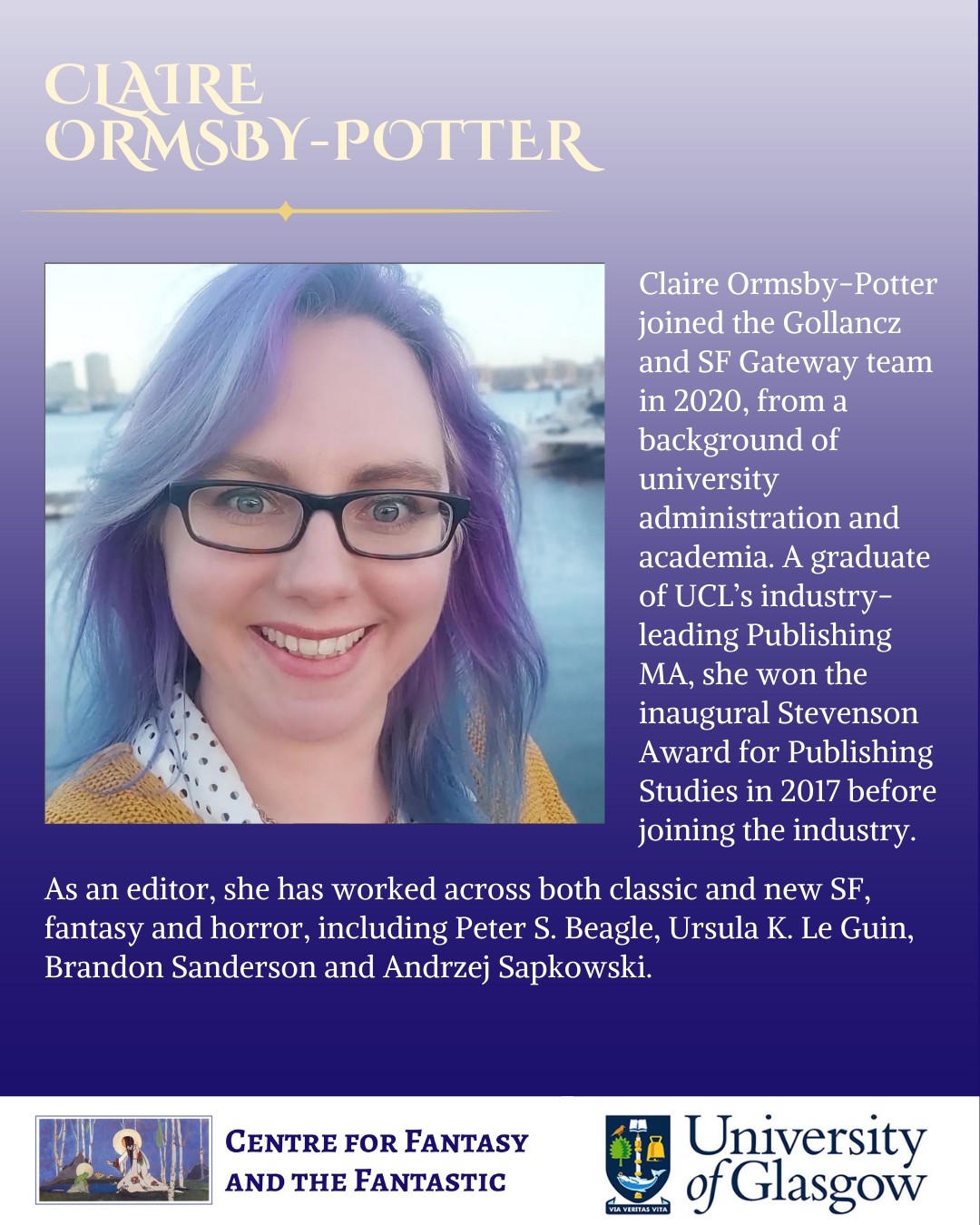
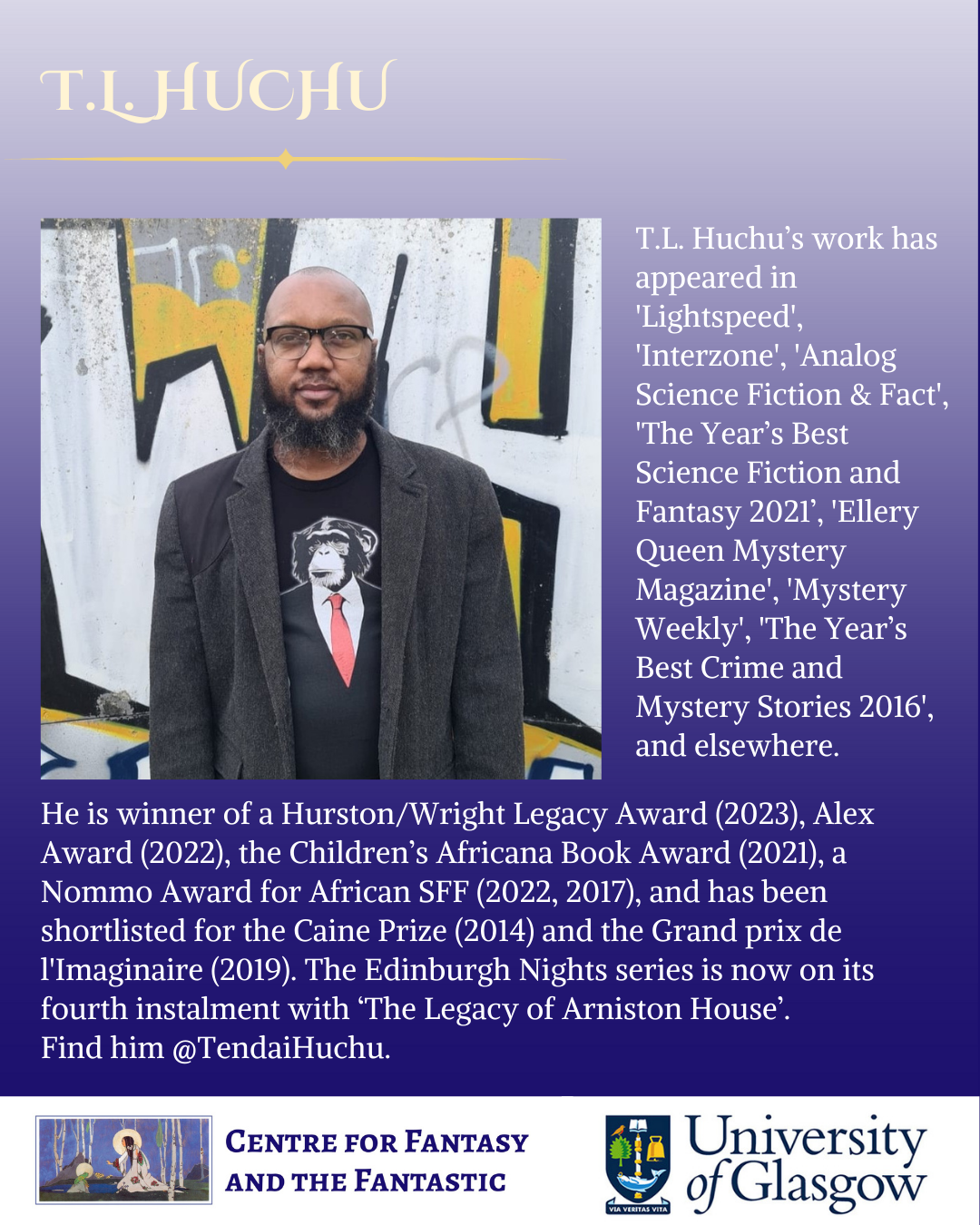
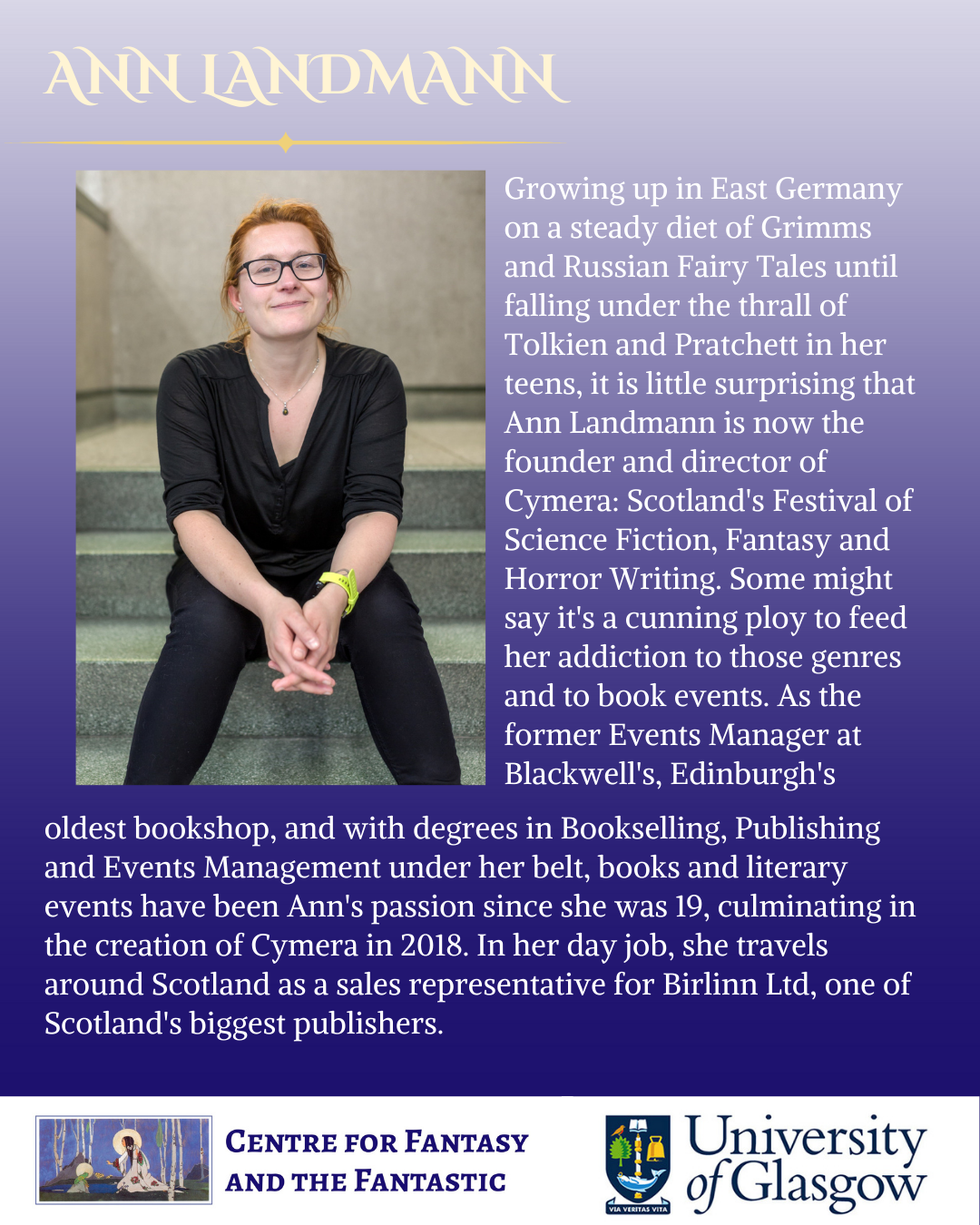
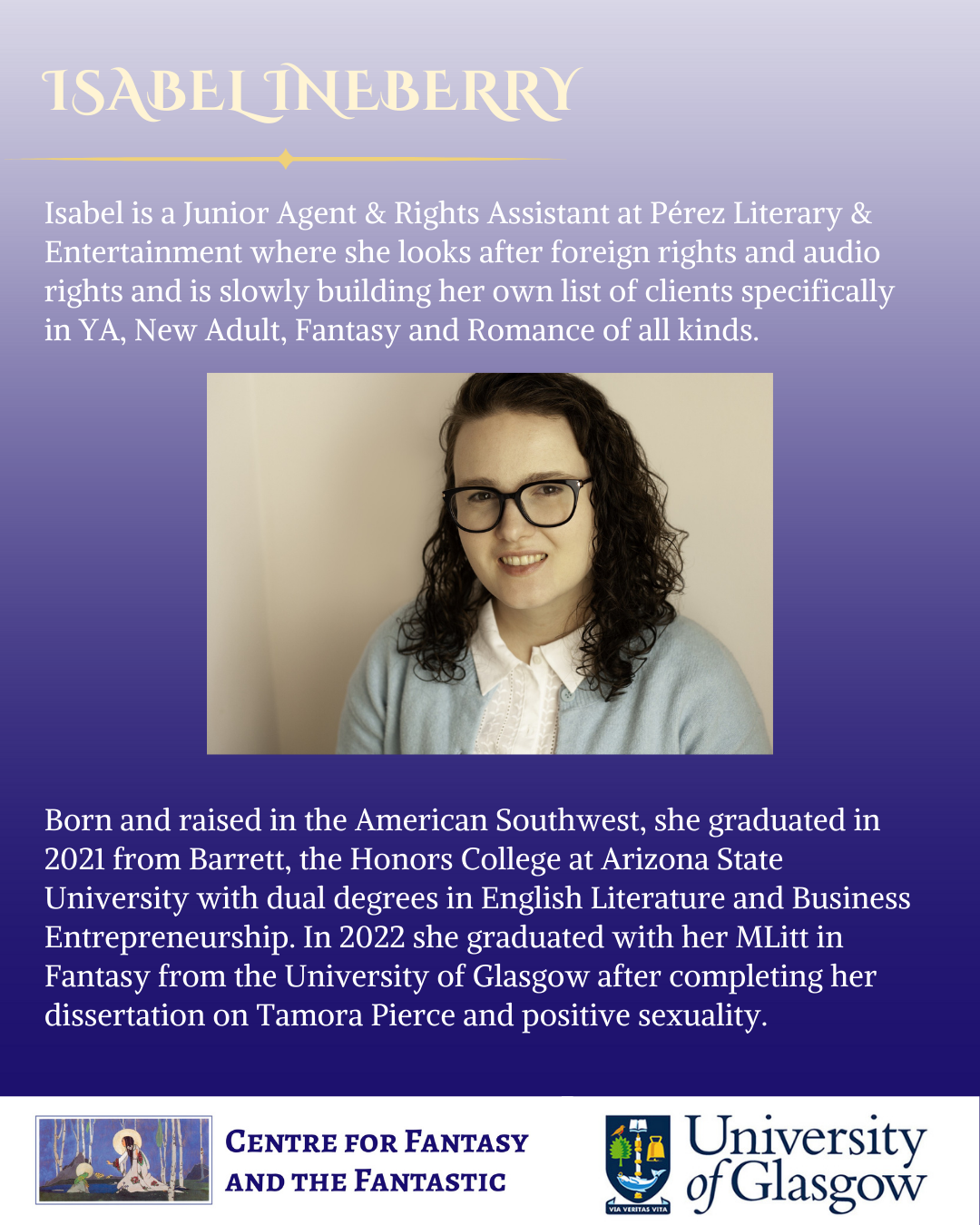
It’s one month until our symposium on “Publishing Fantasy for Younger Readers”, an in person event at the Advanced Research Centre (ARC), to be held on Thursday 3rd April 2025, from 9:15-17:00, hosted by the Centre for Fantasy and the Fantastic at the University of Glasgow and the Children’s Literature and Literacies Team, School of Education. Alongside our keynote by Frances Hardinge, we are delighted to give you more information on our roundtable guests.

Swipe below to read more about them.

Register for our free, in person symposium here.

Download the schedule here.

Download the programme here.

Publishing Fantasy for Younger Readers: A Symposium (3rd April, 2025) – Registration and Programme (UPDATED)


The Centre for Fantasy and the Fantastic at the University of Glasgow and the Children’s Literature and Literacies Team, School of Education, are delighted to host a symposium on “Publishing Fantasy for Younger Readers”, an in person event at the Advanced Research Centre (ARC), to be held on Thursday 3rd April 2025, from 9:15-17:00. The event will include papers on various parts of the publishing process, a roundtable discussion on ‘Publishing Fantasy’, and a keynote by Frances Hardinge.

Register for our free, in person symposium here.

Download the schedule here.

Download the programme here.

You can see our CFP here.

*Please note that the list of panel speakers below has been updated*

GIFCon 2026: GIFCon 2026 – The Technologies of the Fantastic – Call for Papers

Centre for Fantasy and the Fantastic, University of Glasgow 

Check back here for Event Registration – COMING SOON!
Check back here for the full Programme of events – COMING APRIL 2026
Check back here for speaker abstracts and bios – COMING SOON

Conference date: 13th–15th May 2026 (hosted online) 
 
The Centre for Fantasy and the Fantastic is pleased to announce a call for papers for Glasgow International Fantasy Conversations (GIFCon) 2026, to be held online on 13-15 May, with the theme of ‘Technologies of the Fantastic’. 

The GIFCon 2026 CfP deadline has passed and we are no longer accepting submissions. Thank you to everyone who submitted and the committee will be in touch shortly with accepted proposals for this year.

The Centre for Fantasy and the Fantastic is excited to announce the call for papers for Glasgow International Fantasy Conversations (GIFCon) 2026, to be held online on 13-15 May, with the theme of ‘The Technologies of the Fantastic’.

Many addendums have been made over the years to Arthur C. Clarke’s famous third law: ‘any sufficiently advanced technology is indistinguishable from magic’ (‘Technology and the Future’), from Professor Barry Gehm’s corollary, ‘any technology distinguishable from magic is insufficiently advanced’ (Analog) to Terry Pratchett, Ian Stewart, and Jack Cohen’s explanatory statement in The Science of Discworld that ‘Technology works because whoever built it in the first place figured out enough of the rules of the universe to make the technology do what was required of it … With magic, in contrast, things work because people want them to’. Such discourse leaves us asking what, if anything, fundamentally separates the technological from the magical?

Though scholars have attempted to clarify the division between science fiction and fantasy by suggesting that the latter is solely concerned with the impossible whilst the former is concerned only with fact, such binaries disregard the foundations of the fantastic prevalent in science fiction, in which ‘the only way of discovering the limits of the possible is to venture a little way past them into the impossible’ (Arthur C. Clarke Profiles of the Future). Similarly, the fantastic is filled with the technological. We can find technology in carefully constructed runes and magical glyphs that operate as locks and keys; in the textile metaphors of spell weaving; in the taxonomy of the naming of the wind and waves; and in the engineering of biomechanical monsters piloted by traumatized teens to fight angelic horrors.

This year, GIFCon invites the consideration of the technologies of fantasy, emphasizing those things that are too often overlooked both in the real world and in fantasy, whether through hierarchical practices that limit the definition of the scientific or because ‘technology’ has become so ubiquitous in everyday life.

GIFCon is a three-day virtual conference welcoming proposals from researchers and practitioners working in the fields of fantasy and cognate genres/subgenres across all media, whether from within academia or beyond it. We are particularly interested in submissions from postgraduate and early career researchers, and warmly welcome proposals from researchers whose work focuses on marginalized communities and subjects.

Topics for papers may include, but are not limited to:

  • The rules of magic and magic systems.
  • The Science-Fantasy genre.
  • Who are these fantasy worlds made for? What does their magic and technology account for, and who do they overlook?
  • Nonwestern technologies and colonialist constructions of science in Fantasy.
  • Exploring Fantastic infrastructures: how cities, buildings, modes of transportation, paths, and worlds are shaped by fantastic interventions/inventions.
  • How the body (whether human, non-human, posthuman, or something in between) is shaped by technology.
  • Disability and impairment in fantasy literature.
  • The relationship between technology, time, and fantasy.
  • Fantasy as escapism from notions of advancement.
  • The response to technological growth in fantasy.
  • Echoes of the real world in technological fantasies: responses, adaptations and critique.
  • Fantasies created by science practitioners: how real-world science and scientists influence the genre.
  • Technological dystopias and/or utopias.
  • The relationship between Ecology and Technology in Fantasy.
  • Punk Practices: Rethinking technological and social practices through subgenres like cyberpunk, steampunk, or solarpunk.
  • Queer and Trans Theory approaches: how may queer and trans theory offer insights to the concatenation of the magical and technological?
  • What is left out in normative narratives of the scientific and technological? How does fantasy disrupt these narratives?

We also welcome proposals for roundtables and workshops, consisting of 75-minute interactive online sessions which can be run on any aspect of our conference theme by either an individual or group. Generally, workshops have limited capacities and do not set preliminary reading, but participants sign up in advance and flexibility is possible. We encourage creative responses to the workshop call; please select ‘Workshop/Roundtable’ on the proposal form if you intend to lead a workshop or roundtable session.

The submission forms for papers, workshops, and roundtables has passed for GIFCon 2026. Thank you to everyone who submitted!

CFP – Publishing Fantasy for Younger Readers: A Symposium

Publishing Fantasy for Younger Readers: A Symposium 

University of Glasgow, Thursday 3rd April 2025 

Keynote Speaker: Frances Hardinge 

Call for Papers: 

Fantasy literature for younger readers continues to be a booming arm of the book industry, both in the UK and internationally, with successful children’s fantasy novels and series crossing into film and TV and morphing into multimodal franchises. But to what extent do the ways in which children’s and YA fantasies are read and theorized by the academy chime with the ways these genres are commissioned, produced and marketed by the industry? How are trends set and critiqued, how do industry demands drive creativity, what are the roles of readers, and how is the process of book-producing represented fictionally?  

This conference invites answers to all of these questions (and more!) by inviting contributions from academics, publishers, agents, editors, and authors. It explores the fruitful intersections between critical and theoretical knowledge, on the one hand, and practice-based, professional knowledge on the other, seeking to enrich our understanding of the imaginative materials that reach the hands of young readers.  

Suggested topics include, but are not limited to, the following:  

  • Mechanics and processes of publishing (including covers, marketing, etc.) 
  • Trends and phases in Children’s Fantasy 
  • The roles of series and publishing formats 
  • Archival work – e.g. authors’ correspondence with agents and publishers 
  • Age-related categories/demographic imaginaries 
  • Representations of the book trade in Children’s Fantasy 
  • Censorship and transgression 
  • Children’s Fantasy in different countries and cultural contexts 
  • Fan cultures (fan fiction, fan art, BookTok, etc.) 

We welcome abstracts for twenty-minute papers and other contributions (250 words).  These should be submitted along with a short biographical note (50-100 words) to arts-fantasy@glasgow.ac.uk by 30th November 2024. 

Please use “Publishing Fantasy for Younger Readers Abstract” as your e-mail subject.

CFP: Tolkien sessions at IMC Leeds 2025

In 2025 Tolkien at IMC Leeds (7-10 July 2025) will be celebrating our ten year anniversary having been started in 2015 by our founder Professor Dimitra Fimi.   

The special thematic strand of this conference will be ‘Worlds of Learning’. 

We are very pleased that the 2025 IMC Tolkien Sessions will again be sponsored by the Centre for Fantasy and the Fantastic at the University of Glasgow

Paper submissions are being sought for the following 2025 Tolkien at Leeds sessions:  

Tolkien: Medieval Roots and Modern Branches

This session can accommodate wider topics and new approaches to Tolkien’s medievalism, ranging from source studies and theoretical readings to comparative studies of Tolkien’s works.  

Learning, Lore and Craft in Tolkien’s Medieval World 

Papers in this session can explore the role that learning, preserving lore and producing crafts in their widest sense play in Tolkien’s world-building of his Middle-earth legendarium and other fictional and academic works.   

Oral Tradition and Medieval Transmission in Tolkien’s Works 

“From ‘The Book of Lost Tales’ to ‘The Red Book of Westmarch’ and ‘The Notion Club Papers,’ Tolkien crafted various narrative frameworks to convey the conceit of transmitting his invented secondary world into our primary reality. In this session, papers can delve into the significance of orality in Tolkien’s works and explore the diverse transmission frameworks he developed. Additionally, researchers may investigate the literary works that might have influenced Tolkien’s efforts to create these connections 

J.R.R. Tolkien as Teacher and Mentor at Leeds and Beyond 

In this session, papers will celebrate Tolkien’s pivotal role as a teacher and mentor to students at the Universities of Leeds and Oxford. Topics may encompass how Tolkien’s teaching and mentorship influenced scholars, the academic work he supervised, and the establishment of academic clubs like The Viking Club at Leeds and its counterpart, Kolbitar, at Oxford. Additionally, attendees can explore students’ memories of Tolkien as both a teacher and mentor

Tolkien at Leeds Annual Roundtable: Teaching Tolkien 

The Annual Tolkien at Leeds Roundtable will invite educators to discuss and debate teaching methodologies and the unique challenges of bringing Tolkien’s works into 21st-century classrooms.

Please submit a paper contribution title and abstract by 31 August 2024 to  

Dr. Andrew Higgins (asthiggins@me.com) 

  • Length of abstracts: 150 words (max!)  
  • Please include a short bibliography of main research your paper will be drawing on and be in dialogue with.  
  • Papers will be 15-20 minutes long (3 session papers will be preferred) 
  • With your abstract, please include name and details of contributor (affiliation, address, and preferred e-mail address)

Philophantast: A Speculative Fiction and Philosophy Conference – Registration and Programme

Registration

A free hybrid conference for postgraduate students and early career researchers to be held on June 05 and 06 2024 at the University of Glasgow, supported by Glasgow’s Centre for Fantasy and the Fantastic.

Registration is now open! To register, please complete the form found here.

If you have any questions about registration please email us at philophantast@gmail.com

Programme (All times in British Summer Time – GMT+1)

08:30 – 08:55: Informal Registration, Tea & Coffee
08:55 – 09:00 Opening Remarks

09:00 – 10:10 Panel 1

Giovanni Carmine Constabile (Friedrich Schiller University Jena) – The Beloved and Lúthien Tinúviel: Erotic Epiphany in Lévinas and Tolkien – Online

Hongliang Zhou (Changsha University of Science and Technology) – Happily Ever After: The Portrayals of Love and Sex in Chinese Zaju Theater under Kublai Khan’s Mongolian Rule – Online

Sophie Hylands (Sheffield Hallam University) – ‘Everyone has agreed on the need for a big change’: Imagining the Revolutionary ‘Event’ in 1930s Speculative Fiction – Online

10:10 – 10:20 Break

10:20 – 11:30 Panel 2

Taylor Driggers (University of Glasgow) – “All people are glyphs”: Queer Kinship and the Ethics of Reading in Laurie J. Marks’s “Elemental Logic” Novels – In-person

Rebecca Bachmann (Justus-Liebig-University Gießen) – Good for her. Feminist horror movies between empowerment and revenge fantasies – Online

Valentin Via (Rovira i Virgili University) – Exploring Post Apocalyptic, Queer, and Viscosity Aesthetics in the Filmography of Bertrand Mandico – Online

11:30 – 11:35 Break

11:35 – 12:45 Panel 3

Sagar Rao (Princeton University) – The Rasa of Roleplaying: Indian Aesthetic Theory and the Fantasy Roleplaying Game – In-person

Anna Maria Ronewicz (University of Szczecin) – Queering Heterotopias Through the Voices of an Archivist and a Museum Guide: Liminality in Contemporary Audio-Drama – Online

Saundarya (University of Delhi) – Representing the Other: Injustice and Indirect Agencies in Devanoora Mahadeva’s Kusumabale – Online

12:45 – 13:30 Lunch

13:30 – 14:30 Keynote: Katharine Jenkins (University of Glasgow) – Blade Runner 2049 and Feminist Philosophy – In-person

14:30 – 14:35 Break

14:35 – 15:45 Panel 4

Argha Basu (Indian Institute of Technology Patna) and Priyanka Tripathi (Indian Institute of Technology Patna) – Narratological Formation of Discursive Subjectivities and Surfacing of Feminist Ontology in Select Indian Dystopian Fictions – Online

Sam Tegtmeyer (University of Glasgow) – The Curiosity Shop: “Discworld” and the Aesthetics of Fantasy – In-person

Edmund Ankomah (Illinois State University) – Interrogating a Fanonian Xenoracio-pathology in Black speculative fictions – Online

15:45 – 15:50 Break

15:50 – 17:00 Panel 5

William Taylor (University of Glasgow) – Alien Grammar: Using Speculative Fiction to Produce the ‘Disorganism’ in David Roden’s Snuff Memories – In-person

Gabriel Philpson (Pontifícia Universidade Católica de São Paulo) – Perspectivation and (cosmo)technical (imaginative) temporalities: the Angenommen script book as the culmination of the Flusserian Writing – Online

Maria Torres Romero (University of Málaga) – Towards a Posthumanist Philosophy of Technology in Ian McEwan’s Machines Like Me – Online

17:00 – 17:10 Break

17:10 – 18:00 Panel 6

Maha Farooq (Islamabad Model College for Girls I-8/4) – Speculative World Building in K-Pop: Sub-creation in Ateez’ Discography – Online

Chen Chen (University of British Columbia) – Desire At the Edge of Existence: Affect and “Weapon Fetishism” in Liu Cixin’s Ball Lightning and The Three-Body Problem Trilogy – Online

08:45 – 09:00 Tea & Coffee

09:00 – 10:00 Keynote: Henry Bartholomew (Zi’an Jiaotong-Liverpool University) – Dark Ontologies: Speculative Realism and the Gothic – Online

10:00 – 10:10 Break

10:10 – 11:20 Panel 7

Gunnar Lundberg (University of Minnesota) – Guano as a Gimmick: Applying Capitalist Form and Aesthetic Judgment to the Land – In-person

Sarah Snyder (University of Minnesota) – The Eco-erotic Speculative in The Blazing World of Margaret Cavendish – Online

Mayank Jha (Indian Institute of Technology) – You form a line to formalize the former lies – Online

11:20 – 11:25 Break

11:25 – 12:35 Panel 8

Saya Kanemoto (University of Leeds) – How not to be a prisoner of scissors: Ende and Bataille on the right kind of life – Online

Olivia Ho (University College London) – ‘A third thing, a heartish city’: Dialectical tension in China Miéville’s doubled cities – In-person

Smyrna Sharon S (Christ University) – A Study of the concept of Utopia in Vandana Singh’s short stories – Online

12:35 – 13:15 Lunch

13:15 -14:25 Panel 9

Ruchira Mandal (Lady Brabourne College) – Ideal Order in the World: Justice and Being on the Disc – Online

Nilo Sanchez (University of São Paulo) – Speculative Fiction as a Platform for Advocacy in Social Movements – Online

Katarina Dulude (University of Glasgow) – The Longing of the Silent People: Exploring Types of Nostalgia and Their Connection to Fantasy in Lud-in-the-Mist – In-person

14:25 – 14:30 Break

14:30 – 15:40 Panel 10

Stephen Pollicott (University of Lincoln) – Contrary to Descartes: The New
Weird and the Existential Other
– In-person

Devika Yadav (Jawaharlal Nehru University) – Death, Death Everywhere! A
Study of Post-Death in Kazuo Ishiguro’s Never Let Me Go and Agustina
Bazterrica’s Tender is the Flesh
– Online

Megan Boothby (Memorial University of Newfoundland) – “How have the
monsters learned to speak?”: Phenomenology, Consciousness, and
Communication in Ray Nayler’s The Mountain in the Sea
– Online

15:40 – 15:50 Break

15:50 – 17:00 Panel 11

Guillaume Andrieux (University of Glasgow) – Harmful Fictions – In-person

Wan Ziqian (Central China Normal University) – Speculative Fiction as Counterfactual Analysis – Online

Kerry Shanahan (Cambridge University) – ‘The True View About All People’: Watching Science Fiction and Rethinking the Debate on Personal Identity – Online

17:00 – 17:05 Break

17:05 – 18:15 Panel 12

Ashton Hoene (Indiana University Bloomington) and Matthew A. Hoffman (Indiana University Bloomington) – “Doctor…Who, Exactly?” – What Doctor Who Can Teach Us About Personal Identity – Online

Felipe Zárate Guerrero (University of Durham) – Truth in Fiction: Canon, Fanon, and Noncanon in Massive Serialized Collaborative Fictions – In-person

Cristina Diamant (Octocon; London Science Fiction Research Community) – Myles, Martian Away with the Fairies! Postcolonial Satire and Speculative Philosophy in Myles na gCopaleen’s Cruiskeen Lawn column (1940-1966) – Online

18:15 – 18:30 Closing Remarks

GIFCon 2024: Conjuring Creatures and Worlds – Programme

Event registration can be found here including tickets for Workshops and the Networking Event.
Speaker abstract and bios can be found here.
Keynotes and Reading Suggestions can be found here. 
Workshops and Roundtable information can be found here. 

This document is updated as needed. All times listed are BST, British Summer Time.

Zoom Links are sent to registered attendees only by Eventbrite emails during GIFCon.

Twitter
Instagram
Facebook
Discord


9:45 – 10:00: Platform Wide Welcome / Opening words and explanation of the mechanics with Will Tattersdill  

11:00-11:15 Coffee Break ☕

Panel 1
11:15 – 12:30 

Panel 1A
Intertextual Conjurations 
Chair: Emma French 
Deputy Chair: Olivia Cacciatore 

11:15 Vaibhav Dwivedi, “Of Faceless Monsters and Secret Terrors: Analysing the Hybrid Anatomy of Slenderman” 
11:35 Elliott Greene, “(Re)Writing Reality: Authorial Power and Narration as Conjuration in Alan Wake 2” 
11:55 Maria Damkjær, “Conjuring worlds through book culture” 
12:15: Discussion


Panel 1B
Shifting Legends 
Chair: Sam Tegetmeyer
Deputy Chair: Maggie Naylor 

11:15 Grace Rhyne, “Charlotte Riddell: Literary Banshee” 
11:35 Martine Gjermundsen Ræstad, “When Nature Speaks: Fictional A.I. as Folkloric Creatures of the Technological Age” 
11:55 Anisha Das, “Legends of the land: Assam’s mythical creatures and their ecological resonance.” 

12:15: Discussion


Panel 1C
Monster Myths   
Chair: Dulmi Wickremasinghe
Deputy Chair: Karla Calvillo-Salinas

11:15 Zainab Wahab, “Monsters of Greed and Guilt: Examining Mythical Monsters as Symbols of Oppression in Tumbbad and Ghoul” 
11:35 Hannah Mimiec, “‘The Screaming Horrors’: Animal Advocacy and Eldritch Horror in Watership Down” 
11:55 Corinne Matthews, “Conjuring Consent: Magic, Power, and Patriarchy in Young Adult Fantasy”  

12:15: Discussion

12:30-13:30 Lunch Break 🍽️

13:30-14:30: Keynote: Emily Selove

Chair: Matthew Sangster
Deputy Chair: Orla Davey

14:30 – 14:45 Coffee Break ☕

Panel 2 
14:45 – 16:00

Panel 2A
The Imperial and the Gothic
Chair: Georgina Gale  
Deputy Chair: Chris Lynch Becherer

14:45 Hannah Frances Roux, ““Not the Real Orient but a Fantasy”: C.S. Lewis’s Calormen and Edith Sitwell’s Modernist Orientalism.” 
15:05 Manon Hakem-Lemaire, “The Fantasy of Alterity in Richard Marsh’s Imperial Gothic Novel The Beetle (1897)” 

15:25 Discussion
Panel 2B
Constructed Disability
Chair: Grace A.T. Worm 
Deputy Chair: Maggie Naylor 

14:45 Emilie Morscheck, “Reimagining Disability in YA Fantasy: Exploring Harper and Rhen in ‘A Curse So Dark and Lonely’” 
15:05 Madeline Wahl, “Who Can Speak Characters Into Existence?: Stuttering, Fluency, and Conjuring Characters in Cornelia Funke’s Inkheart” 
15:25 Şevval Tufan, “Liminal Worlds, Marginalised Beings and Disabled Bodies in Ihsan Oktay Anar’s “The Atlas of Misty Continents” and “Amat”” 

15:45 Discussion
Panel 2C
The Non-Human
Chair: Will Tattersdill 
Deputy Chair: Diana Rotar

14:45 Ane B. Ruiz-Lejarcegui, ”Enacting the Nonhuman: A.I. Consciousness and Text-Reader Interaction in Becky Chambers’ A Closed and Common Orbit” 
15:05 Scarlett Butchers, ““This was a place of wonders once”: David Rudkin’s Magical Landscapes” 
15:25 Nick Stember, “Desert Solitaire: Tales of the Strange, Fantastic, and Immortal in Nie Jun’s Seekers of the Aweto” 

15:45 Discussion
Panel 2D
Monstrous Sexuality
Chair: Dulmi Wickremasinghe 
Deputy Chair: Robbin Dowling

14:45 
 Brynnah Runyan, “Alienation of A-Spec Identities: Sexuality, Romantic Love, and What it Means to Be Human” 
15:05 Mercury Natis, “Letting the Beastly Beast Go: Navigating compulsory heterosexuality through King Pellinore and the Questing Beast in The Once and Future King” 

15:25 Discussion

16:15-17:00 Research Spotlight with Martine Gjermundsen Ræstad in the Discord


Panel 3  
9:30 – 10:45 

Panel 3A   Female Horrors  
Chair: Hollie Willis
Deputy Chair: Hollyn Middleton

9:30Caroline Hannum, “Girls Against Gods: Divinity as the Female Hero’s Antagonist, a Metaphor for Patriarchal Control” 
9:50 Xiana Vázquez Bouzó, “Representations of the Alien Enemy in the Post-Anthropocene: Two Case Studies of Filmic Depictions of Otherness through Gender (Under the Skin) and Animality (Nope)” 
10:10 Amy Richmond, ““It makes us feel a little like God”: Conjuring Delusions and Creation in Mona Awad’s Bunny” 

10:30 Discussion
Panel 3B Marginalized Multimedia
Chair: Emma French 
Deputy Chair: Maidah Rihan 

9:30 Catherine Hall, “Dwarvish Point of View?: Neo-Khuzdul, Fanfiction, and the Construction of an Alternative Middle-earth” 
9:50 Kristine Larsen, ““Even those who are different can survive”: Dragons, Speciesism, and Procreation in Andrzej Sapkowski’s The Witcher and its Adaptations” 

10:10 Discussion
Panel 3C Science Cycles  
Chair: Will Tattersdill 
Deputy Chair: Diana Rotar 

9:30 Rebecca Lloyd, “Reuse, recycle: Terry Pratchett’s Igors and the monstrous remade body.” 
9:50 Vincent Pritchard, “The Conjuring Trinary: Systems of Summoning” 
10:10 Dr. Bettina Charlotte Burger, “Their Primitive Superstition vs. Our Scientific and Enlightened Magic – Magic Systems in T.L. Huchu’s Edinburgh Nights series” 

10:30 Discussion

10:45 – 11:15Coffee Break ☕

12:30-13:30 Lunch Break 🍽️

13:30 – 14:30: Keynote: Carolyn Jess-Cooke

Chair: Dimitra Fimi
Deputy Chair: Will Sherwood  

14:30 – 14:45 Coffee Break  ☕

Panel 5  
14:45 – 16:00

Panel 5A  Monster Girls
Chair: Hollie Willis 
Deputy Chair: Hollyn Middleton
 
14:45 Inês Vaz, “Monster Girls Turning Darkness to Light: Subversive Uses of Monstrosity in She-Ra and the Princesses of Power and Nimona” 
15:05 Tara West, “Made a Villian: ND Stevenson’s Nimona and a Lesson in Difference” 
15:25 David Muiños Garcia, “Motherless: Absent, Spectral, and Monstrous Motherhood in Video Games” 

15:45 Discussion
Panel 5B Representations and Symbols in Film 
Chair: Sam Tegtmeyer 
Deputy Chair: Robbin Dowling

14:45 Zoe Wible, “A Link Between the Historical Evolution of  Creature Design in Fantastic Film and Fine-Grained Representation of Non-Human  Experience?” 
15:05 Barbora Kaplánková, “Children of Miyazaki: Travellers into the Unseen” 
15:25 Tam Moules, “Holly Berries Like Drops of Blood: Conjuring the Green Knight as Monster in Prose and Film” 

15:45 Discussion
Panel 5C Conjuring Identity
Chair: Grace A.T. Worm 
Deputy Chair: Maggie Naylor 

14:45 Michael Quinn, ““The stolen future cannot be given back to me”: Exploring personal identity through Paragon in Robin Hobb’s ‘Realm of the Elderlings’” 
15:05 Siravich Khurat, “Shoukan: The Summoners who conjure the other Half of their Souls” 
15:25 Supriya Baijal, “Magical Realms of Morality and Mystery: Reimagining Reality in ‘The Adventures of Amir Hamza’ and ‘Five-and-Twenty Tales of the Genie’” 

15:45 Discussion

16:15-17:00 Research Spotlight with Michael Quinn in the Discord


12:30 – 13:30: Keynote: Zen Cho

Chair: Will Tattersdill
Deputy Chair: Orla Davey

13:30- 13:45 Coffee Break ☕

Panel 6  
13:45 – 15:00 

Panel 6A Interrogating Television  
Chair: Will Sherwood 
Deputy Chair:  Catherine Hall

 13:45 Zvonimir Prtenjača, “X-Men’s White Gaze: Conjuring an Apocalypse of Superheroines of Colour” 
14:05 Dulmi Wickremasinghe, “An LOTR world “for everyone”? Discussing Amazon’s interventions in Tolkien’s representation of Elvish gender aesthetics”
14:25 C. T. Power, “House of the Dragon: Gender, Race and the Persistent Past” 

14:45 Discussion
Panel 6B   Conjuring Utopia
Chair: Emma French 
Deputy Chair: Rebecca Solomon

13:45 Astrid Roesen Abildgaard, “Conjuring a World of Women – And a Solution to our Climate Struggles? Human-nature relationships in Charlotte Perkins Gilman’s “Herland”” 
14:05 Rachel Harrison, “From Her Mind to Herland: The Women Conjuring Gynotopia” 
14:25 Meg Horridge, “Conjuring Utopia: How Ursula K. Le Guin’s The Dispossessed Builds an Imperfect World” 

14:45 Discussion
Panel 6C Re-Writing History 
Chair: Georgina Gale  
Deputy Chair: Karla Calvillo-Salinas

13:45 Hollie Willis, “’The Locals Bite Back’: A Defence of the Tuunbaq and the Use of Fantasy in ‘The Terror’” 
14:05 Gao Weiming, “Conjuring Historical Figures and Alternative History Narratives: A Study of the Japanese Fantasy Franchise Fate” 
14:25 Rebecca Pearce, “”All in a Day’s Work for a Hero”: Once Upon a Time and the Fantastical Byronic Hero-Villain Cycle” 

14:45 Discussion

16:00 – 16:15 Coffee Break ☕

Panel 8  
17:15 – 18:30 

Panel 8A Experiencing Change in Fantasy
Chair: Hollie Willis  
Deputy Chair: Robbin Dowling

17:15 Fiona Reid, “Humans and robots: neuroqueer identity exploration through Dungeons and Dragons” 

17:35 Anna Milon and Tom Emanuel, “Conjured Presence: Spiritual Experiences in Fantasy Spaces” 

17:55 Discussion
Panel 8B The Other Other
Chair: Will Sherwood 
Deputy Chair: Karla Calvillo-Salinas 

17:15 Iria Seijas-Pérez, “Analysing the Witch Figure in Irish YA Fiction: Deirdre Sullivan’s Perfectly Preventable Deaths (2019) and Sarah Maria Griffin’s Other Words for Smoke (2019)” 
17:35 Nathaniel Harrington, “Teachd Chonain: Celticism, settler colonialism, and the fantasy barbarian” 
17:55 Olivia Scarr, “(Un)homely Cultivations: the botanical Other as the ‘Monstrous Feminine’ in Short Fiction of the Fin de Siècle” 

18:15 Discussion
Panel 8C Body Transformation
Chair: Dulmi Wickremasinghe 
Deputy Chair: Olivia Cacciatore 

17:15 Alice Langley, “Transformation as conjuration: the power of the post-menopausal woman.” 
17:35 Ning Lee, “Age’s Mischief: Writing Ageing into the Fantastika in Kazuo Ishiguro’s The Buried Giant” 
17:55 Rachel Cairns, “Fat in the Forgotten Realms: Fat embodiment, monstrosity and the non-normative body in participatory fantasy storytelling” 

18:15 Discussion

18:45-19:30 Research Spotlight with Anna Milon and Tom Emanuel in the Discord 

Philophantast: A Speculative Fiction and Philosophy Conference CFP

A free hybrid conference for postgraduate students and early career researchers to be held on June 05 and 06 2024 at the University of Glasgow, supported by Glasgow’s Centre for Fantasy and the Fantastic.

Deadline for Submissions: April 19 2024

Contact Email: philophantast@gmail.com

Call for Papers:
Speculative fiction and media encompass multiple genres and modes that, like philosophy, make us question the possible and impossible. Speculative creations provide tools to delve into philosophical questions, such as exploring the nature of identity and approaching the ineffable, in addition to speaking truth to power and empowering marginalised voices. This hybrid conference on speculative media and philosophy, sponsored by the University of Glasgow’s Centre for Fantasy and the Fantastic, seeks to showcase how speculative fiction and media can create and express philosophical insights. Speculative media has the capacity to incentivise scholars, critics, creators, and wider audiences to embrace and reflect on philosophical perspectives beyond the academic context, thus bridging the interdisciplinary gap between philosophy and the media we create, consume, study, and enjoy. Rather than considering philosophy as the abstract, systematic analysis of existence, knowledge, and reason with little to no correlation with our everyday lives, we wish to highlight the proximity of philosophy in praxis and theory through speculative media.

We invite submissions focusing on any genre or subgenre of speculative fiction, including but not limited to afrofuturism, alternate history, fantasy, the fantastic, horror, the gothic, utopia, dystopia, and science fiction. We also encourage submissions that focus on media such as film, games, comics and graphic novels, music, theatre, and television, as well as literature. Likewise, we welcome proposals from all philosophical perspectives and branches. For example, papers may address continental, analytical and indigenous philosophies and philosophical traditions; queer, non-western, post-colonial or anticolonial philosophical theory; branches such as aesthetics, epistemology, ethics, logic, and political philosophy; as well as ontological, phenomenological, and theological insights on or developed by speculative media.

We welcome proposals for 20-minute papers from postgraduate students and early career scholars. We also welcome panels and roundtables with a minimum of 3 and maximum of 4 presenters, and proposals for workshops. Papers may address, but are not limited to, the following topics:

• The analysis of speculative literature and media through philosophical lenses
• Speculative literature and media acting as thought experiments for philosophical ideas
• Imagination and philosophy
• Speculative philosophy and speculative literature and media
• Philosophical discourses developed by speculative literature and media
• Speculative fiction as an inclusive philosophical practice

Previous examples of studies that encompass both speculative media and philosophy include Marxist thought in Fantastika, imagining alternative worlds in speculative fiction, Neoplatonic thought in J.R.R. Tolkien’s literary production, studies on the abject in horror writing and cinema, and the fictionalisation of philosophers in literature and games.

Please submit an abstract (around 300 words), a short bio (maximum 150 words), and state if you wish to present in person or online to philophantast@gmail.com with the subject line ‘Abstract Submission’ by April 19 2024. Only applications from graduate students and early career researchers will be considered for this conference. We are particularly keen to highlight the contributions of underrepresented voices within speculative media and/or philosophy at this conference, and will prioritise contributions that demonstrate in abstract and/or bio that they align with this goal. If you have any questions, please contact the committee at philophantast@gmail.com